
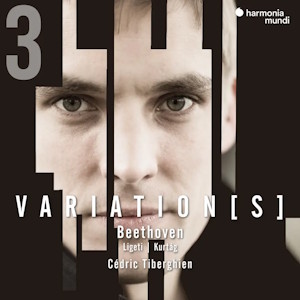
Ludwig van Beethoven (1770–1827)
Six Variations in F major on a Swiss Song, WoO 64 (c.1790)
Eight Variations on the Romance ‘Une fièvre brûlante’, WoO 72 (1795–96)
Twelve Variations on a Russian Dance, WoO 71 (1796–97)
Ten Variations on ‘La stessa, la stessissima’ from Salieri’s Falstaff, WoO 73 (1799)
Thirteen Variations on the Arietta ‘Es war ein alter Mann’, WoO 66 (1792)
Thirty-Three Variations on a Waltz by Diabelli, Op. 120 (1819–23)
György Ligeti (1923–2006)
Musica ricercata (1951–53)
György Kurtág (b. 1926)
Játékok: Fleurs nous sommes… and A Flower for Márta (Book VII, No. 14) (1973–onwards)
rec. 2024, TAP – Scène nationale de Grand Poitiers, France
Reviewed from a WAV download 44.1kHz/16-bit
Harmonia Mundi HMM 902437.38 [2 CDs: 137]
Anton Diabelli’s famous 1819 invitation to a large number of composers to submit a variation on his waltz was at least in part a celebration of the variation form. Cédric Tiberghien’s Harmonia Mundi series of the complete Beethoven Variations for Piano is a modern equivalent in something of the same spirit. Now reaching its third and final volume, its juxtaposition of Beethoven’s many sets of variations with those of other composers covering pretty much the whole period of classical music has been revelatory and tremendous fun.
Previous volumes haven’t shied away from the 20th century, with Webern, Cage, Feldman and Crumb all featured. For Volume 3, Tiberghien has added Ligeti and Kurtág, who sit alongside five sets of Beethoven variations on Disc 1 before we reach the Diabelli. As in the earlier volumes, it’s invigorating to hear contemporary keyboard languages next to Beethoven. Ligeti, in his Musica ricercata, plays a kind of long game with pitch material: the first piece works with two pitch classes, the second with three, and so on, the cycle expanding through twelve pieces to the full chromatic and culminating in a strict fugue marked Omaggio a Girolamo Frescobaldi. The Kurtág contributions, drawn from various books of Játékok, are the Fleurs nous sommes… sequence and A Flower for Márta, miniatures of a few seconds to a minute or so, each turning around a single sound idea. Both Hungarian composers have a playful side that sits well with the relatively minor Beethoven WoO compositions on Disc 1 and, as with the previous volumes, the interleaving makes the disc digestible as a recital. Tiberghien plays the Beethoven WoO sets impeccably and with flair. Their variety lies in the choice of themes (my favourite being the aria from Salieri’s Falstaff) and whilst Beethoven’s treatment of them is always witty and pleasing, I can’t see myself reaching for them individually very often. I have, however, listened to the disc as a whole a number of times because of the variety and structure the modern compositions give it.
Both Hungarian composers are also an important prelude to the Diabelli, and Tiberghien’s playing of the cycle needs to be heard through that modernist lens, I think. I say this because, taken in isolation, Tiberghien’s Diabelli might strike one at first as a slightly quirky reading. It feels exploratory and undemonstrative. He is good at wit and parody though, and there one immediately harks back to the Ligeti, which is suffused with the rhetoric of the late Beethoven Bagatelles (Herbert Schuch’s interleaving of Musica ricercata with the Op. 119 Bagatelles on AVI Music demonstrates this vividly). Indeed, listening to Tiberghien’s playing of Diabelli’s theme with the Ligeti still fresh in mind, I was reminded of Alfred Brendel’s comment in his famous essay on the work that Diabelli’s waltz tries ‘a bit too hard to mimic a modern bagatelle’.
The Kurtág is more revealing still about Tiberghien’s approach. The booklet note, by Jean-Paul Montagnier, draws a specific parallel between Variation 20 of the Diabelli and the Fleurs nous sommes… pieces, on the grounds that both are ‘focusing on the sound colour for its own sake, and exploiting the piano’s reverberative powers’. The pairing is suggestive, and Tiberghien plays as though persuaded by it. His Variation 20 has the quality of a Kurtág miniature: an inward turn, a passing moment, sound colour for its own sake. The same temperament shapes his Variation 30, the Andante, sempre cantabile that opens the closing slow section. These contemplative variations are, in his hands, beautiful but slightly self-contained. This is the broader pattern in his Diabelli, an instinct for the variations as discrete soundworlds rather than as components of a single architectural span. He throws new light on some of the individual variations wonderfully, but I missed a feeling for the cycle’s overall structural logic.
My own sense of that logic was fundamentally shaped in 2022 by Mitsuko Uchida’s magnificent Decca recording. The contrast with Tiberghien is instructive. Where Tiberghien plays Variation 20 as a moment of inward suspension, Uchida lets it stand as the cycle’s centre of gravity. And she plays Variation 30 with real weight and consequence, so that the closing movements arrive as the culmination of an architecture that has been built across the preceding hour. By contrast, Tiberghien is almost perfunctory in Variation 30, and overall, for all his brilliant characterisation of individual movements, his reading feels slightly disjointed at times.
The ‘architectural’ reading has good scholarly support. William Kinderman’s 1987 monograph established that Beethoven began the Diabelli in 1819, set it aside for the last three sonatas and the Missa Solemnis, and returned to finish it in 1822–23, when he added new variations at the opening, in the middle and at the end. The 1819 draft had a single C minor variation (the present Variation 30). When he came back to the work Beethoven added Variations 29 and 31, the enlargements creating a substantial slow section. The result, in Kinderman’s phrase, is ‘not a symmetrical but an asymmetrical plan, an overall progression culminating in the last five variations’. Brendel makes the same point: the slow C minor variations, he writes, ‘act as a brake to which the reinvigorating fugue responds, not as a finale (being in E flat major) but as an elemental experience, a purifying ordeal from which the “waltz” emerges transformed, “reborn”‘. The closing five variations are the work’s destination, and the slow material that prepares for them is important structurally, not just colouring the cycle’s emotional palette. It is the integration of these closing pages that Uchida finds and Tiberghien for me doesn’t quite. Even so, I should stress there’s much to admire in this new Diabelli, particularly in the context of the modern works on Disc 1. Tiberghien is a pianist of acute intelligence and considerable rhetorical range, and with his ear tuned by the Ligeti and the Kurtág, his Diabelli reveals affinities with both that would never be found in a standalone reading.
Similar insights are found throughout the series as a whole, which is one of the best things to have happened to our appreciation of the variation form on disc. Tiberghien has done what Diabelli’s 1819 invitation, in its modest commercial way, was hoping someone would do. He has used variation as a way of putting composers in conversation with each other across time. Brendel closes his Diabelli essay with a line from Kleist’s On the Marionette Theatre which he calls ‘an outline of the Diabelli Variations’: ‘When perception has passed through infinity, gracefulness reappears.’ That line could stand as an outline of the whole Tiberghien project too. The journey has been one of the more graceful things in recent recorded Beethoven.
Dominic Hartley
Buying this recording via the link below generates revenue for MWI, which helps the site remain free













