
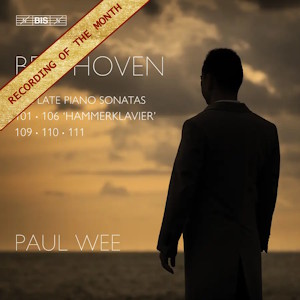
Ludwig van Beethoven (1770–1827)
Piano Sonata No. 28 in A major, Op. 101 (1816)
Piano Sonata No. 29 in B flat major, Op. 106 ‘Hammerklavier’ (1818)
Piano Sonata No. 30 in E major, Op. 109 (1820)
Piano Sonata No. 31 in A flat major, Op. 110 (1821)
Piano Sonata No. 32 in C minor, Op. 111 (1821–22)
Paul Wee (piano)
rec. 2024, Wyastone Concert Hall, Monmouth, UK
Reviewed from a stream on Apple Music
BIS BIS-2765 SACD [2 discs: 128]
Charles Rosen, in his book, Beethoven’s Piano Sonatas, makes a remark about the Hammerklavier sonata which in his undemonstrative prose is easy to read past on a first encounter but which turns out to be the key to thinking about the late sonatas as a group. Op. 106, Rosen writes, is closer to the sonata models of Beethoven’s early years, ‘transformed and made almost unrecognizable by the will to create something new out of the old experience’. The radicalism of the last sonatas, he thinks, is partly explained because the ‘writing of op.106 had given Beethoven a new confidence.’ What Rosen identifies is a paradox: that the largest, most physically demanding, most apparently summative of the late sonatas is in some ways the most backward-looking, the one in which Beethoven was still working through inherited materials. There is greater radicalism in what follows.
It is an instructive lens through which to hear this set. Paul Wee’s discography to date has established him as one of the great current keyboard virtuosos, the pianist to whom one turns when nothing less than transcendent technique will do. I came to his Beethoven late sonatas expecting the Hammerklavier to be the centrepiece. His account is as fine as any I know. What I did not expect, but should have, is how completely the other four sonatas hold their ground. The set asks to be heard whole, as a traversal of Beethoven’s late writing in which Op. 106 is a fulcrum rather than a summit.
What of the preceding sonata, Op. 101? In his superb booklet notes Jonathan Gaisman makes a suggestive point about the sonata which dovetails with Rosen’s framework: that the A major sonata is in important respects a rehearsal for the Hammerklavier. The two are explicitly linked by Beethoven’s own für das Hammerklavier designation, but they are also linked by the way they handle materials. Both end with finales permeated by counterpoint which eventually erupt into fugue; both engage seriously with the implications of Bach, whose manuscripts Beethoven was studying at the time; both subject their first movements to the discipline of a process in which familiar formal articulations are softened or hidden in the continuity of the writing. Op. 101 is the workshop for Op. 106. And Wee plays it as such. The first movement is taken at a flowing tempo, the metrical displacements registered but never dramatised, the harmonic ambiguity of the opening heard not as a puzzle to be solved but as a condition to be inhabited. This is a movement Theodor Adorno once described as the sonata form becoming ‘a lyric poem, entirely subjectivized, spiritualized, stripped of the tectonic.’ That remark in turn is the philosophical kernel of an article by Roger Allen referred to by Gaisman which makes the case that this first movement was the structural model for the Prelude to Tristan und Isolde. I would normally read the reference as interesting programme-note erudition. Here it’s more. The Tristan affinity comes through clearly in Wee’s playing. I have heard the Op. 101 first movement many times in many hands and never before been so directly persuaded that what is happening in the music is a version of what Wagner thought he was doing forty years later. The melodic line does not so much sing as persist, and Wee’s willingness to let chromatic motion dominate metrical accent leaves you in the same harmonic-temporal medium as the Tristan Prelude. Whether or not the case for an actual model holds, the experience of the resemblance is what Wee delivers.
The march of Op. 101 is tautly delivered, the contrasts of register carefully accentuated. The little slow movement is shaped with care before the brilliant presentation of the finale, here knotted, rough, sometimes darkly humorous. The contrapuntal clarity Wee achieves is exceptional. The voices come through with uncanny definition, requiring a touch capable of differentiating dynamic levels between fingers of the same hand, and a sense of the rhetoric of fugue as something other than texture. Wee has both.
The Hammerklavier follows. Thrillingly, the first movement honours Beethoven’s metronome marking. This is minim = 138, Op. 106 being the only sonata for which Beethoven left an explicit indication, often ignored. Schnabel was the first on record to attempt it. Wee is among the few since who can sustain it without sounding harried. The point is not just that he can play it fast but that he can think at that speed. The descending third sequences which Rosen identified as the development section’s ‘almost only method of construction’, pursued with ‘a determination and fury previously unheard in music’, emerge here as a kind of compositional logic visibly working itself out, not as a sequence of effects.
The Scherzo is dispatched with sharp wit, rightly played as the sardonic parody it is. But the heart of the work, and one of the great challenges of the late repertoire, is the Adagio sostenuto. It lasts the better part of eighteen minutes on Wee’s recording. The harmonic colouring, throughout, is unindulgent: this is not a movement Wee plays for maximum tragic weight, despite the long tradition of doing so. It is an utterance shaped by control rather than collapse. Gaisman points to the anticipation of the opening of Brahms Symphony No. 4 in the development; Wee makes it audible without italicising it. And the ornamental writing of the recapitulation is taken at face value, without the rubato that would make it sentimental.
The Largo bridge to the finale is improvisatory in the right way: searching, contrapuntal in flickers, allowing the fugue subject to be willed into existence rather than announced. And the fugue itself — a tre voci, con alcune licenze, is, again, played as three voices speaking, not as texture. Wee takes the marked tempo, as he does in the first movement. The result is riveting: a performance of tremendous force which never loses the polyphonic lines. The wrenching of iron bars, in Philip Barford’s phrase, between fugal procedure and sonata-style harmonic dialectic is felt as the work’s central drama.
Barford is good on op. 110 too. One of his most arresting observations is that grasping the half-concealed presence of the fugue subject in the opening Moderato cantabile requires what he called ‘the positive use of the imagination, not passive absorption of programme notes’, because ‘musical experience is a consciously directed waking dream, built up from the substance of inspired intuitions.’ That phrase, ‘consciously directed waking dream’, is the best single description I’ve heard of what really good late Beethoven playing demands. It is not enough for the pianist to render the notes accurately. What is required is the active imaginative work of holding multiple lines and temporalities simultaneously in mind and projecting that simultaneity into the sound. Wee does this. The fugue subject of Op. 110 is present in his opening Moderato not as a foreshadowing but as a structural fact you only recognise on the way out, when the fugue arrives and the relationship becomes retrospectively obvious. The Arioso dolente is properly broken. Wee allows the hesitations to be just that, rather than rhetorical effects, and I caught my breath listening. And the fugue, building back from exhaustion into the eventual triumph of the final pages, its subjects cascading with a fragile beauty, is one of the high points of the set. Wee takes an audible decision to let the music gather itself rather than to drive it. Impeccable judgment, magical playing.
Of Op. 109 there is less to say. Wee’s reading is so well balanced that it doesn’t require extensive commentary. The first movement’s Vivace ma non troppo / Adagio espressivo alternations are handled with the calm of a player not seeking to dramatise their strangeness. The Prestissimo is fierce without being brutal. The variations of the Andante molto cantabile are graded carefully, the trill-decorated returns of the theme beautifully calibrated, and the closing return to the cantabile opening exactly that, a return, not a peroration. I have heard the work given more crudely dramatic readings. I have not often heard it given more organically coherent ones.
That leaves Op. 111. I can’t hear this work without thinking of Thomas Mann’s Doctor Faustus. Kretzschmar’s lecture on the Sonata in Chapter 8 is purportedly an attempt to answer the question of why it has no third movement. His answer, delivered after he has played the Arietta through, is that the sonata has come to ‘an end without any return’, and that by ‘the sonata’ he means not this work alone but the form itself. One of the things to say about Wee’s Op. 111 is that he plays it as if he agrees.
The first movement, with its diminished sevenths and its compressed, contrapuntal Allegro con brio ed appassionato, is taken, again, at speed. Wee finds anger and exhaustion here rather than any overdone melodrama. The transition to the Arietta is shocking in the right way: the same harmony at the end of the first movement and the beginning of the second, but, in Gaisman’s phrase, a world apart. The variations of the Arietta are graded with the kind of patience that lets each successive subdivision of note-values register as a real intensification rather than as a mechanical scheme. Variation 3, sometimes called the boogie-woogie variation (a characterisation and misreading that has refused to die) is here, properly, an outburst of exultation rather than an anticipation of anything. The trills of the later pages are not decorative but, rightly, structural. And the moment Kretzschmar singles out — where the added C sharp finally ‘consoles’ the motif the movement has held in suspense — is played without artificial highlighting. Wee’s realisation matches the substance of Mann’s description without insisting on its rhetoric.
Wee, as is well known, is a distinguished barrister. I think it’s fair to say that the Bar’s reputation for cultivated outside interests has rarely been better served than by this set. Especially when one considers that Gaisman too is a barrister, a KC, no less. As I hope I’ve made clear, his booklet note is a piece of striking prose: literate, well-informed, willing to take positions and to defend them. It’s an unusually thoughtful companion to the discs. The recorded sound is excellent as I’d expect from BIS. The Steinway Model D is recorded with the kind of clarity that lets the contrapuntal writing register without becoming dry. I listened to this via Apple’s streaming service, where the Dolby Atmos mix was remarkably vivid, especially with headphones.
When reflecting on the set as a whole I know there are some who will perhaps prefer their late Beethoven slower, weightier, more overtly transcendent. Not me. What Wee offers is something more useful and, in the end, more moving: a reading of these five works which trusts the music to do its own metaphysics, while honouring Beethoven’s intentions, and which lets the late style speak in its own voice. Edward Said wrote of Beethoven’s late works that they ‘remain uncoopted by a higher synthesis: they do not fit any scheme, and they cannot be reconciled or resolved since their irresolution and fragmentariness are constitutive’. Here’s a pianist who lives by that realisation, and we are all beneficiaries.
Dominic Hartley
Buying this recording via the link below generates revenue for MWI, which helps the site remain free














What a musical, beautiful, ideas-driven, literate, and thoughtful review! Thank you so much.