
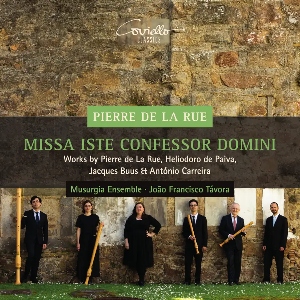
Pierre de La Rue (c1452-1518)
Missa Iste confessor domini
Musurgia Ensemble/João Francisco Távora
rec. 2025, Mosteiro de S. Salvador de Grijó, Vila Nova de Gaia, Portugal
No texts
Reviewed as a download
Coviello Classics COV92603 [48]
There is no lack of recordings of Renaissance sacred music written in the Iberian Peninsula in the 16th and early 17th centuries. They mostly focus on music by Spanish composers. In comparison, not that much music from Portugal is available on disc, which is largely due to the earthquake which hit Lisbon in 1755. It destroyed the royal library, which contained most of the country’s musical heritage. Recently performers have focused on lesser-known aspects of Portuguese musical history, and the monastery of Santa Cruz in Coimbra, in the north of Portugal, plays a major role in this process. There Francisco de Santa Maria worked for more than thirty years as mestre de capela. To his oeuvre the ensemble Arte Minima, directed by Pedro Sousa Silva, devoted a disc on the Pan Classics label (review).
One of the members of that ensemble is the recorder player João Távora, who is also the founder and director of the Musurgia Ensemble, which – according to the booklet to the recording under review here – is “dedicated to the interpretation and dissemination of newly rediscovered music from the 16th to 18th centuries”. One of its main interests are facets of Portuguese musical heritage. From that perspective one may wonder why it recorded a mass by Pierre de La Rue.
His Missa Iste confessor domini is part of a choirbook known as P-Cug MM 2, which today is preserved in the General Library of the University of Coimbra. The choirbook may have been put together in the Dutch town of ‘s-Hertogenbosch, shortly after 1530. It includes masses by several masters of the Franco-Flemish school, such as Noel Bauldeweyn, Jean Mouton, Pierre Moulu and Adrian Willaert. Távora, in his liner-notes, expresses the assumption that it may have been a commission or acquisition by the monastery. In any case, it shows that the monastery had a wide interest in music from across Europe. That does not surprise, if one knows, for example, that the music of Josquin Desprez was very popular in Spain.
La Rue’s mass performed here causes quite some problems, though. In Munich and in Vienna two copies of the same mass are preserved, but with different titles. There they are called Missa supra O quam glorifica luce, and attributed to Antoine de Févin. However, it has been impossible to establish musical material from the chant O quam glorica luce, associated with the feast of the Assumption of the Blessed Virgin Mary, in this mass. Távora mentions that a related melody may have been sung with that text. Whatever the case, the problem has not been resolved as yet, and that also goes for the different attributions. In New Grove the mass is listed among the ‘doubtful and misattributed works’ in La Rue’s work-list.
There are also some musical differences between the Coimbra copy and those from Munich and Vienna. The former includes clear instructions for the performance of the canon of discantus and tenor in the Sanctus, whereas the indications in the latter two sources are “defective or misleading” (Munich) and “incomplete or confused” (Vienna). In the Coimbra copy the second Agnus Dei is missing; only the Vienna copy has it, scored for two voices, and that section has been inserted here.
The performance of the four-part mass is rather unusual: two voices (soprano and tenor) with recorders. It is known that across Europe sacred music was performed with instruments, although certainly not on a regular basis, but mostly on special occasions. Such instruments were usually loud winds (cornetts, sackbuts, and in Spain especially dulcians), or probably also viols. Over many years of reviewing I can’t remember having heard sacred music with recorders, until the disc with music by Santa Maria, mentioned above, and later a disc with motets by Vicente Lusitano, also performed by Arte Minima (review). Unfortunately, the liner-notes to the present disc don’t discuss this issue (neither do the liner-notes to the Arte Minima discs). It would have been interesting to know whether we have to do here with a practice typical for the Coimbra monastery.
The singing and playing is very good, but I don’t find the overall effect of this line-up really satisfying. The main problem is the balance – or rather lack of it – between voices and recorders. The two singers act like soloists, singing with the accompaniment of recorders. However, one of the features of the stile antico is the equal treatment of all the parts. I think that a performance by four singers, with recorders playing colla voce, would have resulted in a more satisfying performance.
The rest of the programme documents the interest in instrumental music in the monastery. All the pieces are from manuscripts connected to it. One of the composers is Heliodoro de Paiva, who was canon of the monastery. Jacques Buus was a Flemish composer who worked in Venice, as second organist at St Mark’s, and later also played at the imperial court in Vienna. The presence of music of his pen in a collection connected to the Coimbra monastery shows its international orientation. All the instrumental pieces are intended for organ, but a performance by a consort of recorders is entirely legitimate. Here, the recorder players show their capabilities.
Undoubtedly this is a very interesting recording. The booklet does not say so, but this may well be the first recording of La Rue’s mass. Doubtful works tend to be overlooked by modern performers. From that angle this disc deserves the attention of any lover of renaissance polyphony. No matter how good the performances are, the performance practice does not really convince me. In any case, I would like to hear more about the reasons recorders are participating in performances of sacred music in 16th-century Portugal.
Johan van Veen
www.musica-dei-donum.org
twitter.com/johanvanveen
https://bsky.app/profile/musicadeidonum.bsky.social
Contents
Pierre de La Rue
Missa Iste confessor domini:
Kyrie
Gloria
Heliodoro de Paiva (1502-1552)
[Verso do 4º tom]
Pierre de La Rue
Missa Iste confessor domini:
Credo
Jacques Buus (c1500-1565)
Ricercar VI
Pierre de La Rue
Missa Iste confessor domini:
Sanctus – Benedictus
António Carreira (?-1599)
[Tento de 2º tom por Gsolreut]
anon
Iste confessor domini
Pierre de La Rue
Missa Iste confessor domini:
Agnus Dei
Buying this recording via the link below generates revenue for MWI, which helps the site remain free













