
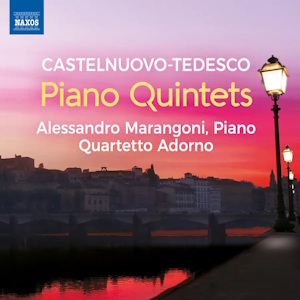
Mario Castelnuovo-Tedesco (1895-1968)
Piano Quintet No.1 in F Major, Op.69 (1932)
Piano Quintet No.2, Op.155, “Memories of the Tuscan Countryside” (1951)
Alessandro Marangoni (piano)
Quartetto Adorno
rec. 2024, Almo Collegio Borromeo, Pavia, Italy
Naxos 8.574692 [62]
Mario Castelnuovo-Tedesco, an Italian composer of Jewish origin, rapidly made a name for himself in the 1920s. His position worsened with the rise of Fascism. In 1939, he left Italy for the United States, where he settled initially in New York. He then moved to Hollywood, where he worked as a film composer for fifteen years. He became an American citizen in 1946 but frequently went back to Italy. While he composed prolifically in all forms, he is particularly remembered for his work for the guitar; encouraged by Andrés Segovia, he wrote over a hundred compositions.
His two Piano Quintets come from opposite ends of his career. He wrote the first for the International Festival of Contemporary Music in Venice, where it was very successful; he considered it the best of his earlier chamber works. It is in four movements, in a late-Romantic idiom lightly touched with neoclassicism in the middle movements. The outer ones, closer to César Franck, are in the full-blooded manner of Franck’s Piano Quintet. The first movement, after a rhapsodic opening, launches into a sonata allegro; the sinuous second subject offers some relief. There is a powerful development and a recapitulation which builds to a big climax. The second movement is gentle and lyrical with a touch of melancholy. The third movement is a scherzo, very fast and light on its feet. The finale returns to the idiom of the opening movement. It is incisive and rhythmical, although there are mysterious and haunting episodes.
The composer wrote the second Piano Quintet during his time in Los Angeles. The presiding spirit this time is Fauré. Furthermore, this is a programmatic work which evokes scenes in Italy. The first movement, titled Le colline (the hills) and marked Sereno e scorrevole, conjures the Tuscan countryside with an attractivc tune in the strings over undulating passages on the piano. This movement is in the sonata form; at the recapitulation, the roles of piano and strings are exchanged.
The second movement, I cipressi (the cypresses), is a theme with five variations. The theme is a hymn-like set of homophonic chords on the strings. The variations are increasingly decorative. After the fourth, a new theme is introduced, an evocation of the owl cry which is the basis of the fifth variation; it returns at the end, after the block chords have been given out again, this time by the piano.
The third movement, Processione nel mese di Maria (Procession in the month of Mary), recalls a religious procession. It is a scherzo with two trios, one an evocation of a village band, the other of a litany. The finale, La mietitura (the harvest), is based on a song which turns into a tarantella. It becomes increasingly frenzied but, at the end, the first theme of the opening movement brings back the serene atmosphere.
Castelnuovo-Tedesco had only been a name to me. I was very pleased to discover these two excellent works. The performers, also new to me, are old hands at this repertoire. The Adorno Quartet have recorded Castelnuovo-Tedesco’s string quartets and guitar quintets. The recording is predictably fine. This excellent disc should make new friends for the composer.
Stephen Barber
Other review: Rob Barnett
Buying this recording via the link below generates revenue for MWI, which helps the site remain free
Previous review: Rob Barnett













