
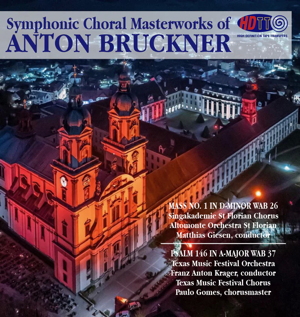
Two major choral works, magnificently recorded [WK]
Anton Bruckner (1824-1896)
Mass No.1 in d minor WAB26 (1864)
Psalm 146 in A major WAB37 (1858)
rec. live, 2018/2024
High Definition Tape Transfers HDTT22956 [75]
Like many composers, Anton Bruckner had a career that can be divided into three parts. In the St. Florian’s period, he was still essentially a provincial composer. In the Linz period, he pursued professional training with the eminent teacher Simon Sechter, among others, and was first exposed to the music of Richard Wagner. From the Vienna period come the major symphonies.
Bruckner’s Psalm 146 is the longest of his five psalm settings, and probably the first of his large-scale choral/orchestral works. (There is some confusion about when he actually wrote the work, or finished revising it.) It is in six large sections. While it sounds to a great degree like late Schubert, it also demonstrates a few typical Bruckner features: strong support from the low brass, with no fewer than four trombones, thematic transformation between movements, and quiet sections featuring one or two woodwinds.
The work begins with an orchestral introduction; the choir takes up its beautiful, flowing material. After a short recitative section, there is a double chorus on the words Gross ist unser Herr. This section most clearly demonstrates the St. Florian’s period Bruckner. It has little of his later contrapuntal mastery, but does possess an almost majestic intensity. The Arioso section that follows is the fulcrum of the work. It opens with beautiful music for the four soloists, and Bruckner soon skillfully adds the chorus. The soloists are also heard at the conclusion of the section as it moves into the chorus Alleluja! Lobet den Herrn. The first part of this shows some quite interesting development of material heard earlier in the piece, while the second part is unfortunately less interesting. Still, it is hard to imagine why Bruckner did nothing to promote this piece, given its overall quality. Indeed, the its first performance was not until 1971.
The orchestral introduction to the Kyrie of Mass No.1 puts us basically in the sound world of Bruckner’s symphonies. Soaring passages and ascending sequences in the orchestra immediately draw us in. The Gloria has a glorious Laudamus te; the orchestra plays an even more important part than in the Kyrie, and helps carry the thematic development throughout the Gloria. Majestic trumpet calls lead to an imposing “Amen”, but the trumpets continue, seguing into the Credo section. After the opening Credo in unum Dei, there comes a very gentle and sincere Et incarnatus est in which the soloists are prominent, followed by Et resurrexit, which sounds like a movement from one of Bruckner’s symphonies (if you ignore the voices). The concluding Et in spiritum sanctum is almost Classical in texture, and the soloists excel here.
The Sanctus is perhaps the least interesting section of the Mass, but the Benedictus that follows is the highlight of the whole work, with skillfully created alternating passages for orchestra and voices. The hushed reverence of the Agnus dei is very effective, and the concluding Dona nobis pacem is truly noble.
The disc comprises two different works performed in different years at Bruckner festivals in two different countries. What unites them are the sponsorship by the Bruckner Society of America and the engineering by John Gladney Proffit, well-known in a number of fields related to music.
The first festival is the Brucknertage held every year at St. Florian’s and usually presenting at least one large-scale Bruckner choral work. In 2018, it was the Mass No.1. No more authentic performance could be imagined, not only because of the venue, but because all the soloists seem to be natural Brucknerians. I especially enjoyed the singing of bass Michael Wagner. The chorus is quite capable, although occasionally a little shrill. Matthias Giesen is the director of the Brucknertage and the organist at St. Florian’s. It states the obvious to say that his command of his forces is idiomatic and fluent.
The Texas Music Festival takes place annually at the University of Houston’s Moores School of Music. For their 2024 season, the Bruckner bicentennial, they performed Psalm 146 and the Symphony No.9. Led by Franz Anton Krager, music director and chief conductor of the Festival, soloists, chorus and orchestra produce a huge sound, appropriate to the text of Psalm 146; they also do well in the quieter moments of this substantial work. The young soloists are all quite talented, especially alto Sarah Dyer. Finally, we must again mention the work of John Gladney Proffit (who also wrote the excellent notes). As on other HDTT recordings (review ~ review ~ review), he has done audio wonders.
William Kreindler
Availability: High Definition Tape Transfer
Performers and recording data
Mass No.1
Regina Riel (soprano)
Gerda Lischka (alto)
Markus Miesenberger (tenor)
Michael Wagner (bass)
Singakademie St Florian Chorus, Altomonte Orchestra St Florian / Matthias Giesen
rec. live, 13 August 2018, Stiftsbasilica St Florian, Sankt Florian, Austria
Psalm 146
Krista Renée Pape (soprano)
Sarah Dyer (alto)
Zachery Averyt (tenor)
Mark Diamond (baritone)
Texas Music Festival Chorus, Texas Music Festival Orchestra / Franz Anton Krager
rec. live, 8 June 2024, Moores Opera House, Houston, Texas, USA













