
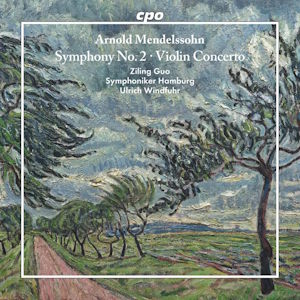
Arnold Mendelssohn (1855-1933)
Violin Concerto in G minor op 88 (1920)
Symphony No. 2 in C major op 93 (1922)
Ziling Guo (violin)
Symphoniker Hamburg/Ulrich Windfuhr
rec. 2022/23, Hamburg, Germany
cpo 555665 2 [74]
Who was Arnold Mendelssohn? If you were wondering, this Mendelssohn was a great-nephew of the ever-green Felix. Arnold made his name as a conductor at Bielefeld but after the Great War he dedicated himself to writing music. His First Symphony was premiered in Darmstadt in 1920. It was there also that this Violin Concerto was premiered under Michael Balling with the soloist Otto Drumm. Balling also conducted the Mendelssohn Second Symphony with the Hessian State Theatre Orchestra, again in Darmstadt.
Looking for another full-lipped, high-tensile violin concerto? Look in the direction of Arnold Mendelssohn. In the embrace of the convivially brilliant Ziling Guo this catchy concerto is well worth the investment of 35 minutes of your listening time. It’s up there with the fiddle concertos by Schoeck, Karlowicz, Korngold and, yes, Haydn Wood, “fellow travellers” all. If there is the lingering fragrance of Tchaikovsky and Elgar about it, that is no hardship in what is a golden age sunset of a work. The sound-style is familiar but the ideas bloom freshly and are neither threadbare nor careworn. The only mildly false subfusc note comes in the rum-ti-tum folkdance finale. The movement pays its dues with a smilingly relaxed flourish.
The Second Symphony is in four movements. The first is an Allegro con brio. A sturdy symphonic tread is set against derring-do with dash and slash aplenty. It signs off by doffing the cap to well-mannered nineteenth century convention. The ensuing Andante has a Schubertian rustic chivalry even if it is a little drowsy. A Vivace is done and dusted in ten minutes. Light-footed and high-spirited as a Rossini overture, it stays consistently anchored to this peppy lodestar. The finale spans ten minutes. It starts placidly enough and adopts a Brahmsian mien. Shadows drift through the pages, but so does that Rossini/Schubert playfulness. That’s the lay of the land. It’s not a big bow-wow of a tragic symphony.
The adept playing in both these substantial works suggests even greater familiarity than was perhaps the case. cpo’s team strike a deep perspective with sound that is blazingly entertaining. In the Concerto, which is recorded in a different acoustic from the symphony, the aural vista is rich and deep with a good bass heft that will surely satisfy.
The liner note booklet by Jürgen Bohme skilfully avoids the fusty academic circumlocution that once characterised cpo’s efforts. What a label this is for probing and freshening the repertoire: new peripheries always being established.
Rob Barnett
Buying this recording via the link below generates revenue for MWI, which helps the site remain free













