
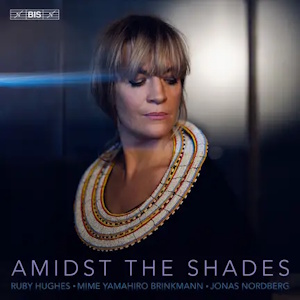
Amidst the Shades
Ruby Hughes (soprano)
Jonas Nordberg (lute and archlute); Mime Yamahiro Brinkmann (viola da gamba)
rec. 2023, Länna Kyrka, Norrtälje, Sweden
Sung texts provided
BIS BIS2698 SACD [78]
Ruby Hughes’s performance of Dowland’s ‘Come away, sweet love doth now invite’, is very slow and very expressive indeed. There is great intimacy here, appropriate both to the forces involved and to the circumstances under which these songs would originally have been performed, but this does not prevent her from realising the mounting excitement in the rising phrases that close each verse. She employs subtle and gentle ornamentation where appropriate, and a short flourish from the lute separates each verse. By the time we get to ‘Time stands still’ it has become clear that Hughes is going to take all the time she needs to make her point in this repertoire. This is courageous singing, sometimes even daring, but I think most listeners will be drawn in. The exquisite pianissimo line she traces when repeating the final phrases that close several of these songs is reproduced throughout the recital. It is especially noticeable at the end of the deeply melancholy ‘Flow my Tears’.
The group of three songs by Robert Johnson confirms and maintains Hughes’s manner. From Richard Bratby’s concise but excellent booklet note we learn that Shakespeare authorised Johnson’s settings of two of Ariel’s songs from The Tempest. He was surely delighted by Johnson’s treatment of the words ‘ding-dong bell’ in ‘Full fathom five’, and Hughes’s delivery of them is delicious.
Although ‘Songs or Ayres’ were often published in multiple volumes – Dowland produced three – John Danyel contributed only one, his ‘Songs for the Lute, Viol and Voice’ of 1606, which amounts to almost all of his music to have survived. The songs are fine enough to rival any composer active in the field, and ‘Grief keep within’ is one the finest of them all. It is, in fact, three songs in one, dedicated to ‘Mrs M. E. her Funerall teares for the death of her husband’. Poor Mrs M. E. has not been identified, but Danyel’s music makes for a noble and moving memorial, where the presence of the viola da gamba adds to the gravity and seriousness of intent. This is music of real character, with considerable and sometimes surprising use of devices such as chromaticism and syncopation, as well as illustration, when tears ‘trickle down’ from the widow’s eyes, for example. Ruby Hughes works wonders with the words ‘pine, fret, consume, swell, burst, and die’ which bring each of the three sections to an end, sometimes with open-throated fullness, sometimes in a near-whisper.
Hughes’s style here is boldly interventionist, involving slow tempi and extreme variations in terms of dynamics, pulse and tone. Some listeners may find this too much. They will complain, perhaps, that Hughes is ‘not letting the music speak for itself’. Purcell’s ‘Amidst the shades’, the song that gives this album its title, will confirm this for such listeners. I do not share this view. On the contrary, I find these performances communicate with great passion and power. She is also blessed with a voice of uncommon beauty.
The recital closes with a group of more recent compositions. The Britten was originally part of his remarkable unaccompanied choral work, A Boy Was Born, completed in its first version shortly before the composer’s twentieth birthday. The simple piano part, itself a transcription, is played here by Jonas Nordberg in his own version for the lute. He has also arranged the piano part of Cheryl Frances-Hoad’s ‘They bore him bare-faced on the bier’, though much of that song is sung unaccompanied. Ruby Hughes writes that ‘there is something very timeless about how [Errollyn Wallen] writes for the voice and the lute’, a surprising comment, I find, since much of the accompaniment of ‘The Shadow of my sorrow’ is composed of a single line. That ‘sorrow’ is played out through some quite spectacular wailing from Hughes, and in truth both songs provide vivid and powerful responses to the texts. Even so, the fusion of voice and lute that is present in the older music seems largely absent here. Deborah Pritchard’s songs are sung unaccompanied, evoking, so writes the composer, Ophelia’s ‘yearning for peace in her soul’. They employ a relatively conventional musical language, and are very affecting indeed, the final diminuendo into nothing at the end of the second song providing an atmospheric close to the recital.
Three pieces are for lute alone. Holborne’s ‘Last Will and Testament’ is pensive, as its title would suggest, whereas the two Dowland pieces are lighter affairs. I do not have the specialist knowledge needed to comment on the realisation of the originals, nor do I have access to the scores, though I do have several of the Elizabethan songs in the old Stainer & Bell editions originally edited by Fellowes, and find that what is played is often remarkably close to what is printed there. Nordberg plays these three pieces, as he does the accompaniments to the songs, with the utmost delicacy, sensitivity and sound musical sense. Mime Yamahiro Brinkmann’s richly sonorous performance of Tobias Hume’s ‘Loves Farewell’ is also a particular pleasure.
This disc prompted me to listen to a few performances that I hadn’t heard for a long time, firstly in search of a wider view, but then also simply for pleasure. Among these were Nigel Short and Michael Chance in the Danyel songs, and Martyn Hill and John Mark Ainsley in Tippett’s realisation of ‘Sweeter than Roses’. Then there is Janet Baker in the Britten and in Dowland’s ‘Come again’, two songs which, if my memory serves, were on the very first collection she recorded for HMV after her two superb Saga LPs. Hughes takes not far short of twice as long over the Dowland as Baker did, firstly because she sings four verses to Dame Janet’s three, but also because the approach is radically different. Baker, at a faster basic tempo, is direct, even assertive, and with no lingering. I also rediscovered a fascinating document, boy alto John Hahessy in 1961 singing ‘Corpus Christi Carol’ with Britten at the piano. The composer, who was famously dismissive of pretty much anything in the way of ‘interpretation’ of his music, adopts a fast, regular pulse that gives the song an almost perfunctory feel, and encourages Hahessy to sing out firmly in each of the ‘Lully, lullay’ choruses. Even Janet Baker is more overtly expressive than that. In all these direct comparisons, though, the singing is simpler, straighter, than that of Ruby Hughes, whose very special approach fully convinces this listener. And now a word of warning: the dominant thematic strand here is grief, with the expected consequences for the music and the mood. I think listeners will appreciate this recital most by listening to it in groups, and the way the programme is organised makes this easy. Heard that way the recital becomes a deeply satisfying experience.
William Hedley
Buying this recording via the link below generates revenue for MWI, which helps the site remain free
Contents
John Dowland (1563-1626)
Come again, sweet love doth now invite
Can she excuse my wrongs?
Time stands still
Flow, my tears
Lord Strangs’ March (lute solo)
Mrs Winters Jump (lute solo)
Robert Johnson (c.1593-1633)
Care charminge sleepe
Where the bee sucks
Full fathom five
Anthony Holborne (1545-1602)
Last Will and Testament (lute solo)
John Danyel (1564-1626)
Grief, keep within (Mrs M.E. her Funerall teares for the death of her husband)
Tobias Hume (c. 1569-1645)
Loves Farewell (viola da gamba solo)
Henry Purcell (1659-1695)
Amidst the shades
O solitude
Here the deities approve
Sweeter than roses
Benjamin Britten (1913-1976)
Corpus Christi Carol
Errollyn Warrel (b. 1958)
The Shadow of my Sorrow
Deborah Pritchard (b. 1977)
Ophelia’s Songs: How should I your true love know
Cheryl Frances-Hoad (b. 1980)
They bore him bare-faced on the bier
Deborah Pritchard
Ophelia’s Songs: Will he not come again













