
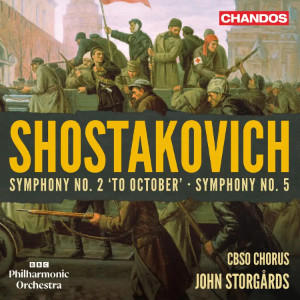
Dmitri Shostakovich (1906–1975)
Symphony No. 2 in B major, Op. 14, ‘To October’ (1927)
Symphony No. 5 in D minor, Op. 47 (1937)
CBSO Chorus
BBC Philharmonic Orchestra/John Storgårds
rec. 2025, MediaCityUK, Salford, Manchester, UK
Russian text and English translation
Chandos CHSA5378 SACD [67]
This release has already been very favourably reviewed by my colleague Dominic Hartley. I am a relatively late convert to Shostakovich’s symphonies and am still not by any means comfortable with them all but the Fifth Symphony has long been one of the most popular and the odd little one-movement/four-section Second Symphony makes for an intriguing pairing. I recently acquired Barshai’s box set of the complete symphonies which mightily impressed me; back in 2002 on its release, all three of its reviewers (review ~ review ~ review) gave high praise to the execution of both the symphonies featured in this new release. However, I also have an attachment to recordings of the Fifth by Bernstein (NYPO,1959 -despite its shrill upper frequencies), Stokowski (live LSO, 1964), Mackerras (RPO, 1994) and van Zweden (Hong Kong PO, 2022 – see my review), and DH favours Maxim Shostakovich and Kurt Sanderling – so the competition is tough.
There is no doubt that the Second is a hard nut to crack, being the young Shostakovich’s enthusiastic embrace of the Modernist idiom exemplified by Berg and the Second Viennese School allied with Soviet Futurism. The opening, depicting order gradually emerging from “primordial chaos”, is hardly without precedent in classical music, being a device exploited by Haydn, Strauss, Nielsen and Mahler to name but a handful, and it is especially atmospheric and well-gauged here. I am also particularly struck by the clarity and precision of the BBC Philharmonic in their execution of the highly complex counterpoint and cross-rhythmic passages and the committed, authentic-sounding contribution of the CBSO Chorus; they actually make a better job of the declamatory, shouted conclusion to the choral section than Barshai’s choir. The contribution of the soloists, too, led by leader Yuri Torchinsky in his torturous violin riffs, is very impressive and Storgårds very skilfully manages the gradual transition from the fragmentary, disorienting idiom of the first three sections into the much more tonal – possibly ironic, given the banality of the text – style of the choral ode.
Storgårds’ approach to the Fifth is much cooler, more detached and objective than, for example, Bernstein’s famous recording almost seventy years ago and that perspective is entirely valid given that the debate continues regarding what the music – especially the finale – “means”. That difference is evident right from the opening bars: Bernstein leans much more aggressively into the jagged, widely stepped melody and that extra aggression is enhanced by the harshness of the old analogue sound compared with the smoother, more spacious Chandos recording. In truth, I find Bernstein’s manner more invigorating and engaging; the same is true of their respective deliveries of the little Allegretto: Storgårds phrases more flexibly and less emphatically whereas Bernstein drives home its martial character and perhaps thereby misses some of its whimsy. These interpretative divergences obtain throughout and are presumably consistent with how each conductor gauges the emotional orientation and import of the symphony. Both deliver the beautiful Largo sensitively and it is here that the new recording most benefits from modern, digital sound – which is also true of van Zweden’s excellent account; the greatest disparity is in the finale over which Storgårds takes nearly two and a half minutes longer. He tends towards the “let the music speak for itself” school of interpretation as opposed to the more interventionist approach of Bernstein and van Zweden; the former’s delivery of the finale is frantically exciting and I have to say I prefer it while acknowledging its excess.
Ralph Moore
Other reviews: Dominic Hartley and William Hedley
Buying this recording via the link below generates revenue for MWI, which helps the site remain free













