
Timothy McCormack (b. 1984)
your body is a volume (2016-19)
the hand is an ear / the ear is a heart (2022)
JACK Quartet
Austin Wulliman (violin)
rec. 8 December 2021; 1 July 2024, CMC Studio, Columbia University, New York City, USA
Kairos 0013322KAI [70]
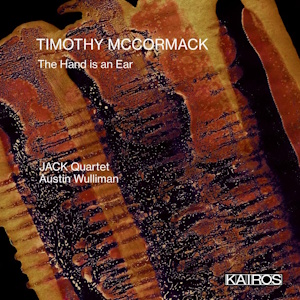
The cover of this disc stops you before you’ve heard a note. Based on an artwork by the Austrian painter Jakob Gasteiger, it is a field of dark ochre and scorched brown, its surface ridged and scored as though fingers or blades have been dragged through wet pigment. It looks like something made by pressure and contact, and it tells you with unusual precision what you are about to hear.
After a few seconds, your ears pick up the barest hint of something. What? A scratching, scuttling. Then it becomes both more incisive and more abrasive, coming into and out of definition—the sound of material being uncomfortably stretched. Fuzz, static. All of it gradually increasing in volume. Some six minutes in, a chasm seems to open up for literally three or four seconds and then closes. You are simultaneously disoriented and in a state close to rapture. What is this?
Perhaps the perennial problem with music writing is its unavoidable reductiveness. For the most part, writers and readers have to shrug and put up with it, and it’s such a given of criticism that we mostly forget about it. But every so often, along comes a composition that starkly exposes the inadequacy of the tools at our disposal. That feeling washed over me last year when I came to write about Timothy McCormack’s piano work mine but for its sublimation. I found that the best I could do was to describe what I heard in simple technical terms and its consequent emotional effect, rather than attempt anything more complicated. Perhaps my state of dazed zeal might have been enough to encourage prospective listeners to seek it out. I hope so.
Where to go then with this new disc? I was going to write that the two works on this album represent a fundamental reimagining of two primary forms, the string quartet and the solo violin composition. But actually, the writer of the booklet notes—the singer and writer Ty Bouque, a close creative collaborator of the composer—would resist that formulation. For Bouque, these pieces do not so much reimagine existing forms as bypass the category entirely. They may have a point.
In my review of mine but for its sublimation I was so absorbed by the music that I gave almost no context about its composer. This seems a good moment to make amends. Timothy McCormack, born in Cleveland, Ohio in 1984, was originally a bassoonist—a fact that matters because it shaped an abiding fascination with the physical mechanisms of instruments and the bodily actions needed to play them. McCormack studied composition at Oberlin, then at the University of Huddersfield, and also took contemporary dance classes with Jill Johnson, a former dancer with the William Forsythe company; the choreographic dimension of instrumental performance has remained central to McCormack’s thinking ever since. Now teaching at the University of California San Diego, McCormack describes their music as ‘haptic’—compositions concerned with the physical relationship between a performer and their instrument, threading an intimacy between tone and noise. That is as good a starting point as any, though it leaves out the emotional force that accumulates from the sustained focus of the longer works.
The JACK Quartet—Christopher Otto and Austin Wulliman (violins), John Pickford Richards (viola), Jay Campbell (cello)—are among the foremost ensembles for new music anywhere in the world. your body is a volume was written for them. Wulliman’s double role on this disc deserves emphasis: he plays violin in the quartet and is also the soloist on the hand is an ear / the ear is a heart, a fortieth birthday gift. His presence binds the two works together in a way that goes beyond programming.
I’m lucky to have seen the scores of both pieces, and they are worth discussing, not only because they illuminate the musical thinking but because even in digital form they are striking objects—impeccably laid out, visually exacting, and elegant. Both works use a proportional time-space notation in which physical distance on the page equals elapsed time, with each measure spanning roughly ten seconds. Conventional rhythmic notation is abandoned: there are no quavers or semiquavers, only spatial relationships between events. Both works deploy five graduated degrees of finger pressure (from full contact with the fingerboard down to the lightest harmonic touch) and five levels of bow pressure (from the bow merely resting on the string to near-maximum force). Each degree has its own notehead shape or size. The bow’s position along the string is mapped with equal precision, with four specified degrees of tasto (over-the-fingerboard) placement alone. Both works are to be played with the bow in continuous contact with the strings throughout.
Where the scores diverge is instructive. In your body is a volume, there is no conductor, no click-track, no external timekeeper of any kind. Instead, the four players navigate the work through a system of aural triggers—specific sounds made by one instrument that cue events in another—transmitted purely through listening. Crucially, the score stipulates that these triggers must be invisible to the audience: no gestures, no nods, no visual synchronisation. An ideal performance, McCormack writes, would involve absolutely no physical movement beyond what is needed to produce sound. Communication becomes the structural principle of the piece, and its fabric is woven from mutual attention. The entire work is built on noise generated by heavy bow pressure at slow speed in the tasto region, treating each individual string—each with its own gauge and tension—as a distinct voice within a dense thicket of others.
The hand is an ear, by contrast, is a solo in the fullest sense: one performer in communion with a single instrument whose strings have been deliberately detuned. Pitched sounds are possible but much of the material is noise-based, and the scordatura (alternative tuning) creates a timbral world in which familiar violin territory has been fundamentally estranged. McCormack’s programme note could hardly be more direct: the piece is about sensation—sound as something physical and vibratory, felt on the fingertips and through the whole body. Where the quartet is a social organism negotiating shared attention, the solo is a private act of corporeal listening.
Bouque’s booklet essay demands a word. It is by far the most ambitious piece of liner note writing I have come across for a new-music recording—dense, intellectually serious, and steeped in the work of Jacques Derrida and Hélène Cixous. Bouque reads McCormack’s titles (particularly the recurring use of ‘you’—you actually are evaporating, your body is a volume, yours in the process of being absorbed) through a framework drawn from Derrida’s essay on poetry, where the poem demands to be internalised so completely that its textual origin is erased—what Derrida called a writing that becomes the body of the one who receives it. Bouque argues that McCormack’s notation functions in an analogous way: it prescribes physical actions in such granular detail that the performer’s body becomes the site where the music takes form, and the score itself effectively vanishes.
Bouque also highlights several registers crucial to McCormack’s work: HIV and its cultural legacies alongside dance, geology and painting, making the point that none of them are what the music is about. They are instead ways of thinking that run parallel to the music’s own formal logic, illuminating it from outside without determining its content. Not everyone will find this theoretical register immediately approachable, and the essay certainly assumes a familiarity with continental philosophy that many listeners won’t share. But those who persevere will find genuine illumination, and the essay’s own uncompromising rigour mirrors the character of the music it addresses. McCormack’s own programme notes, by contrast, are brief and direct. Between the two, a reader who wants to understand what they are hearing has ample material.
These are some of the words I wrote down when listening to your body is a volume:
Ratcheting. Like a pulse. Engines. Tools. Momentum. Monochromatic but utterly immersive. Pandemonium—literally, in the Miltonic sense, a place built. Foghorn. Didgeridoo. Narrative, somehow. Broken machinery? Relentless. The soundtrack to a Tarkovsky film that was never made. Kettledrums. Planes overhead. A hint of an open A string—disorientation within disorientation. Bedlam. These are not amplified instruments! Relative calm. Rattling. Something being dragged. Discomfort. Metallic.
I set them down deliberately, without polish, because I think they tell a truth about this music that a more orderly account would obscure. On first and second hearing, the sheer strangeness and weight of the sound is so overwhelming that conventional aesthetic categories simply do not apply. You are inside something, and the usual reviewer’s impulse to stand outside the music and describe it as an object is not available to you. It is only after several listens that the larger shape of the work begins to come into focus—the immense, slow contour of a fifty-one-minute span whose proportions, one gradually realises, are as carefully calibrated as anything in the notational detail. We can hear a form that swells and subsides in enormous waves, with a near-total dip around the thirty-three-minute mark before a final surge. Bouque’s point about Derrida is relevant here, and not only for the performers. The listener, too, finds that the music cannot be held at arm’s length; it demands to be taken in bodily, internalised, absorbed on its own terms. You do not so much listen to your body is a volume as submit to it, and the submission is not comfortable, but it is profoundly rewarding.
It is almost impossible to overstate the technical demands the work places on its performers, and the JACK Quartet meet them with a precision and a sustained intensity that I find difficult to imagine being matched. The combination of endurance, concentration, and mutual attentiveness required by the trigger system, sustained over nearly an hour, places this beyond the reach of all but the most committed and experienced ensembles. The score’s instruction that the audience should be seated close to the players is honoured in this recording; one feels an extraordinary proximity to the sound, every grain and fibre of it audible.
The hand is an ear / the ear is a heart occupies a different world. It is twenty minutes long, and Bouque’s description of the work’s structure as two inversions of a single relationship is, one discovers on listening, less a critical interpretation than a literal account of what happens. The first half is all suppression and resistance—strings detuned, bow pressure applied against the grain, the instrument audibly straining, the writing intensely concentrated and full of a palpable, literal tension. Nothing prepares you for what follows. A sudden eruption of plucked strings and more conventional bow placement tears the work open. What comes after has, for want of a better word, a rhapsodic quality: relative tonality, a slow registral ascent, a sustained intensity that is no longer the intensity of constraint but of release. Its physical effect on me was euphoric.
I had the waveform of the piece open on my laptop as I was writing this and the structural divide is startlingly visible—a period of lower amplitude punctuated by surges, then a dramatic shift around the twelve-minute mark into a denser, more consistently forceful second half. You can see the solidus, the upward stroke, that Bouque identifies as one of the most shattering moments in McCormack’s output. What you cannot see is the way the music after it refuses to relent, demanding of the performer a commitment that is as much physical as it is musical.
Wulliman’s performance is one of those rare occasions where the standard vocabulary of praise feels not just inadequate but faintly absurd. The control of bow pressure, the sensitivity to the micro-gradations that McCormack’s notation specifies, the sheer stamina required to sustain twenty minutes of this kind of playing—all of this is evident, but what stays with you is something less tangible, an impression of total absorption, of a performer who has internalised the music so completely that the boundary between the written and the played has effectively dissolved.
A word on the recording as a whole. The two works were taped nearly three years apart—your body is a volume in December 2021, the hand is an ear in July 2024—both at the CMC Studio at Columbia University, with Murat Çolak as engineer and producer and McCormack credited as co-editor. The consistency of sound across the two sessions is notable. The acoustic is close and dry, which is exactly what the quartet’s score demands, and the dynamic range captured—from the barest whisper of bow on string to passages of real ferocity—is handled with impressive fidelity.
What does this disc represent? Something very large, I think. your body is a volume is not merely one of the most striking string quartets of recent times, it is a work that asks fundamental questions about what the medium is for and what four stringed instruments in proximity to one another can become. the hand is an ear / the ear is a heart does something comparable for the solo violin, finding in a single instrument and a single body an emotional range that its austere surface might seem to preclude. Between them, they confirm McCormack as a composer who matters.
The dedication of your body is a volume reads: ‘may this restore you, contain you, as a blanket.’ In a work of such severity and uncompromising rigour, that tenderness is perhaps the most striking thing of all.
Dominic Hartley
Availability: Kairos












