
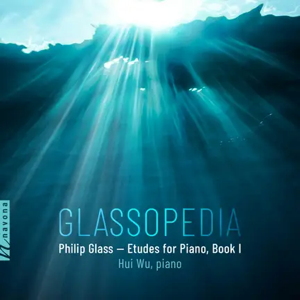
Philip Glass (b. 1937)
Glassopedia: Etudes No.1-10 (Book 1)
Hui Wu (piano)
rec. 2025, Allegro Recordings, Burbank, USA
Reviewed as lossless download
Navona Records NV6826 [57]
“And still they come”, to quote HG Wells’s The War of the Worlds (perhaps it’s Jeff Wayne’s prog rock version I’m thinking of). This is the third recording of Philip Glass’s Etudes that I’ve reviewed in the last year or so. The previous two were by Máire Carroll (Delphian – review) and Vanessa Wagner (InFine – review), so Chinese-born LA-based pianist Hui Wu makes it three women in a row taking on the challenge. While that’s not important musically, I think it is interesting that across the thirteen sets in my collection that include at least one book’s worth of Etudes, the women are in a majority.
Hui Wu has a substantial track record of competition prizes in her CV, but as far as I can tell, this is her first recording. According to the webpage for this digital-only release, this is the first of a series in which she intends to record all the solo piano works of Philip Glass. That is a substantial ambition; I am aware of one other major series: that by Nicolas Horvath on Grand Piano, though I’m not sure whether its six volumes comprise the complete music.
If one were ever to doubt that a piano is a percussion instrument, this recording would dispel such thoughts. I don’t think it is a quirk of the recording or the instrument, but rather an artistic decision by Wu. From almost the first notes of Etude 1, it is apparent that Wu is going to use the sustain pedal very sparingly. The sound of the piano, especially in the right hand, is frequently clangourous, and comes as quite a shock when one is used to the more rounded tones of other performers. To some extent, I can understand this approach in Glass’s music, though perhaps more in his early works, rather than these from the 1990s onwards, when a softer, more Romantic feel entered his compositions. I have to admit to finding it quite tiring to listen to more than a couple of pieces in a row. Such is Wu’s “disdain” for the sustain pedal that in Etude 5 – around 2:30 – where there is a significant pause between notes, the sound simply stops dead, and there is absolute silence for a second or two before the next note is played. I listened to four other versions, and in each case, the previous note was sustained across the pause.
That’s not to say that everything is hard-going. Her performance of No. 6, my personal favourite of the twenty, comes closest to that of Víkingur Ólafsson’s in terms of the volcanic eruptions of power throughout. Her clear bell-like playing ensures that the gentle textures in No. 2 are fully elucidated, though the very high notes around 1:30 are very brittle. No. 9 is breathlessly exciting, and one of the best versions I’ve heard.
Wu pairs her choice of piano sound with tempos that are in general a little quicker than most, though not exceptionally so, as can be seen in the table below. No, the Horvath timings are not typos; perhaps he omits repeats – who could tell in this music without the score – but he definitely plays like a bull at a gate.
| No. 2 | No. 5 | No. 9 | Total | |
| Hui Wu | 5:46 | 9:09 | 2:33 | 56:42 |
| Máire Carroll | 7:38 | 9:02 | 4:02 | 58:03 |
| Maciej Ganski (DUX) | 5:47 | 11:15 | 2:11 | 61:46 |
| Nicolas Horvath | 3:03 | 4:19 | 2:11 | 38:34 |
| Jenny Lin (Steinway & Sons) | 5:32 | 8:08 | 3:10 | 60:40 |
| Maki Namekawa (Orange Mountain) | 7:23 | 8:19 | 3:58 | 61:26 |
| Víkingur Ólafsson (DG) | 6:00 | 8:55 | 2:32 | — |
| Jeroen van Veen (Brilliant Classics) | 7:26 | 9:49 | 3:53 | 72:59 |
| Vanessa Wagner | 6:58 | 8:42 | 2:20 | 63:19 |
As I’ve said, I don’t think the sound of Wu’s piano is due to the instrument or the recording; indeed I think the sound quality is very good: immediate and clean, but not recorded so closely you can hear the mechanism work, as was the case with a recording I recently reviewed. There are no booklet notes, only what is included on the Navona website.
This is definitely a case of listening before buying. I would suggest sampling the starts of Nos 1 & 10, because they will give you an instant guide to Wu’s soundworld. It will be interesting to see where she goes next with her Glass survey, and if she adopts the same approach to other works. Will I join her on that next stage? I’m not sure.
David Barker
Buying this recording via the link below generates revenue for MWI, which helps the site remain free













