
Johannes Brahms (1833-1897)
Symphony No. 2 in D major, Op. 73
Tragic Overture, Op. 81
Hallé Orchestra/Stanisław Skrowaczewski
rec. 1987, Free Trade Hall, Manchester, UK
IMP Classics 30367 00982 [62]
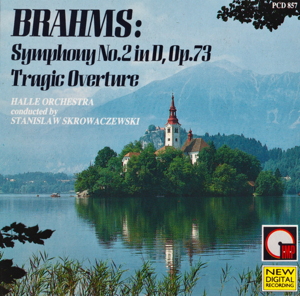
This is the most beautiful, relaxed, lyrical – yet never slack – recording of Brahms’ sunniest symphony. I was recently reminded of its excellence – and indeed its existence – but my reviewer colleague Philip Harrison, for whom it was an early and still treasured purchase, and having listened to it on YouTube I hastened to acquire the CD, copies of which on the IMP/Carlton Classics label may still be found. (There are several different CD issues by them, some with an island lake scene – used here – others adorned with crops from Frederic Lord Leighton’s paintings, and the alternative catalogue no. PCD 857 rather than the numeric distributor number of my CD above and yet another on the MCA label; the four symphonies were also issued in a box set.)
I was surprised to discover that, despite its age and reputation, and the plethora of reviews by other interpreters, this recording appears never to have been reviewed on MusicWeb. It has the distinction of being in first-rate digital sound and being in the new wave which includes the first movement exposition repeat – whereas Toscanini, Furtwängler, Szell, Klemperer, Karajan, Sanderling et al never did. Boult changed his mind, hence his 1970 recording with the LPO has it, but his recording with the same orchestra fifteen years earlier does not – and typically he clocks in at a brisk nineteen minutes compared with Skrowaczewski’s twenty-two.
Despite its predominate lyricism there is no shortage of drive or spring in the faster, more dramatic passages, of which there are still many. The playing of the Hallé – which wasn’t always reliably immaculate – is terrific; the warmth and depth of the sound right from the opening low strings and horn motif promise a performance of nobility and distinction. There is real momentum to the development of the movement without undue haste. The soft horn playing from principal from Laurence Rogers is especially mellifluous.
The ambiguity of mood of the Adagio – is it melancholy, consoling, or both? – is beautifully captured and we are treated to more dulcet horn-playing before the stormier passages and serene conclusion. The Allegretto, first gentle and pastoral, then skipping and playful, is played with charm and delicacy; Skrowaczewski lingers lovingly over the coda, then he shakes off all languor and drives the last movement fiercely but joyously towards the climax. It is noticeable how meticulously he graduates the dynamics of different sections: sometimes the pianissimi are daringly refined over long stretches then he launches his orchestra at the melody like a wild man to engineer a thrilling conclusion, with timpani running riot.
The bonus is the Tragic Overture, whose bombast and rather unmemorable, fragmentary nature I have never warmed to. I have always considered it to be second-rate, if not third-rate, Brahms – but I recognise that it is given as enthusiastic and animated an advocacy as possible here.
Ralph Moore
Availability
Only available second-hand













