
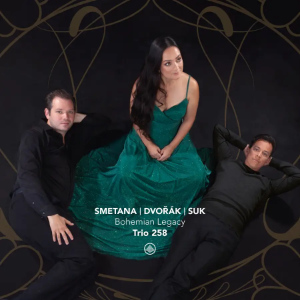
Bohemian Legacy
Bedřich Smetana (1824-1884)
Piano Trio in G minor, Op. 15
Antonín Dvořák (1841-1904)
Piano Trio No. 3 in F minor, Op. 65 (B130)
Josef Suk (1874-1935)
Elegy in D-Flat Major, Op. 23
Trio 258
rec. 2025, Singelkerk, Amsterdam, The Netherlands
Challenge Classics CC720047 [75]
My colleague Mark S. Zimmer welcomed the release of Trio 258’s debut album, The Return, devoted to two works by Rachmaninov (review); here, they turn their attention to three Czech pieces by composers linked by their love of country and culture: “The album Bohemian Legacy…is a heartfelt tribute to three generations of Czech composers… whose music embodies the soul of Bohemian culture.”
Their sound is predicated upon their use of gut strings and the adoption of a Romantic, expressive, “old-fashioned” approach, employing portamento. The recital opens with a wailing Roma-style lament for the solo violin and remains passionately agonised throughout. As the notes point out, Smetana wrote it shortly after the loss of his four-year-old daughter and moments of peace or repose are rare. At times, it is lyrical, especially when the piano has the floor, as it were, but often the melody is quite fragmented, as if the composer were battling with conflicting emotions. It is not an easy listen. The opening of the second movement, marked ““Allegro ma non agitato” has a sporadically demonic quality and while the “Allegro” instruction is simple enough, it is hard to see how such music can be played without sounding “agitato”. However, it soon resolves into a more resigned and gently melancholy mode which seems far less Bohemian folk-song-influenced than the preceding movement. The finale first charges ahead before a slow, wistful melody is intoned, first on cello then on violin; again, it seeks to reconcile opposing moods and the Trio 258 are both sensitive to the seismic mood changes and fully up to executing the fast intricate passages in unison. I must be honest and confess that this is not music which captures me in the way Dvořák’s chamber music can but am fully aware that it is as well played here as anyone could desire.
The trio by Dvořák is less celebrated than the “Dumky”, Op. 90, but is still a mature work and I find it more immediately rewarding than the Smetana trio. My acquaintance with it has been through the 1987 recording on the CBS label with the starry trio of Emmanuel Ax, Young Uck Kim and Yo-Yo Ma, which is slightly more relaxed and indulgent than the fierier Trio 258 here. The piano often has a bigger role here than in the Smetana and Lestari Scholtes seems to revel in the spotlight. It is a more coherent, melodically appealing work than the Smetana trio and provides a pleasing contrast; the artists sounds as if they are enjoying playing the soaring “Poco adagio” third movement. The “con brio” finale has a prevailingly insistent, feverish pulse and tension is maintained throughout its ten minutes.
The programme is rounded off by Suk’s short Elegy, which acts as an encore. It is at first overtly sentimental but the brief stormy middle section provides variety and the conclusion is serenely lovely.
The sound is exemplary; the balance between the instruments is very good. (However, I could do without the superfluous cardboard sleeve.)
Ralph Moore
Buying this recording via the link below generates revenue for MWI, which helps the site remain free
Performers: Lestari Scholtes (piano); Eduardo Paredes Crespo (violin); Leonard Besseling (cello)













