
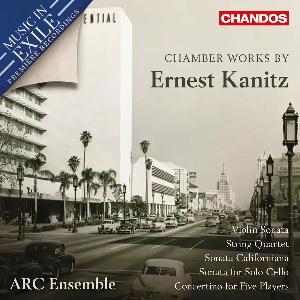
Ernest Kanitz (1894-1978)
Chamber Works
Violin Sonata, Op.10 (1921)
String Quartet in D major (1945)
Sonata for Solo Cello (1955)
Concertino (1956-57)
Sonata Californiana, for E flat Alto Saxophone and Piano (1948)
ARC Ensemble
Wallace Halladay (saxophone), Anna Štube (violin), Joel Quarrington (double bass)
rec. 2025, Koerner Hall, TELUS Centre for Performance and Learning, Royal Conservatory of Music, Toronto, Canada
Chandos CHAN20374 [73]
Ernest Kanitz is one of those musicians who had a distinguished career as a composer, conductor and educator. His output, however, was relatively conventional, so he became neglected after death amidst the bustle and noise of the mid-20th century, and in his case despite considerable post-exile successes in America. Search for other recordings of his work brings up nothing beyond an album from 2016 on the Orion label, with no further mentions in the current catalogue. A native of Vienna, Kanitz initially studied law, became a student of Franz Schreker after graduating, and later was championed by the likes of Alexander von Zemlinsky and Clemens Krauss. Forced to leave after the Nazi annexation of Austria in 1938, he lived and worked in America, with premières performed by some leading US orchestras. The booklet notes for this release are very informative about Kanitz’s life and work.
The Violin Sonata No. 1, Op. 10 gained a certain amount of popularity, with performances and radio broadcasts with high profile musicians of the day. Opening with a deceptively wistful feel, the first movement soon turns into something robust and heartfelt in its directness. This is fast-paced and intense, and very much music of its time but with turns of wit to go along with its passages of romantic eloquence. The central Adagio has its impassioned climaxes but to my ears is a more muted continuation of the restless music that has gone before. Imagine it played forte and in double tempo and maybe we would get that effect. Either way there are few aria-like melodies, and where they do emerge they are soon fragmented and thrown into a boiling ferment. The third movement is marked Epilogo and opens with lighter playfulness in the piano, the dance-like quality of the music willingly taken up by the violin. Tenderness takes over in a slower central section from which the ritmico character of the opening returns with fugue like counterpoint, heading towards an ecstatic and emphatic final few bars.
The String Quartet in D major dedicated to Ernst Toch is summed up as ‘whimsical’ in Simon Wynberg’s booklet notes, but the opening Elegy has a dark and forbidding character to my ears. The whimsy kicks in from the light-textured second movement’s Rondino, and a reflectively nostalgic third movement that takes us back to Europe in an Old Viennese Tune and Variations. The work is capped by a rousingly swift Finale which might seem engineered for rapturous applause, though the last minutes are relatively quiet and strangely enigmatic. Nothing is ever quite what it seems with Kanitz, and it seems the work might never have been performed publicly in his lifetime.
The Sonata for Solo Cello is a well-crafted work that makes full use of the instrument’s range, with extreme highs for some melodic passages, and rhythmic impact in the low register in parts of the Allegro deciso first movement. The second movement is more ruminative, though there is plenty of declamatory drama to cut through its lyrical introspection. The final third movement puts plenty of virtuoso demands on the player, with Kanitz’s signature restlessness emerging in pizzicato interjections and rhythmic energy that stops quite unexpectedly.
Including clarinet and piano with strings with double bass, the Concertino for Five Players is enjoyable in its sonorities and contrasts between sprightly energy and fascinating linear expressiveness. Kanitz never lost his mid-European aesthetic, but you can hear touches of Americana creeping in here and there. The final Fugue might have turned into something Bernstein-esque but is in no way imitative of anyone in its refined brevity. The Sonata Californiana for alto saxophone and piano goes further in this American feel, and not only by virtue of its instrumentation and its title, Kanitz revelling in a West Coast atmosphere that must have made a relaxing contrast to the grim darkness of late 1930s Austria and memories of war. The music doesn’t lapse into jazz but has an accessible nature, the final movement entitled Hollywood having a Gershwin-like energy.
Superbly performed and recorded, this is a fine production with an intriguing and enjoyable programme of première recordings. I for one am delighted to have been given the opportunity to discover the music of Ernest Kanitz.
Dominy Clements
Previous review: Jonathan Woolf
Buying this recording via the link below generates revenue for MWI, which helps the site remain free













