
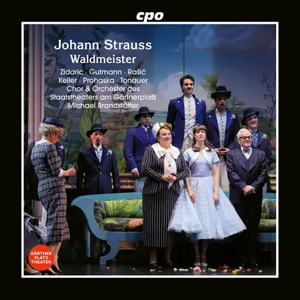
Johann Strauss II (1825-1899)
Waldmeister (1895)
Daniel Prohaska (tenor) – Erasmus Peter Müller
Andreja Zidaric (soprano) – Freda
Matteo Ivan Rašić (tenor) – Botho Wendt
David Gutmann (baritone) – Tymoleon Gerius
Sophia Keiler (soprano) – Pauline Garlandt
Anna-Katharina Tonauer (mezzo) – Jeanne
Chorus and Orchestra of the Staatstheater am Gärtnerplatz/Michael Branstätter
rec. live, 24-28 April 2025, Museumsquartier, Halle E, Vienna, Austria
Booklet with notes in German and English
cpo 5557012 [75]
If anyone comes to Waldmeister expecting to find Strauss’s musical inspiration to be at the same level as it was for Die Fledermaus(1874) or Der Zigeunerbaron (1885), his most wide-ranging and complex score, then they will find this late operetta to be a disappointment. It is also no match for the less well-known but superb Simplicius (1887), where the composer attempted to push the boundaries of what was acceptable subject matter in a Viennese operetta.
Waldmeister was Strauss’s final operetta, written when he had turned seventy. The premiere in 1895 was considered a success despite a great deal of drama going on backstage in the lead-up to the premiere, a situation that was all too common an experience for Strauss in his theater works. Despite the initial popularity of the work in both Vienna and Berlin, Waldmeister soon faded from view. The reason is not hard to fathom: the story is a rather strange rehash of W.S. Gilbert’s magical teapot theme from The Sorcerer. The plot doesn’t really work when combined with Strauss’s less than top-drawer music; however, even second-rate Strauss is eminently tuneful and enjoyable on its own terms.
The title Waldmeister has a double meaning here; it refers to the director of forestry who is one of the chief characters but it also refers to a native plant (Woodruff) which according to folklore has mildly hallucinogenic and aphrodisiacal effects when brewed into a tea, which is exactly what happens here at the end of the Second Act. This must be the only operetta in history which is set in a botanical college. The original production had the storyline begin when a storm drives the members of a hunting party to a remote forestry college, not far from Dresden. Much of the humor of the original libretto made fun of the Saxon regional dialect. For this first modern production that provided this recording, the plot was changed partly to eliminate the dialect humour but the editors moved the action so that rather than a college the partygoers (no hunting here) are taking refuge in a remote and rundown hotel. However, the botanical theme was retained and I feel it worth pointing out that one of the main character’s names is a direct tribute to a famous Danish botanist of the late 19th century (something the accompanying booklet fails to mention).
This recording is based on the first modern revival of the work, hence the revisions to the libretto. None of that is especially relevant here, as only small bits of dialogue have been included in this recording. The musical numbers have been recorded complete. Munich’s long standing second opera house, The Gärtnerplatz, has had a long history of staging operetta, musicals and lighter operas which would be lost on the stage of the National Theater. This recording appears to derive from a visit that the Munich company made to Vienna, which is unusual considering Vienna has its own permanent second opera house, the Volksoper.
The entire cast of Waldmeister offers enthusiasm and commitment to this quirky enterprise, even if the quality of the singing is not going to cause one to sit up and take notice.
One of the most pleasing performances comes from Andreja Zidaric’s dulcet sound as Freda; she is also well-partnered by Matteo Ivan Rašić’s boyishly charming Botho. The other memorable contribution comes from David Gutmann, who makes a lively chief forester with his fine ringing baritone, particularly good in the upper range.
From there things the singing is less noteworthy. Sophia Keiler’s sound is a bit squeaky and with her none too secure soprano she doesn’t make the intended effect as Pauline, the opera singer. Anna-Katharina Tonauer offers a winning characterization of Pauline’s frustrated secretary, but her voice has moments of uneven tonal bursts which diminish her portrayal. Daniel Prohaska spends much of his time by using a sort of pitched sing-speech that is remarkably similar to what Rex Harrison did for Professor Henry Higgins in My Fair Lady. This is something that may not wear well on repeated listening.
Presiding over this is the carefully guiding hand of Michael Branstätter in the orchestra pit. He does not make the mistake of trying to drive the music at a pace that it wouldn’t be able to bear. His approach is more laid back, but he retains a sense of rhythmic control. Indeed his direction of the score is probably the most pleasing aspect of this recording.
This is a live recording and there are times when stage noises invade the listener’s awareness, particularly during the Act Two Finale. There is a moderate sense of spatial presence for the orchestra, but the voices are disappointingly close to the microphones, causing a tendency to magnify any vocal flaws of the performers.
So, while this is not the revelation that I was hoping it would be, it is a reasonably enjoyable disc , especially for those who enjoy operetta and want something new to experience. It is likely that this will be the only way to hear Waldmeister for some time to come. The booklet contains the usual notes and plenty of photos of the production, but disappointingly no libretto is provided.
Mike Parr
Buying this recording via the link below generates revenue for MWI, which helps the site remain free
Other cast
Robert Meyer (baritone) – Christof Heffele
Regina Schörg (mezzo) – Malvine
Caspar Krieger (tenor) – Danner
Erwin Windegger (actor) – Martin/Sebastian
Alexander Paul Findewirth (baritone) – Erich
Riccarda Schönerstedt (soprano) – Regina













