
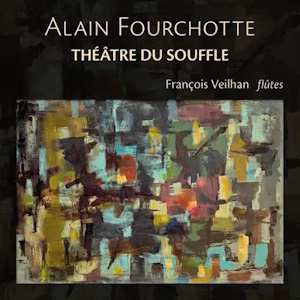
Théâtre du Souffle
Alain Fourchotte (b. 1943)
Songerie (2013)
Concretude (2024)
Aphorismes (1977)
Souffles II (2019)
Double (1981)*
Éole (2018)
François Veilhan (flutes), Élise Partou (flute)*
rec. 2025, Studio de Montreuil
Triton TRIHORT 590 [71]
Ah domage, the documentation for this release est seulement en français. I’m sure we’ll manage somehow, but flute-only recordings are a hard enough sell as it is without translated texts. Potential purchasers are hereby notified that this is a very French production indeed, and my review will be an impression of what I hear without much context.
Songerie for solo flute is written in three movements. It has a both lyrical and formal quality in its first movement, which has a meditative mood, and a melodic charm that breaks its lines into a procession of musical words or short phrases. The central movement widens out into more virtuoso territory, with flutter-tongue and interval leaps and little repetitions that at times suggest birdsong. The third movement takes us back to the atmosphere of the opening, but with echoes of the higher registers reached in the second movement. This is an atonal but attractively expressive piece that would fit in well with any reasonably ambitious recital.
As its title suggests, Concretude adds ‘sons fixés’ to a solo flute that opens with breath sounds and a gently melodic idiom in which we have become grounded by the previous piece. The soundtrack inhabits that musique concrète world in which we can have fun trying to guess where the sounds come from. It peeps and twitches, rumbling at one point like a hungry stomach, making use of the human voice and clustered tones, but allowing the flute space to perform through and in-between its relatively sparing content.
Aphorismes is a set of six pieces for flute, with the second piece for alto flute and the fifth for bass flute. Fourchotte’s expressive kitbag is further extended in this work with some multiphonics, singing through the notes, what sound like alternative fingerings and moments of framed improvisation. The contrast between the concert flute and the lower instruments is a nice one, but Fourchette’s characteristic restraint and refined ear for nuance is more of a transposition than a transformation between instruments. As aphorisms half of these pieces are quite extended at over three minutes each, with the rest just over a minute and the finale just short of two minutes.
Souffles II is written for soundtrack, concert flute and alto flute, opening immediately into a vast and unsettlingly surreal space in which demons breathe hot air at us. Echoing and breathy flute sounds and whistle tones enter the space, but the entrance of the ‘live’ flute doesn’t grow from this texture which to me is a missed opportunity. I am always intrigued to hear how composers integrate live instruments with soundtracks, but this is more a solo + accompaniment scenario. I like the section at around 09.07 where low, rubbery noises create a bed on which the flute can float, but the reedy organ-like tones elsewhere don’t do much for me. Flute finally meets tape towards the end with a reappearance of the breathy sounds from which the soloist can emerge, singing on gently and receding as the demons take over once more in the final section.
Double is a brief flute duet in two movements, with the instruments weaving in and out of each other’s lines and textures at times as if ignoring each other but joining as one just enough to form a strange unit. This is fascinating music with a fine rhetorical quality, and is another piece that could enhance any concert programme.
The disc concludes with Éole for amplified bass flute. Any amplification effect is lost or unnecessary on a recording, but the bass flute has a generally softer sound and less projection than your standard concert flute so this can be effective on stage. At nearly 17 minutes this is a substantial work, but it has plenty of contrast in technique and material to fill its allotted space. As a good representative of Alain Fourchette’s idiom there is that sense of restraint and nuance within an atonal exploration of material and sonics that has its own character. I don’t find his music too complex, and he doesn’t move into virtuosity for its own sake. With excellent performances by François Veilhan, very fine recorded sound and nice 1950s artwork this is a disc worth acquiring, and if you fancy entering the abstract arts on show in the Théâtre du Souffle you may enjoy its welcoming seats and high artistic ceiling.
Dominy Clements
Buying this recording via the link below generates revenue for MWI, which helps the site remain free













