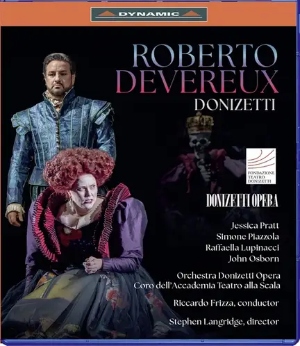
Gaetano Donizetti (1797-1848)
Roberto Devereux, Lyric Tragedy (1837)
Opera in three acts, libretto by Salvadore Cammarano, critical edition by Julia Lockhart.
Elisabetta: Jessica Pratt
Il duca di Nottingham: Simone Piazzola
Sara: Raffaella Lupinacci
Roberto Devereux: John Osborn
Lord Cecil: David Astorga
Coro dell’Accademia Teatro alla Scala, Donizetti Opera Orchestra / Riccardo Frizza
Stephen Langridge (stage direction)
rec. live, 15 November 2024, Donizetti Opera Festival, Teatro Donizetti, Bergamo, Italy
Booklet with notes in English
Dynamic 58076 Blu-ray [132]
This is one of four operas which Donizetti called his Tudori – those based on Tudor history. The others are Anna Bolena (1827), Elisabetta al castello di Kenilworth (1829), and Maria Stuarda (1835). They are not rigorously historically accurate, of course. In Roberto Devereux,Queen Elizabeth abdicates in favour of James VI of Scotland. He did become King of England as James I, but only after Elizabeth’s death.
Devereux has returned after leading the fighting in Ireland, and now is being accused of treason. Queen Elizabeth, who loves him, gives him a ring which can assure pardon if ever his life is in official danger. Devereux gives the ring to his beloved Sara, wife of his friend Nottingham. When the Queen and Nottingham discover this liaison, Devereux is sent to the Tower to await execution. Nottingham detains his wife at home, and so delays her in taking the ring to prevent Devereux’s beheading. Sara arrives with the ring just as a cannon shot has announced that the execution has been carried out. The Queen, distraught at this outcome, has Nottingham and Sara arrested, and has a vision of the dead Devereux. She announces her abdication and her imminent death.
This impressive production opened the Donizetti Festival in 2024 in Bergamo, the composer’s birthplace, at the theatre that bears his name. In Stephen Langridge’s production, the characters are well delineated, especially when they interact. Set and costume designer Katie Davenport has almost the entire set in black, framed by a broad and bright neon rectangle. (That sometimes obscure the surtitles when they run across the bottom of the rectangle.) There are bright-red objects, such as a chair/throne and Sara’s bed. A table just outside the frame and to one side is laden with symbolic items: books, flowers, quills, candles, an hour-glass and a skull. The latter two are also seen on the floor, memento mori as time runs out for Roberto and the two noblewomen.
Costumes are Tudor-style, with ruffs for the chorus who are often seen from the ruff up in court galleries that run across the black back wall about halfway up. Female dresses have elements of colour. Elisabetta’s gown features a print of those still-life objects, the skull prominent among them. Wearing that same gown is the figure of death – a skeleton, operated by two puppeteers – which taunts Elisabetta, dancing with a younger double of Roberto.
The cast is very good. Roberto Devereux is the title role, but the chief protagonist is Elisabetta, sung here by bel canto specialist Jessica Pratt. Her soprano is on the lighter side. In the booklet interview, conductor Riccardo Frizza references Edita Gruberova and Mariella Devia as his reference types for the Queen’s vocal style. Pratt’s agility and accuracy above the stave are on the level needed for the role. She sings her climactic closing scene wonderfully.
In the title role, John Osborn is effective vocally and histrionically. His tenor sounds in good shape, and is touching in the prison scene. As his erstwhile friend Nottingham, Simone Piazzola makes a sonorous Duke of Nottingham. As Nottingham’s wife Sara, whom this production shows as pregnant, Raffaella Lupinacci is very effective, not least in the duet with Roberto which closes Act I. The comprimario roles – Lord Cecil, Walter Raleigh – are well cast too.
Music director Riccardo Frizza chose Julia Lockhart’s recent critical edition of the score based on the 1837 premiere in Naples. There is no overture: Donizetti added one for Paris a year later. Frizza’s tempi keep things moving but with sufficient flexibility to give time for truly expressive bel canto singing. The Donizetti Opera Orchestra played well for him, with good dynamic range but never of a volume that covered the vocalists. The Coro dell’Accademia Teatro alla Scala sing – and act – very well. The booklet in English has a synopsis and a detailed track list. There also are two very instructive interviews, with the conductor Riccardo Frizza, and with stage director Stephen Langridge. The Blu-ray disc is expertly filmed and edited. There are no extras, but then none are needed on such a successful portrayal of this fine production of one of the strongest of all Donizetti’s operas.
Roy Westbrook
Other cast and production members
Sir Gualtiero Raleigh: Ignas Melnikas (Student of the Bottega Donizetti)
Un famigliare di Nottingham e Un Cavaliere: Fulvio Valenti
Chorus master: Salvo Sgrò
Set and Costume Designer: Katie Davenport
Lighting Designer: Peter Mumford
Puppet Animation Director: Poppy Franziska
Technical details
Picture format: 1080i High Definition.
Sound format: PCM Stereo/DTS-HD Master Audio5.1
Region code: 0 (worldwide)
Subtitles: Italian, English, French, German, Korean, Japanese
Buying this recording via the link below generates revenue for MWI, which helps the site remain free