
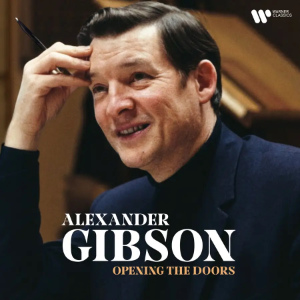
Sir Alexander Gibson (conductor)
Opening the Doors
rec. 1966-1982, various locations
Texts and translations not provided
Available for streaming and/or download only
Warner 2685463415 [434]
Scottish conductor Sir Alexander Gibson was born in 1926 and to celebrate his centenary Warner has released for streaming and downloading “Opening the Doors”, a selection of records made for HMV/EMI. Gibson is fully deserving of this little title. He was appointed to the post of principal conductor of the Scottish National Orchestra at the age of thirty-two years in 1959 and went on to form Scottish Opera three years later. However, the album title also pays tribute to his wider achievements. As Warner say in their blurb, he was more than a conductor, he was a cultural architect, breaking down established institutional barriers to classical music and opening the doors to a new audience, especially in his native Scotland.
The set consists of reissues of some much-loved material from his time in Scotland (and elsewhere) deriving from recordings dating from 1966 to 1982. I was pleased to see a wide selection of repertory selected for the box which happily includes a fair amount of opera, as well as standard orchestral material. Although they are not available as a physical product, there is about seven CDs-worth of music in total. Many collectors and concertgoers with longer memories and wider concert experience than I may well associate Gibson with the music of Sibelius. Warner includes just thirty minutes of music from the Finnish composer, most of which is from the jolly incidental score for King Christian II; it is a shame we could not have had more, as Gibson recorded Sibelius throughout his recording career from the famous LSO Fifth made with Kenneth Wilkinson for RCA in 1959 to the symphonies 1 and 2 for Collins Classics thirty years later in 1989. The Chandos cycle dating from the early 1980s was a highlight. EMI do have some Sibelius symphonies in their archive (1,2 and 5 dating from the early 1970s) but one must remember that in those days they also had the Hallé/Barbirolli records in the catalogue. Making records in those days was expensive and a rare privilege. All things considered, I think Warner have chosen a splendid selection of records which I hope will encourage listeners to dig deeper into this fine legacy of recorded music.
The first part of the set includes colourful, descriptive music from Bizet, Britten, Ravel and the aforementioned Sibelius. Most of the selections are light in nature. The Sibelius record was actually made in London just after a Prom date in 1966 which included Mahler’s Das Lied von der Erde (of which more later). Bizet’s Petite Suite was named as “Children’s Games” on the original issue Classics for Pleasure LP. These five movements orchestrated from Jeux d’enfants are sweetly shaped, with lovely phrasing for the strings at “Petit mari, petite femme”. As representative of an early digital Britten LP from 1983, we have the delightful early Soirées musicales with music based on Rossini. The Bizet that kicks off the programme was coupled with Ravel’s suite for Mother Goose and on the other side of the record: Saint-Saëns’ Carnival of the Animals, in a dashing performance made with pianists Peter Katin and Philip Fowke. We get all these pieces included in the first course of this bumper menu.
Gibson’s early opera seasons in Scotland were short, just April to June. His vision was grand, however, and from the very first, Pelléas et Mélisande, his productions and casts make mouth-watering reading. His Ring was constructed over five years, culminating in 1971. David Ward was Wotan and Anita Välkki sang the first Brünnhildes. 1967 saw a famous Così fan tutte with Janet Baker in the cast and in 1969 it seemed that the whole world had come to Glasgow to see the first complete performance of Berlioz’s The Trojans. Henze would come to conduct his own Elegy for Young Lovers in 1970, and Gibson himself did a lot more Wagner in the seventies too including Tristan und Isolde, Die Meistersinger and Der fliegende Holländer. Wozzeck was first given in 1980. What a shame there is no Wagner in the box. We do have some very nice mementos, all the same.
There is included a 35-minute selection from Lehar’s The Merry Widow sung in English in the translation by Christopher Hassall. We don’t get all the scenes included on the LP, but what we have is adorable. Catherine Wilson is Hanna and Jonny Blanc sings Danilo. After being introduced to him and hearing the finale to Act 1, we get the full introduction, dance and Vilja song (great sonics), followed by “jogging in a one-horse gig” with Wilson’s lovely “Gee up Lassie!”. I was humming that the whole afternoon thereafter. The grisettes of Paris with their “‘Allo ‘Allo” accents are just brilliant. What a lovely souvenir of a clearly special work for Gibson. The record of highlights to Don Giovanni is illustrated purely by side 1 of that disc. I enjoyed the stylish and very musical Leporello of Stafford Dean very much. The excerpts we hear from Verdi’s Un ballo in maschera are not as satisfying. Like the Mozart opera, this same cast performed on stage a few months before the recording. On these excerpts however we hear nothing of tenor Charles Craig. I was puzzled too with the cut of the recitative “Ecco l’orrido campo” before the aria “Ma dall’arido stelo divulsa”. After hearing the wonderful prelude to the scene, it feels odd to jump straight to the aria, which is sung convincingly well nevertheless by Cristina Deutekom with genuine squillo della voce. I was less enamoured with the Renato of Jan Derksen.
Nice as it is to have these excerpts, the final two are on a different level. One is highly recommended, the other, absolutely essential listening. When Gibson unveiled his truly complete Rosenkavalier in May 1971 it was another auspicious triumph for the company. With curtain-up at 7pm and fond farewells at a quarter-to-midnight it was a long evening but by all accounts, very special. The revival a few years later saw Helga Dernesch return as the Marschallin. Janet Baker was replaced as Octavian by the lovely Anne Howells and Teresa Cahill sang a beautiful Sophie. The great bass Michael Langdon was Ochs. Like the other highlights excerpted here, we only get part of the original LP but enough to feel the quality. Gibson’s prelude is steadier and perhaps more measured than you may be used to, leading to a lush first scene between the elegant Dernesch and the youthful sounding Howells. We hear “Di rigori” surprisingly (a bit too intense for me, to be honest; a little more temperance perhaps might be preferable first thing-of-a-morning, with one’s hot chocolate) but sadly the monologue “Da geht er hin” is not included. A clash of cymbals brings us to the Presentation of the Silver Rose. Cahill, as I hinted before, sounds gorgeous. The final scene of Act 2 with Ochs begins at Annina’s “Herr Kavalier!”. Michael Langdon is stupendous in this role, from his very first “Sie wart’ auf Antwort“, his voice captivates me. I cannot praise his portrayal enough and we are so glad to have this little studio-made vignette. The final trio which was on the LP is omitted here in the box, alas.
Janet Baker’s Dido in both the Purcell and Berlioz settings is legendary. After a summer singing The Trojans on stage in Scotland (in English) she made the last great scene in the studio with the LSO and Gibson, in French. For me this LP released in 1970 as ASD 2516 and re-issued many times since is truly classic. Occupying side 1, the scene begins at dawn in Dido’s palace. Aeneas has fled. The greatest of all the British singers, breaks our hearts, as in her role as the Queen of Carthage, she implores Anna and Narbal to go and beg him for just a few days more. Her “Adieu, fière cite” so moving and who could still have dry eyes as she throws her veil onto the pyre “D’un malheureux amour, funestes gages”. Old hands will please forgive the gushing sentiments this old record brings out in me, those who don’t know it need to prioritise as a matter of urgency. Life is too short! The great final scene of what has always been and always will be the most treasured opera for me, ends in the full war-cry/curse of the North Africans. Magnificent. (See Ralph Moore’s survey for similar praise of those excerpts.)
Although perhaps not quite in the same league as Les Troyens, what we have next is yet another famous LP and kudos here to Warner – we get it in its entirety. ASD 2400 had a title: Music of the Four Countries. In my last couple of years teaching secondary school Mathematics, I was asked to help out and teach a few hours of GCSE Geography to a year 11 and was surprised at how few of my students knew the fundamental differences between, say, England, Great Britain and the United Kingdom. Perhaps this box set may have helped. Recorded in the Usher Hall, Edinburgh in April 1968, England, Ireland, Scotland and Wales are represented respectively by Smyth, Harty, MacCunn and German. This has always been a popular record and was an early issue on mid-price CD, too. The performances are ideal. My favourite is the wonderful Harty piece that Romantically portrays those fallen Irish soldiers, the “Wild Geese” who rise again at nighttime from their French battleground graves and sail homebound again to their beloved Ireland. It was lovely to hear the four pieces again and the fact they are dispersed across the program matters not a whit.
The set includes a reminder of that Beethoven Piano Concerto cycle Gibson and the SNO made with John Lill. We also get Gibson and his Scottish National Orchestra in the very obvious matching of artists and repertory that is Mendelssohn’s Scottish symphony. There are no prizes for guessing the coupling on the original issue. This is a very nicely realised account. I like the cello countermelody at 8:26 before the recapitulation in the first movement. Gibson brings the woodwind out well, too. No first movement repeat obviously in those days. Scurrying strings and bucolic woodwind characterise the snap rhythms of the second movement. The adagio is beautifully rendered. If I am being completely honest, I would rather Warner had chosen a symphony by Tchaikovsky or Dvořák, though. Like Barbirolli, of whom I am often reminded when listening to much of this set, Gibson is better experienced perhaps in the music of the 1870s and 1880s than in the middle of the nineteenth century.
The Vaughan Williams Fith Symphony that Gibson made in London with the Royal Philharmonic is a curious choice for inclusion. This is an early digital recording but fear not, the sound is remarkably fine. It is a little saggy, though, and for me there are far too many versions in the work’s discography that offer more than this one. I am much happier with Warner’s final choice for inclusion: Mahler’s Das Lied von der Erde, produced and engineered in Glasgow’s City Halls by John Boyden in 1974. It features the mezzo of Alfreda Hodgson aged thirty-four at the time and the Lancashire tenor John Mitchinson, a little older but still only in his early forties. This is a majestic account of the great Mahler work. Gibson gets the absolute best from his players and is fully committed to the piece. Hodgson who had sung Mahler for Klemperer and just recently had sung this very work for Horenstein is in glorious form. Mitchinson is superb, too. He was about to begin the ripest period of his career singing parts such as Idomeneo, Florestan, Grimes and finally Tristan. Here, he is at his very best, I think. There are very few accounts of Das Lied von der Erde made in the last twenty-five years that can touch this. (Again, see Ralph Moore’s survey of this work, which agrees.)
All things considered, then, this is a very nicely curated project. Yes, we could all hanker after a favourite recording that Warner missed out. I would have loved to have had something from that Berlioz overtures LP made at Kingsway Hall with the LSO on New Year’s Eve/Day 1970 (has that set ever had a CD transfer?). The Gibson discography also lists an unpublished Chopin record made with the Spanish pianist Rafael Orozco in 1969 (you must also hear his Rachmaninov, by the way). A booklet in pdf form, even if just listing works and dates would have been lovely, too. That said, I am very satisfied with what we do have and sincerely hope the release brings the name of Sir Alexander Gibson before a younger generation of music lovers. He deserves that.
In listening to these records again I was curious to hear some other older records Gibson made before he embarked on his Scottish mission. He was of course Music Director at Sadler’s Wells for a brief spell in the late fifties and conducted a large amount at Covent Garden in that period, too. I decided to treat myself to a few titles from the HDTT catalogue and to investigate too a very famous (non-HMV) record he made in that period that has still yet to receive a CD transfer from a major label. Look out for a multi-review of those titles which will be posted in due time.
Philip Harrison
Buying this recording via the link below generates revenue for MWI, which helps the site remain free
Contents
Bizet: Petite suite des “Jeux d’enfants”, Op. 22, WD 39
Scottish National Orchestra/Sir Alexander Gibson
Britten: Soirées musicales (after Rossini), Op. 9
English Chamber Orchestra/Sir Alexander Gibson
Sibelius: King Christian II Suite, Op. 27
Sibelius: Karelia Overture, Op. 10
Ravel: Ma Mère l’Oye
Scottish National Orchestra/Sir Alexander Gibson
Mozart: Don Giovanni, K. 527 – highlights
Don Garrard (bass),
John Shirley-Quirk (baritone),
Rachel Mathes (soprano),
Stafford Dean (bass),
Ann Murray (mezzo-soprano),
Scottish Chamber Orchestra/Sir Alexander Gibson
Saint-Saëns: Le carnaval des animaux
Peter Katin (piano), Philip Fowke (piano), Adrian Shepherd (cello)
Scottish National Orchestra/Sir Alexander Gibson
Lehár: The Merry Widow – highlights
Jonny Blanc (tenor),
Catherine Wilson (soprano),
David Fieldsend (tenor),
David Hillman (tenor),
Gordon Sandison (baritone),
Patricia Hay (soprano),
Scottish Philharmonia/Sir Alexander Gibson
Smyth: The Wreckers – Overture
Mendelssohn: Symphony No. 3 in A minor, Op. 56 ‘Scottish’
Scottish National Orchestra/Sir Alexander Gibson
Verdi: Un ballo in Maschera – highlights
Cristina Deutekom (soprano),
Jan Derksen (baritone),
Patricia Hay (soprano),
Pieter van den Berg (bass),
William McCue (bass),
Scottish National Orchestra/Sir Alexander Gibson
German: Welsh Rhapsody
Scottish National Orchestra/Sir Alexander Gibson
Vaughan Williams: Symphony No. 5 in D major
Royal Philharmonic Orchestra/Sir Alexander Gibson
MacCunn: The Land of the Mountain and the Flood, Op. 3
Scottish National Orchestra/Sir Alexander Gibson
Strauss, R: Der Rosenkavalier, Op. 59 – highlights
Helga Dernesch (soprano),
Anne Howells (mezzo-soprano),
Teresa Cahill (soprano),
Michael Langdon (bass),
Derek Blackwell (tenor),
Claire Livingstone (mezzo-soprano),
Scottish National Orchestra/Sir Alexander Gibson
Berlioz: Les Troyens, H 133, Act 5 scenes 2 and 3
Bernadette Greevy (contralto),
Gwynne Howell (bass),
Dame Janet Baker (mezzo-soprano),
Keith Erwen (tenor)
Ambrosian Singers, London Symphony Orchestra/Sir Alexander Gibson
Beethoven: Fantasia for Piano, Chorus and Orchestra in C minor, Op. 80
John Lill (piano)
Scottish National Chorus and Orchestra/Sir Alexander Gibson
Mahler: Das Lied von der Erde
John Mitchinson (tenor),
Alfreda Hodgson (contralto),
Scottish National Orchestra/Sir Alexander Gibson
Harty: With the Wild Geese
Scottish National Orchestra/Sir Alexander Gibson














This review evokes quite a few memories. During my Edinburgh years (1971-5) I heard both Rosenkavalier and The Merry Widow under Gibson. I don’t remember who the singers were in the Strauss but I think not Dernesch. The original cast of the Lehar had Elizabeth Harwood as Hanna, with Catherine Wilson joining later in the run. Harwood was gorgeous (not that Wilson was not good too), but she had just recorded the role under Karajan so there was no chance she could repeat it under Gibson. What a pity none of these operas were recorded complete but, given that they weren’t, it seems even more of a pity that Warner has truncated them still further.
Likewise, in these days of massive “complete” boxes, I have to say I can’t be quite so content with what we have as Philip. I imprinted on Gibson’s CFP versions of Sibelius 2 & 5 (plus hearing him live in the former) and, since I burnt them to CDR years ago I suppose I could say “I’m all right Jack”, but it would be nice to think others could hear them too. I hope, too, that Warner has not forgotten that it has ownership of the World Record Club catalogue, for which Gibson did a Dvorak 9 and a fuller-than-usual Peer Gynt selection.
Another thought is that Gibson’s later records were mainly made by (or later issued by) Chandos, so a similar tribute from them would be welcome.
However, I have to say that no Gibson record that I have heard quite matches the best he could do, on a good day (alas, there were bad days) live. A certain amount of material circulates here and there, though careful selection is needed.
Lastly, from my own memories, I don’t entirely agree with Philip that Gibson is best experienced in the later romantics, though he certainly did them well. He was a very fine Mozartian (I remember in particular a concert in which he conducted Mozart 34, the Robin Orr Symphony in One Movement and Tchaikovsky 5) and was intermittently impressive in Beethoven. I recall an excellent first (not surprising from a fine Mozartian), a highly impressive Eroica, but also an unexceptional 5th, a bland 6th, an exciting if scrappy 7th and an over-speedy 9th