
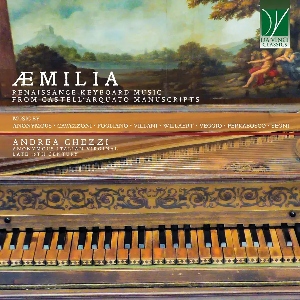
Æmilia – Renaissance keyboard music from Castell’Arquato manuscripts
Andrea Chezzi (virginal)
rec. 2024, Marco Brighenti’s workshop, Parma, Italy
Reviewed as a download
Da Vinci Classics C01118 [62]
In the course of time numerous pieces have been written for keyboard instruments, from the smallest (medieval organetto and clavecyterium) and softest (clavichord) to the largest and loudest (organ). Much of this music has been published, but probably an even larger part has been preserved in manuscript, and that goes especially for the music of the Renaissance period. Some are very well-known, such as the Buxheimer Orgelbuch, others less so, and that probably goes for the Castell’Arquato manuscripts, which are the subject of the present disc. They are part of the archive of the Chiesa Collegiata di Castell’Arquato (Piacenza), in Emilia.
The collection consists of pieces from the 16th and early 17th centuries, created by different copyists. They can be divided into four categories: liturgical works, ricercares, transcriptions of vocal works and dances. Obviously, pieces of the first category have been excluded in this recording, as they were intended for the organ. Andrea Chezzi decided to play the virginals, and selected specimens from the three other categories.
The ricercar(e) (or ricercada) was one of the most common genres, mostly for keyboard or for plucked instruments. Although some authors of the time came with a definition of the ricercare, Chezzi, in his liner-notes, states that “[these] are pieces whose formal structure is rather open, diverging from excessively strict vocal models in the direction of a writing already bound to the keyboard instrument.” The ricercares can include various techniques, including homophony and diminutions.
Whereas many pieces, and especially the dances, are anonymous, the composers of the ricercares – at least those included here – are known. Marco Antonio Cavazzoni was from Bologna and was considered one of the greatest keyboard players of his time. He worked in several places, among them Rome and Venice. His (small) number of extant works has been recorded complete by Glen Wilson (Naxos, 2017).
Jacopo (or Giacomo) da Fogliano was also a keyboard player by profession. He was from Modena, where he worked all his life. The main part of his output consists of frottolas and madrigals. Four ricercares are all that he has left in the field of keyboard music. Giulio (or Julio) Segno, also born in Modena, was a pupil of his. In his oeuvre ricercares for instrumental ensemble, keyboard or lute take the main place. Giuseppe Vilani is an entirely unknown quantity. He has no entry in New Grove, a search on the internet was to no avail, and the liner-notes don’t offer any information about the composers. Claudio Maria Veggio was from Piacenza and was another keyboard player; he may have been active as organist at Castell’Arquato. His oeuvre consists of one sacred work, a book of madrigals, eight ricercares and some keyboard transcriptions.
One of the latter is La fugitiva, a transcription of a now unknown ensemble canzona in four parts, to which Veggio added a fifth part. It is a specimen of the second category in this recording. The originals of transcriptions could be either secular or sacred. The latter may be intended for organ in the first place. Whether O gloriosa Domina by Adrian Willaert is such a piece, is impossible to say, as I don’t have access to the score. It depends on the character of the original as well as that of the transcription. Chezzi points out that in this case the transcriber has taken quite some liberties, and that may explain why it works well on the virginals. The transcription of Domenico Maria Ferrabosco’s madrigal Io mi son giovinetta is much closer to the original.
Dances are defined by their rhythmic structure. They could be played by any instrument or combination of instruments. When played by an instrumental ensemble, they may have been used for dancing, but dances for keyboard were intended for entertainment. Chezzi states that they were probably played during marriage festivities. The titles may refer to the place of origin or a musician who performed a piece. Il Milaneso and Al Milanese refer to Milan, Il Cramoneso and Il Carmoneso may refer to Cremona. Some dances are likely transcriptions of popular songs or tunes.
Two of the dances need to be specified. One concerns a genre, that of pavana, saltarello and ripresa (or coda). The pavana is a solemn dance in a modest tempo, the saltarello is more vivid, and the last of the three is a kind of Kehraus. The combination of pavana and saltarello could be compared with the pavan and galliard pair, known from the English Renaissance. The difference is that the latter were formally separated, whereas the three in these manuscripts follow each other attacca.
One of the dances is a battle piece – another popular genre in the 16th and 17th centuries. Pavana de la bataglia – Il saltarello de la bataglia – La tedeschina is inspired by a famous chanson by Clément Janequin, La Guerre or La Bataille de Marignan, which is a description of a battle of Marignano, southeast of Milan, in 1515. Janequin’s piece may have been known via a lute transcription of Francesco da Milano. The last section consists nearly entirely of repeated notes.
What the dances have in common is that the melodic material is in the right hand, whereas the left hand mainly plays an accompaniment, consisting of chords. They are often homophonic and may include percussive effects.
For the latter, the virginals are the perfect instrument. The programme was partly inspired by Chezzi’s wish to play a historical instrument. The rectangular virginal he plays here is anonymous, but attributed to Vido Trasuntino, who is also known to have built an archicembalo (with extra keys so that all scale degrees could be performed accurately in tune). Although several parts of this instrument are not original, the soundboard, its essential part, is ‘authentic’, and this allows us to gain a good impression of how this music may have sounded at the time it was written. Often, this repertoire is played on the harpsichord, and the use of a virginal makes this disc an interesting alternative to existing recordings. Andrea Chezzi is the perfect guide through the repertoire, which he plays with great care and understanding. The performances of the ricercares and the pavanas have the depth they require; in the dances, he lets loose and shows a good sense of rhythm. He explores the features of the virginal very satisfyingly.
In short, this is a delightful and compelling demonstration of an interesting historical instrument and repertoire that fits it like a glove.
Johan van Veen
www.musica-dei-donum.org
twitter.com/johanvanveen
Contents
Marco Antonio Cavazzoni (c1475-after 1570)
R[i]cercada de Ma[r]ca[ntonio] in Bologna
anon
Pavana – Saltarello de la pavana – La coda
R[icerca]da
Pavana – Saltarello de la pavana – La coda
Jacopo da Fogliano (1468-1548)
R[i]cerchare de Jacobo Fogliano
R[i]cerchare di Jacobo Fogliano de Modena
anon
Pavana – Saltarello de la pavana – R[i]prese
La Delfina
Gazollo
Il Puliselo
La Moretta
Il Cramoneso
Zorzo
Giuseppe Villani (c1519-after 1591) (attr)
Ricercada Vil
anon
O gloriosa D[omi]na (Adrian Willaert)
Claudio Maria Veggio (c1505-bef. 1557)
La fugitiva Claudius a 4
anon
Il Carmoneso
Pavana de la bataglia – Il saltarello de la bataglia – La tedeschina
Jacopo da Fogliano
R[i]cercare di Jacobo Fogliano de Modena
anon
Io mi son giovineta (Domenico MariA Ferrabosco)
anon
R[icerca]da
Pavana in su la chiave di b fa be mi – Saltarello de la Pavana – Ripresa
Il Caselle
Il Milaneso
Ciel turchin
La pose borela
Claudio Maria Veggio
Recercada per b mollo del primo tono
anon
Pavana – Saltarello de la pavana – La coda
Zorzo
Non ti partir da me
Al Milanese
Liciolo
Giulio Segni (1498-1561)
R[i]cerchare di Julio da Modena p[er] musica fi[c]ta
Buying this recording via the link below generates revenue for MWI, which helps the site remain free













