
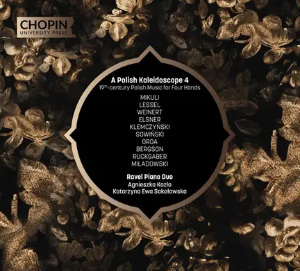
A Polish Kaleidoscope 4
19th Century Polish Music for Four Hands
Ravel Piano Duo
rec. 2024
Chopin University Press UMFCCD238 [69]
I am late to the party here having missed the first three volumes of this series exploring Polish piano duet repertoire (Dux 1174 review, Dux 1422, Dux 1590). The repertoire so far has included composers from the 18th to the 20th centuries with some familiar names along the way, Witold Lutosławski, Henryk Górecki, Ignaz Friedman, Moriz Moszkowski and Stanisław Moniuszko amongst them. In this volume, and with a move from DUX to the Chopin University Press they turn their attention to composers who have mostly been relegated to history books or are mentioned in relation to more famous colleagues and pupils. Józef Elsner for example will forever be known as Chopin’s composition teacher and Karol Mikuli as Chopin’s pupil though his output is appearing now and again on CD. As to the remainder they include a pupils of Haydn, Hummel and Czerny, émigré artist friends of Chopin and, for all their names have faded from view, musicians who helped forge the musical identity of Poland in the 19th century.
The earliest of the composers here is Antoni Weinert who was born in Frýdlant just a few miles outside of Poland. He settled in Warsaw 1774, the year after he took a position at the estate of Prince Antoni Lubomirski and established himself there, working with the Augustinian Church and giving concerts as a flautist. After a period spent in Rogalin where he led the court orchestra he returned to Warsaw and lived out his life there as a composer, teacher and performer. His undated sonata in g minor is in two movements, lacking an opening movement either through intent or loss. The adagio is a sad little sicilienne with a brighter trio and it is coupled with a chirpy Mozartian rondo. Józef Elsner was born in what was then Prussia and seems to have travelled widely. He was active in Wrocław, Brno, Lviv and Warsaw and was principal conductor at the National Theatre for the very nearly the first quarter of the 19th century as well as teaching at the Warsaw Lyceum. His most famous student is Chopin but he also taught Ignacy Feliks Dobrzyński who is beginning to receive some attention and possibly Maria Szymanowska. He was a prolific composer with nearly twenty operas to his name as well as a huge number of scared choral works. Amongst his chamber works is this sonata which joins Weinert’s as perhaps the earliest examples in Poland of duet sonatas. Again Mozart is an influence, especially in the opening allegro though there are hints of Schubert in the andante. The finale is arondo alla Polacca which became such a popular form in the piano salons of Paris in the early 19th century though the demands here are relatively modest and it would have suited the amateur market very well.
Franciszek Lessel was a pupil of Joseph Haydn for the last decade of Haydn’s life and went on to head Warsaw’s Amateur Music Society and teach glass harmonica. The Adagio and Fugue is a rather dramatic piece combining a grandly elegiac adagio introduction with a spirited four part fugue. Despite the drama Lessel brings the piece to a tranquil close in the major key. Born just within the 18th century is Jan Ruckgaber who studied in Vienna with Johann Nepomuk Hummel, later settling in Lviv where he shaped music education partly with the formation in Vienna of the Gallacian Music Society working alongside Franz Xaver Mozart and partly through opening the first music school in Lviv. His Souvenir de Skée is a rather attractive if lightweight lilting waltz. Though undated its style suggests the latter half of the century. It is introduced by two more waltzes, the Grande Valse by Napoleon Orda and Jenny by Michał Bergson. Orda was a sculptor and painter as well as a musician and in his travels he rubbed shoulders with many famous names; Chopin, who also gave him lessons, Liszt, Rossini, Verdi, Gounod as well as a host of poets and artists. He played four hand piano with Adam Mickiewicz’s wife, Cecylia, the daughter of Maria Szymanowska; perhaps they enjoyed playing this sequence of waltz melodies. Like Elsner Bergson travelled widely, studying in Warsaw, Dessau and Berlin with Wilhelm Taubert amongst his tutors. He spent time in Paris where he may have had lessons with Chopin. Moving onwards to Vienna, Leipzig and Hamburg he eventually became a professor in Geneva. His Tyrolean waltz Jenny is energetic and graceful in its brief span with more virtuosic writing than in its companions. Staying with the dance theme we have the Mazurka en forme de rondoletto by Julian Klemczyński, a rather revolutionary figure in Poland; he studied law in Warsaw but was expelled from the university for seditious goings on after which he was involved in the November Uprising. He soon moved to Paris and joined the ranks of those many pianists producing reams of fantasies and other salon music, rather successfully one might add as at least twenty publishers issued his works, Heugel, Ricordi and Schott amongst them. The mazurka is a vigorous concert piece far removed from Chopin’s more intimate dances.
Wojciech Albert Sowiński was another Pole who lived in Paris except for a period studying in Italy. He was a pupil of Czerny…or perhaps Hummel; the booklet is uncertain and indeed biographical information is thin on the ground though we know he spread the good word with his dictionary of Polish musicians; in it he describes himself as a musician of the Polish people who digs up old national songs from oblivion. In his brilliant variations on a favourite Italian air he does decorating rather than rescuing, writing five variations and a finale that are highly entertaining and dazzling if fairly lightweight, just the kind of stuff that Parisian soirées would have loved.
The book-ends of this recital are Karol Mikuli’s Méditation and a sonata by another forgotten name,
Florian Miładowski. Several of Karol Mikuli’s works have at least appeared on CD recently though this duet work appears for the first time. His pedigree is good, having studied piano under Chopin and composition under Anton Reicha and he went on to teach giants like Moritz Rosenthal and Alexander Michałowski while composing and editing Chopin’s complete works. The Méditation is a mournful and elegiac though lovely song without words with a flowing accompaniment. Far more unfamiliar is Florian Miładowski who studied alongside Stanisław Moniuszko and in later years studied under him. In Vienna he studied piano with Joseph Fischof before settling for a while in Vilnius where he founded the Society of Saint Cecilia to promote church music. He lived in France from 1862 until his death in Metz in 1889, a time in his life that is mostly undocumented. His Sonata is a lively and frankly joyous piece. The opening allegro is a lilting triple time movement with no pretensions, a wee bit Mendelssohnian as is the energetic scherzo with its attractive treble writing in the middle section. The buoyant finale – no slow movement here – is a real toe-tapper and highly virtuosic as is the rest of this utterly delightful piece. Very little of his music seems to be available but there is a four hand polonaise that I hope will find its way onto a future issue.
This is a lovely disc. Pianists Agnieszka Kazło and Katarzyna Ewa Sokołowska play with real affection and enthusiasm. There is plenty of variety of mood and style and it is a pleasure to have a chance to hear some enjoyable music that would otherwise lie forgotten. Presentation is first class and the booklet notes by Michał Bruliński are wonderfully comprehensive. I hope that this series will continue and blow the dust off some more worthy music.
Rob Challinor
Buying this recording via the link below generates revenue for MWI, which helps the site remain free

Contents
Karol Mikuli (1819-1897)
Méditation Op.14
Franciszek Lessel (1780-1838)
Adagio and Fugue Op.11 (publ.1812)
Antoni Weinert (1751-1850)
Sonata in G Minor
Józef Elsner (1769-1854)
Sonata in B Flat Major Op.16 (1805)
Julian Klemczyński (1807-1851)
Mazurka en forme de rondoletto Op.11
Wojciech Albert Sowiński (1805-1880)
Variations brilliante sur un air favori italien Op.12
Napoleon Orda (1807-1883)
Grande valse (1838)
Michał Bergson (1820-1898)
Jenny – Valse Tyrolienne
Jan Ruckgaber (1799-1876)
Souvenir de Skée. Pensée fugitive Op.76
Florian Miładowski (1819-1889)
Sonata in E Flat Major













