
Gustav Mahler (1860-1911)
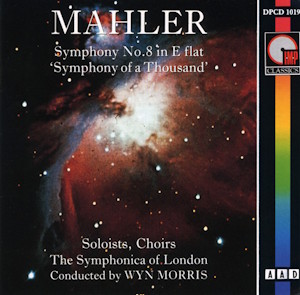
Symphony No. 8 in E-flat major (1906-07)
Joyce Baker, Elisabeth Simon, Norma Burrowes (sopranos), Joyce Blackham, Alfreda Hodgson (contraltos), John Mitchinson (tenor), Raymond Myer (baritone), Gwynne Howell (bass)
New Philharmonia Chorus, Bruckner-Mahler Choir of London, Ambrosian Singers, Orpington Junior Singers, Highgate School Choir, Finchley Children’s Music Group
Symphonica of London/Wyn Morris
rec. 1972, Walthamstow Assembly Hall, London
IMP Classics DPCD1019 [2 CDs: 93]
For the background to this recording, I refer you to the 2016 review of the HDTT BD-A issue by my colleague John Quinn. He liked it but with some reservations regarding the broadness of tempo in the opening of Part II; I was drawn to it by my liking for Morris’ recording of the Tenth Symphony, made around the same time and in the same venue (review).
The opening could hardly be more arresting: the organ blast and choral attack are splendid; the orchestra and massed choirs exude confidence in music for which we must sometimes be satisfied with the conductor acting as a “traffic cop”, co-ordinating the forces without collision rather than actually imposing any artistic vision. The sopranos led by the under-rated and sadly short-lived South African soprano Joyce Barker*, are immediately excellent, and the distinctive voices of tenor John Mitchinson and bass Gwynne Howell also come through clearly. Later, the richness of the two contraltos is much in evidence, too. The recording quality matches the excellence of the performance: the immediacy of the pizzicato plunks and brass flourishes is vivid. Furthermore, the sheer elan of some of the choral singing is breath-taking; they are on the edge of shouting without being in the least unmusical; it is simply thrilling. I have long been a devotee of Solti’s more famous recording released at the same time and featuring a starrier cast, but this is just as compelling.
Morris had something of a reputation for being the Welsh Celibidache, if I may put it that way; his tempi were often stretched to the point of being controversial, and there are incidences of that expansiveness here – but none, I think, which are aesthetically unjustified or unsuccessful. His singers – both soloists and choirs – must have been challenged by the deliberateness of his direction but they rose to the occasion and it pays dividends; I have never heard a grander, more imposing account. The preparatory live performances in the Royal Albert Hall evidently helped enormously.
The opening to Part II is indeed leisurely but it sets a suitably mystical, time-suspended ambiance. I am not troubled by its slow pace and the beauty of the orchestral playing keeps the ear engaged. Baritone Raymond Myer’s name does not crop up anywhere else in discographies or programmes I can find but he is very acceptable; even better is the steely voiced Welsh bass Gwynne Howell in prime youthful voice, aged only 34. Mitchinson is not in sweetest voice but he sings strongly and expressively; indeed, he sang the part quite a few times and is well inside it. The peroration of the movement, beginning with the choir gravely intoning “Alles Vergängliche” is stately and magnificent, and the repetition of text achieves new grandeur as the members of the massed choir sing their hearts out. This has the electricity of a live performance with none of the attendant flaws or distractions.
This recording is no longer commercially available, but very reasonably priced copies may be found on eBay and other outlets.
Ralph Moore
*The early 90’s were exceptionally blighted by the premature deaths of celebrated women singers: in 1992-3, in addition to Joyce Barker we lost Lucia Popp, Arleen Auger, Tatiana Troyanos and Alfreda Hodgson – all great singers.
Availability
Not available new; published as part of Ralph’s ongoing Mahler review series.













