
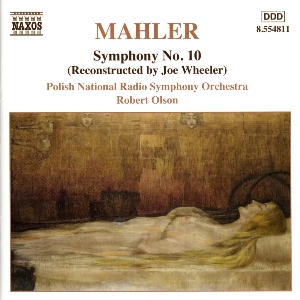
Gustav Mahler (1860-1911)
Symphony No.10 (reconstructed by Joe Wheeler) (1910-11)
Polish National Radio Symphony Orchestra/Robert Olson
rec. 2000, Grzegorz Fitelberg Concert Hall, Katowice, Poland
Naxos 8.554811 [79]
Tony Duggan reviewed this in 2002 and despite a few reservations regarding the spareness of Wheeler’s orchestration found it infinitely preferable to what he viewed as the overworked Carpenter completion. This is, in fact, the least interventionist of the various orchestrations, leaner even than the most widely praised edition by Deryck Cooke. Having said that, in some discussion on the MusicWeb Message Board in 2024 I remarked, “I listened again to the Wheeler version and enjoyed it but found myself increasingly unconvinced as it progressed – especially in its application of brass sonorities in the penultimate movement – but it is such wonderful music that I still thoroughly enjoyed it.”
Eighteen months on and having recently listened to and reviewed a dozen different completions, I wondered if my perspective would have changed, so I revisited it. Several overriding factors obtain here: Olson’s manner is restrained and matches the comparative spareness of Wheeler’s arrangement – as opposed, for example, to Carpenter’s or Barshai’s more interventionist approach – which is closer to Cooke’s but with some notable additions such as the brass I mention above and more percussion; Olson is also more expansive in tempi – not as much as Morris but he is certainly one of the more leisurely from an interpretative point of view , which I like.
The first movement unfolds inexorably, carefully and subtly, and the listener will hear few differences between it and Cooke’s. Olson’s deliberate manner pays dividends in terms of carefully graded control over the structure of the movement but the climactic dissonant chord is not as intense or searing as some. The second dissonant outburst is verging on the tame – at least, as tame as such daring music can be. The Polish orchestra, too, is good but not as sonorous or powerful as the BPO, the VPO or the Philadelphians, so overall the impression is one of tasteful control and moderation – but do we want that in this most emotive of symphonies? The conclusion to the movement is beautifully played, the relative thinness of the Polish strings lending an ethereal, rarefied ambience.
The prominence of brass in Wheeler’s orchestration of the second is much in evidence and frankly, I now care for it even less than I did before. I find it overdone; I think it lends the movement an odd, pervasive, “big-brass-band” character which is at odds with the rustic Ländler “vibe” – but I do like the retention of the quirky xylophone. The short middle movement is more elegant, exuding less menace than is sometimes the case but the sudden forte orchestral climax at 2:46 seems manufactured out of thin air. As with the first scherzo, for me, the second lacks some of the exuberance we hear in more animated versions mainly because Olson gives the music space, slowing down even further for stretches, which underlines its relentless nature, “grinding the music into our minds very tellingly”, as TD puts it. The prevalence of brass here seems more apt, too.
Unsurprisingly, the dull bass drum thumps linking the scherzo with the finale are relatively under-stated compared with the explosion we are sometimes given, but I still think they could be duller and more distant and they are quite swiftly, almost perfunctorily, delivered. I’d like more gravitas. As is almost invariably the case in all the recordings I know, the two flute solos at the opening and close are skilfully handled, although I have heard rounder, more mellow tone. The reprise of the dissonant nine-note chord is very satisfying and the subsequent long farewell exquisitely played – even if the added cymbal clash at 18:46 – shades of Bruckner Seven? – is somewhat startling to those habituated to the Cooke version.
In brief, there is much to enjoy here and it is consistent in its interpretative stance, but I like a little more release and wildness, a little more overt emotionalism, than Olson vouchsafes us; as TD remarks, “Others might prefer more passion.” However, I retain this recording for the interest of hearing Wheeler’s elaboration of the score more than competently played, intelligently conducted and recorded in excellent sound.
Ralph Moore
Other review: Tony Duggan
Buying this recording via a link below generates revenue for MWI, which helps the site remain free














