
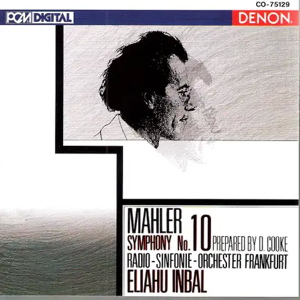
Gustav Mahler (1860-1911)
Symphony No.10 (first performing version by Deryck Cooke)
Frankfurt Radio Symphony Orchestra/Eliahu Inbal
rec. 1992, Alte Oper, Frankfurt, Germany
Denon CO-75129 [71]
It would seem that, apart from passing references to his recordings of Mahler symphonies, Eliahu Inbal’s Mahler output has not been much referenced on MusicWeb. If they are mentioned at all, it is usually admiringly, although Chris Salocks’ review of 2021 remarks that “Inbal’s Tokyo Mahler Tenth is ruined by the conductor’s obsessive and all too audible crooning as he conducts”; this is obviously not that recording but from his much earlier series with the FRSO and is mostly mercifully free of that besetting fault – just the occasional bit of exhortative vocalisation from the podium is apparent – and having just come from listening to a live performance afflicted by coughs, I prize the utter silence this music requires and deserves in the many quiet passages which balance its outbursts of existential agony.
Inbal’s timings are relatively swift; very similar, in fact, to Ormandy’s pioneering recording, and also like Ormandy he has an excellent orchestra, ideally served by Denon’s reliable engineering; the digital sound is very well balanced and offers great depth – essential if we are to savour the lower strings working just as hard as the violin sections. Like Ormandy and Sanderling before him, Inbal favours a relatively direct and driven manner, relying on momentum to provide cohesion. The desperate nine-note chord is chilling but the coda to the first movement is more tender. The outer sections of the first scherzo are unusually brisk and stomping – hardly “country dancing”, more like racing – and in fact I could do with a little more relaxation and am relieved when the frantic pace slackens for the Trio; for me the whole movement is too hard-pressed – though I imagine such drive would be exciting if this were a live performance. The central Purgatorio movement is odd in that Inbal suddenly accelerates at 0:38 – about twenty-five bars in – yet there was obviously no such marking beyond the blanket “Allegro moderato” in Mahler’s skeletal short-score draft – then he slows dramatically. I do not find this to be a successful tactic – it just sounds odd and eccentric, and disrupts its unity. The second scherzo is also somewhat erratic of tempo; I find it mannered and fragmentary.
The drum strokes at the opening of the finale are fine, if a little close in aural perspective and the whole movement unfolds without incident but in an oddly bland manner, and again there is too much wilful pulling about of tempi from bar to bar. Inbal is a conductor whose work I have almost invariably admired but for me this performance does not gel. Maybe it was an off-day, which accounts for its lack of distinction and the shortage of critical response. I do not feel that Inbal had a grasp of the work’s architecture and a result injected too many fussy refinements. The “apotheosis” coda is beautifully played but not with the rapt concentration of the very best recordings; there is not the same sense of torque and tension in the climaxes. The typically Mahlerian portamento of the final upward sweep of a diminished sixth on the violins is very pronounced and I like that but the requisite sheer intensity of tone is lacking; it is a little tame.
This joins Jesús López Cobos’s recording from 2000 on my very short shortlist of two recordings of the Tenth which I do not care to revisit.
Ralph Moore
Buying this recording via the link below generates revenue for MWI, which helps the site remain free














