
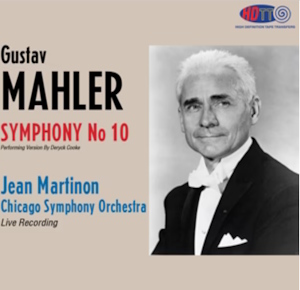
Gustav Mahler (1860-1911)
Symphony No. 10 in F sharp minor (Cooke 1 – first performing version)
Chicago Symphony Orchestra/Jean Martinon
rec. live, 19 & 20 May 1966, Orchestra Hall, Chicago
Reviewed as download
High Definition Tape Transfers HDTT12416 [67]
I am indebted to Paul Breslin who recommended this live performance via the MusicWeb Message Board as a further adjunct to my series of reviews on recordings of Mahler’s Tenth Symphony; indeed, I have borrowed some of his comments from that correspondence because I entirely agree with them.
Remastered from tapes of WFMT broadcasts, it is captured in exceptionally good sound. Its running time of 66:32 marks it out as one of the swiftest; Ormandy’s contemporary studio recording of the same version – its first release – was also relatively fast at 70:16; subsequent recordings generally stretch from the mid to upper seventies. It is the opening and closing movements which make the difference, as in each Martinon shaves off four minutes compared with most other accounts.
The sound, as is so often the case with HDTT, is as good as we are ever going to hear: remarkably rich and deep with a good stereo spread. Individual layers of instrumentation are exceptionally transparent. Coughing is minimal apart from the close of the first movement where it is annoying; apart from that, its quality is such that it could almost be mistaken for a studio recording and the only other extraneous noise is some very faint rumble which is barely audible even if you listen on headphones.
Martinon is driven and unsparing; there is a lean, raw energy to the playing and direction. This is uniform to the whole performance and as a result has a coherence which makes it valid on its own terms. The Primal Scream is very direct and assertive where some recordings make it weirder and more detached.
The first Scherzo is wild and frantic; the playing of the CSO is by no means rough but it is clear that Martinon is not seeking the kind of polish we hear from versions by the BSO and the VPO; the woodwind parp noisily and the percussion are especially emphatic. There is a decidedly restless quality to the Trio. The central Purgatorio movement is pervaded by a sense of foreboding despite its superficial charm; the low strings groan balefully and the brass blast in monitory fashion. The second Scherzo is even more frenetic than the first – as the hectic music dictates – and the playing here is exceptionally virtuosic, especially considering that the orchestra could hardly have been familiar with the score. Just occasionally in this movement, the sound seems to switch focus but it remains very immediate.
The drum thwacks at the start of the finale are suitably dull and thunderous; too many recordings or performances make them too present. The muted brass bray, and the solo flute has a fragility amplified by the flautist’s fast, fluttery vibrato. It is here where I wish Martinon would let the music breathe a little more but he is logically following through his unifying concept of the relationship between movements and their combined architecture. Having said that, the string playing in the final seven minutes is serene – despite what sounds like a false entry at 16:20.
There is a kind of visceral edge and spontaneity to this performance which militates against any sense of transcendence but this is certainly a valid, consistent way to deliver the score, even if ultimately I look for more repose in the quiet passages concluding the two outer movements; it is the interpretative antithesis to recordings by Harding and Chailly. I also feel that music demands the silence and concentration granted the listener only by a studio recording, as even the occasional cough will be a distraction for some. For me, this is interesting but not necessarily a keeper to which I would often return.
Ralph Moore
Availability: HDTTNote: the HDTT website gives the performance date of 12 February, but other sources, including the big box set “The Chicago Symphony Orchestra: The First 100 Years” and ChatGPT give two dates as above, and that seems more likely.













