
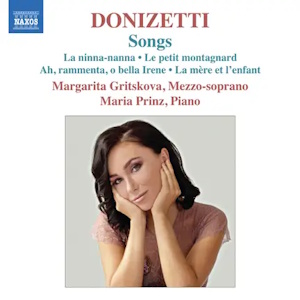
Gaetano Donizetti (1797-1848)
Songs
Margarita Gritskova (mezzo-soprano)
Maria Prinz (piano)
rec. 2024, Königliches Kurtheater Bad Wildbad, Germany
Naxos 8.574485 [77]
St. Petersburg-born mezzo-soprano Margarita Gritskova is a regular member of the Vienna State Opera Company and over the last several years has been working with Pianist Maria Prinz both in recital and on a series of CDs for the NAXOS label. Previous releases have all been of songs by Russian composers (review). This appears to be the first release in which they have turned their attention towards a composer from outside of the Slavic song repertoire.
This series of songs by Donizetti come from the various stages of his professional life. The earliest (Ah, rammenta, o bella Irene) comes from 1830-31 and is set to a text by Metastasio. The latest of the songs (Leonora) is from 1843, just prior to the general decline in his health which caused him to cease composing altogether. Five songs among this collection are without dates and for the majority of them only the publication date is known for certain.
Gritskova and Prinz have shown off their prowess on disc before so there is not much point in my adding to the accolades. Suffice it to state that their accomplishments in this music are of a very high standard and no-one should be disappointed with purchasing this CD. However, I do think that the Russian repertoire shows off Gritskova’s multi-hued voice more ideally than the songs on this recital.
The recital opens on a high point with Su l’onda tremola . This undulating song shows of the mezzo’s abilities with trills and roulades aplenty. This is fairly indicative of much of what one hears on the rest of the disc.
Several of the songs here are in ¾ waltz time including the charming Tu mi chiedi se t’adoro, one of a series of songs Donizetti wrote for the singing wife of his Paris banker; he also dedicated the score of Don Pasquale to her. This song features a series of rapid fire runs which Gristkova surmounts with ease.
The lengthiest song on the recital is the sentimental La ninna-nanna, which springs from a somewhat indigestible text about a group of cherubim playing music beside a sleeping child. Unfortunately, in spite of Gritskova’s smoky-toned reading, the song rather outstays its welcome.
Gritskova does not have a plush sounding voice in the manner of Marilyn Horne, but she has a well-disciplined sound with beautiful warmth in the lower third of her range. As she ascends upwards her top range thins out slightly but in this recital it is hardly noticeable.
In A mezzanotte, Gritskova manages to convey a mood of wryness to the text, which is not an easy thing for singers to put across without facial expression to aid them. It gives her reading a real presence and sense of personality in the voice. Similarly, her very confident and jaunty portrayal of La Zingara, with its heartfelt middle section, shows off Gritskova at her best.
L’amante spagnuolo is a spiffy bolero in which the mezzo supplies a surfeit of panache and at the conclusion, a slightly steely sounding G. At the opposite end of the colour spectrum, the long flowing lines of Una lacrima are test of any singer’s breath control. Gritskova clearly distinguishes herself here.
For my taste the prettiest song of the entire collection is Il barcaiuolo, which Gritskova handles with charm and a delicious touch of restraint. Here and throughout the recital Maria Prinz balances her accompaniment against the soloist perfectly, knowing just when to draw attention to the piano line and when to allow the mezzo to take the spotlight. The Naxos sound on this disc has been handled with great care with a forward placement that has a hint of spatial resonance. In other words simply perfect. Italian texts are supplied but no tranlastions; however, there is a link on the Naxos website where English translations are available for a few of the songs on this collection. I did not bother to investigate them.
Mike Parr
Buying this recording via a link below generates revenue for MWI, which helps the site remain free

Contents of CD:
Su l’onda tremolo
Tu mi chiedi se t’adoro (1840)
La ninna-nanna, A. 202 (1839)
Le petit montagnard, A. 365
Nuits d’été à Pausilippe, A. 183-194: No. 3, A mezzanotte, A. 185 (1836)
La zingara, A. 218 (1842)
La mère et l’enfant, A. 239 (1830)
Soirées d’automne à l’Infrascata, A. 195-200: No. 2, L’amante spagnuolo, A. 196 (1837)
Una lacrima (1841)
Questo mio figlio è un fiorellin d’amore (published posthumously in 1869)
Au tic tac des castagnettes, A. 229
La lontananza, A. 195 (1837)
Leonora, A. 236 (1843)
Nuits d’été à Pausilippe, A. 183-194: No. 1, Il barcaiuolo, A. 183 (1836)
Lu trademiento
La sultana, A. 204 (1839)
Ah, rammenta, o bella Irene ( 1830 or 1831)













