
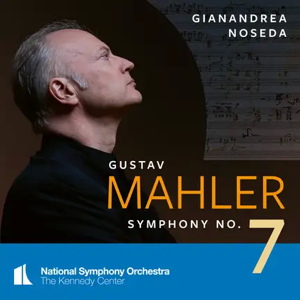
Gustav Mahler (1860-1911)
Symphony No.7 in E minor (1904/1905)
National Symphony Orchestra / Gianandrea Noseda
rec. live, 30 May & 1 June 2024, Concert Hall, Kennedy Center, Washington DC, USA
National Symphony Orchestra NSO0022 SACD [75]
Once upon a time, recordings of Mahler’s Seventh Symphony were not all that common. The work was considered the least approachable of his symphonies. Now new accounts seem to appear every other week! On this one, Gianandrea Noseda leads Washington’s National Symphony Orchestra (NSO). How competitive is it in the extensive discography of the work? I compared this SACD recording with three others in my collection. One of them is Noseda’s earlier account with the BBC Philharmonic, a BBC Music Magazine cover disc from 2010. I thought it a well-played, straightforward interpretation. His tempi for the two Nachtmusik movements are on the quick side, as compared with others I have heard.
The same observations hold for the new performance, but NSO’s playing is superior to that of the BBC orchestra. Indeed, the actual performance here is quite wonderful in all departments. It is from the sound of the orchestra and the individual instruments that I have derived my greatest pleasure. As a characterization of the music, though, it loses out to my earlier benchmarks: both of Leonard Bernstein’s recordings, the classic 1965 (Sony) and the 1985 (DG). None I have heard since challenge for me the supremacy of those accounts.
Most disappointing of all is Ivan Fischer’s reading with the Budapest Festival Orchestra (Channel Classics). When it was issued, it received considerable praise. I purchased it soon after and found it lacking in Mahlerian character; the second movement (Nachtmusik I) was particularly perfunctory. His fourth movement (Nachtmusik II) is better. After his wonderful performance of the Fourth Symphony, I expected more. Concerning the disc under review, I had the fortune to attend one of those concerts by the NSO from which the recording derives, and came away totally satisfied.
From the off, Noseda’s account grabs one’s attention with a sumptuously played and closely recorded tenor horn solo. It is certainly striking, but I am not sure it realises the composer’s intentions. Whenever the instrument appears in the work, it is very present. The recording, which allows one to hear orchestral parts in the brass and the winds clearly, also suffers somewhat from a tubby bass. This is especially true of the timpani. They lack the tactile thwack of Bernstein’s New York Philharmonic or even the BBC Philharmonic. Noseda effectively achieves the heavy tread of the march in a tempo similar to the other accounts.
The horn soloist in the second movement, Abel Pereira, is outstanding, as are the horns in general. They have improved measurably under Noseda’s direction. Still, none I have heard can compare with the New York Philharmonic’s horns on their second recording. I assume the soloist there was Philip Myers with his touch of vibrato. The Kennedy Center Concert Hall’s acoustics are on the dry side, which allows one to hear all kinds of details often missed. The cowbells, for example, can be heard distantly as intended; the harps and the bassoons come through well as do the strings’ pizzicati.
The low brass, particularly the tuba, and the bassoons in the third movement Scherzo have real presence. Noseda characterizes the music well, even if Bernstein brings out the spookiness better in his first recording. Fischer, on the other hand, is under-characterized despite the noticeable glissandi.
While Noseda’s tempo for the march in the second movement works fine – even though the movement is a couple of minutes quicker than Bernstein’s – the faster tempo in the fourth movement loses a little of the moonlit serenade’s atmosphere. Again the horn solos are splendid, as are the strings’ glissandi. The mandolin and guitar parts can also be heard as part of the texture. There is a good instrumental balance and dynamic range overall.
The timpani which introduce the problematic finale could be more incisive, as I noted earlier. The brass, however, are great. As a whole, though, there seems to be a lack of energy in this movement as compared to Bernstein, primarily in his earlier account. Individual details tell, but there seems to be a lack of flow tying everything together. The ending is terrific with its tubular bells, cymbals and tam-tam. One can even distinguish the cowbells here, not always noticeable in other recordings. To really hear the tubular bells stand out, one can turn to Fischer whose bells protrude, rather than being a normal part of the texture. For the symphony’s conclusion, Noseda holds the penultimate note before the final crash longer than Bernstein and others. It works, even if it seems rather excessive.
In sum, there is a lot to appreciate in this new account of Mahler’s Seventh, though it may be unlikely to be anyone’s first choice. For me, it is a fine memento of a concert of which I have fond memories. The product itself is impressive in its hardback book format with Thomas May’s substantial discussion of the symphony, colourful photos and illustrations, and a listing of the orchestra’s personnel.
Leslie Wright
Other review: John Quinn
Buying this recording via the link below generates revenue for MWI, which helps the site remain free














