
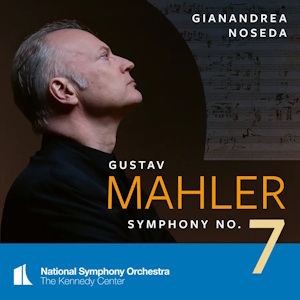
Gustav Mahler (1860-1911)
Symphony No.7 in E minor (1904/1905)
National Symphony Orchestra / Gianandrea Noseda
rec. live, 30 May & 1 June 2024, Concert Hall, Kennedy Center, Washington DC, USA
National Symphony Orchestra NSO0022 SACD [75]
It isn’t often that I begin a review by commenting on the recorded sound but I think such an approach is justified here. The recording was made by a team from Soundmirror, led by producer Blanton Alspaugh. Over the years I’ve greatly admired the results achieved by Alspaugh and his colleagues but on this occasion I’m slightly thoughtful about the recording. I listened to the stereo layer of the SACD and I should say at once that the sound has all the excellent hallmarks of a Soundmirror recording: the sound has presence and impact; and you can hear an abundance of detail. My concern, however, is that the recording is, perhaps, balanced a bit too closely. In the brooding opening to the first movement, for instance, the solo tenor horn is very clearly heard; in fact, for my taste, it’s too prominent. That said, the clarity and impact of the sound made a positive overall impression as the movement unfolded and my ears adjusted.
Of greater concern is the second movement. A solo horn opens proceedings, echoed by another horn, placed at a distance. The recording differentiates well between the two instruments but I can’t help feeling that the solo horn is heard too much in the foreground. Thomas May reminds us in his very useful booklet essay that Willem Mengelberg believed that this second movement was inspired by Rembrandt’s famous painting The Night Watch (which is reproduced in the booklet); as the movement unfolded, I had an increasing feeling that, as depicted here, the night sentries were keeping guard in streets that were quite brightly lamplit. Just to check, I made comparisons with two recent recordings which, like Noseda’s, stem from live recordings: the 2018 version in which Kirill Petrenko conducts the Bavarian Staatsoper Orchestra (review) and the 2024 performance by Sir Simon Rattle and the Bavarian Radio Symphony Orchestra (review). In both cases, the recordings are just a little more distanced than is the case on the Noseda disc; as a result, the opening tenor horn solo can be heard clearly but not too clearly. Similarly, in the second movement, I experienced a much more satisfactory balancing of both horns and Nachtmusik I has a more pleasing nocturnal ambience throughout in both Bavarian recordings. Incidentally, both the Petrenko and Rattle performances were issued on conventional CDs; so, in order to compare apples with apples I listened to all three recordings on the same CD player when making my comparisons (my non-comparative listening to Noseda was done on an SACD player). To be clear, the Soundmirror engineers have produced a recording which is in many ways excellent, but when one bears in mind that the Seventh has been nicknamed ‘Song of the Night’ by some people, I think the recording puts the music-making a little too much in the light of day. I think it’s possible to argue that the recorded sound becomes more appropriate as the performance evolves and suits the bright, ebullient finale particularly well. Perhaps the engineering reflects a perceived need to place the microphones relatively close in order to ensure no audience noise intrudes; if so, that objective was successfully met.
There’s much to appreciate in the performance itself and the Soundmirror team have ensured that we can hear an abundance of detail; that in turn emphasises how well the National Symphony Orchestra plays. Their woodwind and brass sections are excellent, both collectively and individually; the percussion section adds colour in an incisive fashion; the strings also acquit themselves well, though I feel that they don’t quite match the tonal resources of the Bavarian orchestras that play for Petrenko and Rattle.
Noseda doesn’t quite persuade me in the way he handles the huge first movement. The quick music is highly energised and I like that. However, for some reason that I can’t quite put my finger on, the Langsam (Adagio) introduction seems to hang fire. Furthermore, within that introduction there are short episodes of music in dotted rhythms which surely require a lighter touch than Noseda provides. Petrenko and Rattle get these little stretches right but Noseda maintains his initial tempo and as a result these episodes are earthbound. When the introduction yields to the Allegro risoluto ma non troppo, I very much like his sprightly approach; it’s in the slower sections of this movement that Noseda doesn’t quite persuade me in the way that Rattle, in particular, does. When the final climax of the movement arrives, Noseda doesn’t pull back the speed to quite the same degree that I’ve heard some others do; I like that, because it means that the climax is imposing but not overblown.
As I’ve already indicated, Nachtmusik I is too ‘present’. However, I should caveat that by observing that Noseda and his orchestra characterise the music very well. I very much admired the incisive work of the woodwind section. The Scherzo is swift and the performers bring out the weirdness in Mahler’s music. Everything is sharply pointed – as it should be – but I’m not sure that the performance is as ‘shadowy’ as Mahler’s marking of Schattenhaft requires; that may in part be down to the immediacy of the recorded sound. Nachtmusik II is piquant and pithy. I like that, though I wonder if the performance conveys fully the amoroso aspect; a little more warmth would have been the icing on the cake. The Rondo finale opens exuberantly. This opening outburst heralds a bright, extrovert performance. Noseda may not quite match the hedonism that Leonard Bernstein achieved in his first (1966) recording – few have done so – but even so this is a fine, joyful performance in which I think the conductor knits the various episodes together very successfully. Noseda and the NSO really go for it and the results are exhilarating. In the closing pages Mahler throws in everything but the (musical) kitchen sink; I should imagine that this made a terrific impression on the Kennedy Center audience. I say ‘imagine’ because there’s no applause at the end and, indeed, even when I listened through headphone the audience was commendably silent.
As I indicated earlier, there’s a good deal to appreciate and admire in this performance and though I’ve expressed reservations about the recorded sound other listeners may well feel differently. With that in mind I’d strongly recommend sampling the movements through the Presto Classical facility at the foot of this review. I’m glad to have heard this recording, though when all is said and done it doesn’t surpass my favourite versions, amongst which the outstanding Rattle performance from 2024 is the current leader in the field.
John Quinn
Previous review: Leslie Wright
Buying this recording via the link below generates revenue for MWI, which helps the site remain free













