
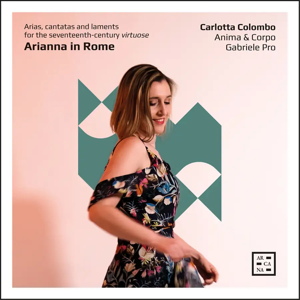
Arianna in Rome
Arias, Cantatas and Laments for the Seventeenth-Century Virtuose
Carlotta Colombo (soprano), Anima & Corpo / Gabriele Pro
rec. 2023, Oratorio di Sant’Antonio dei Cavalieri de’ Nardis, L’Aquila, Italy
Texts and translations included
Reviewed as a download
Arcana A576 [61]
From ancient times until well into the 18th century, women were not allowed to sing in church. That left the secular sphere to manifest themselves as singers. We know several of them, such as the three ladies who were known as the Concerto delle Donne, active at the court in Ferrara at the end of the 16th century, under the direction of Luzzasco Luzzaschi. In the first half of the 17th century, two virtuosic female singers not only acted as performers, but also as composers: Francesca Caccini and Barbara Strozzi. The disc to be discussed here focuses on the art of several female singers active in Rome at that time. It is the result of a research project under the title “The Virtuose di musica in seventeenth-century Italy”.
Arnaldo Morelli (University of L’Aquila), in his liner-notes, refers to a Roman nobleman who attributed the establishment of the stile recitativo to a large extent to the activities of these virtuose. They were widely admired, to which attest poems which sing their praises, the fact that works were dedicated to them and that they and their performances are mentioned in letters. It is also notable that their employers were willing to spend much money to their further musical education. Among the teachers of such virtuose were composers whose music was selected for this recording.
Many pieces for a solo voice and basso continuo were specifically written for female singers. That goes for the three lamentos, the most famous of which is the Lamento d’Arianna by Claudio Monteverdi. The lamento was a famous genre, which had its origin in opera; Monteverdi’s piece is an example, as it was part of his opera L’Arianna, which has been lost. Its fame resulted in separate lamentos, such as the two other pieces, by Stefano Landi and Ottavio Catalani respectively.
Landi’s Lamento d’Armida is the setting of a text inspired by Torquato Tasso’s poem Gerusalemme liberata, written by Giulio Rospigliosi, who was to become pope Clemens IX in 1667. Landi worked his entire life in Rome, where he was closely connected to members of the Barberini family, to whom Pope Urban VIII belonged. Tasso’s poem also includes the text of the Lamento d’Erminia by Ottavio Catalani, who was from Sicily and spent about 25 years in Rome, where he was active as organist and maestro di cappella, and as music teacher to nephews of three popes. The lament was performed within the framework of a comedy by Olimpia Saponara. The piece is included in a manuscript that was put together in the circle around Cardinal Alessandro Damasceni Peretti di Montalto (1571-1623), a well-known patron of music, who had several musicians in his service, among them a female singer. The same manuscript also includes Monteverdi’s Lamento.
Luigi Rossi was one of the most famous composers of his time, who was active as an organist, but whose oeuvre comprises mostly secular cantatas. However, he has become especially known for his opera Orfeo, which was performed in 1647 in Paris at the invitation of Cardinal Mazarin. The cantata Giunsi pur, mai non fu più tardo has been passed down anonymously, but there are good reasons to think that it may be a piece by Rossi. The text was written for a lady who was in the service of Anne of Austria, Queen of France. Morelli assumes that the piece may have been intended for a Roman female singer who was active in Paris in the 1640s. The only source of the cantata is a manuscript which belonged to a singer who was a pupil of Rossi.
Carlo Rainaldi was an architect, like his father, and received his education at the Collegio Romano. There he also learnt music, probably from Virgilio Mazzocchi, who was maestro di cappella at the Collegio. Rainaldi’s compositional oeuvre is small; the largest part consists of nineteen secular cantatas, among which Ch’io sciolga il nodo.
Giacomo Carissimi has become best-known for his oratorios. He is often considered the ‘father’ of the oratorio, but in fact the genre already existed when he wrote his. The secular part of his oeuvre is mostly overlooked. He has left a large number of cantatas; Soccorretemi ch’io moro is one of them. He was also the teacher of a virtuosa: Giulia Masotti, who made successful appearances in theatres in Innsbruck and Venice, and later entered the service of the imperial court in Vienna.
Paolo Quagliati was from Chioggia and settled in Rome around 1574, where he worked for various patrician families as well as for the church. His best-known work is a collection of madrigals for one and two voices and basso continuo, with a concerted violin part, which was published in 1623 under the title of La Sfera armoniosa, at the occasion of the marriage of Prince Nicolò Ludovisi and Isabella Gesualdo, grand-daughter of Carlo Gesualdo da Venosa. Felice chi vi mira is taken from this collection, preceded by an instrumental toccata that is intended as its introduction.
A number of pieces are strophic, which limits the possibilities to connect text and music. It is then the responsibility of the performer to make sure that the affetti which the composer wants to express, are communicated to the audience. Carlotta Colomba succeeds with flying colours. She applies two elements that are essential for a performance of this kind of repertoire: a differentiated use of dynamics, and especially the messa di voce, often used to highlight particularly emotional words or phrases, and a generous application of ornamentation, which was not only used for the sake of variation (and to impress the audience), but also a means of expression. In this repertoire the text always comes first, and the term stile recitativo mentioned above indicates that the text has to be delivered in a declamatory manner. Carlotta Colombo’s skills in this department are impressive, particularly in the non-strophic pieces, such as Monteverdi’s Lamento and Landi’s Alla guerra d’amor, which closes the programme. Now and then I found that Ms Colomba uses a bit more vibrato than is desirable, but overall it did not really bother me.
Most pieces are for voice and basso continuo. In this recording the instrumentalists play ritornellos which have been written in the style of the time by Nicola Procaccini, the harpsichordist of the ensemble Anima & Corpo. The playing is colourful and dynamic, and three instrumental pieces have been added to the programme, by Frescobaldi and Kapsperger.
This disc offers a very interesting and compelling survey of the art of female singers in Rome in the first half of the 17th century. It is to be hoped that the research project that was the basis for this disc will result in more recordings of this fascinating repertoire.
Johan van Veen
www.musica-dei-donum.org
twitter.com/johanvanveen
https://bsky.app/profile/musicadeidonum.bsky.social
Buying this recording via a link below generates revenue for MWI, which helps the site remain free.



Contents
Giovanni Girolamo Kapsperger (1579-1651)
Sinfonia I
Luigi Rossi (1597-1653) (attr)
Giunsi pur, mai non fu oiù tardo
Stefano Landi (1587-1639)
Lamento d’Armida (Quando Rinaldo invitto)
Carlo Rainaldi (1611-1691)
Ch’io sciolga il nodo
Ottavio Catalani (1560-1629)
Lamento d’Erminia (In che misero punto or qui mi mena Fortuna)
Girolamo Frescobaldi (1583-1643)
Canzon V a due canti e basso
Giacomo Carissimi (1605-1674)
Soccorretemi ch’io moro
Paolo Quagliati (1555-1628)
Toccata con un violino e la tiorba inanzi che si canti ‘Felice chi vi mira’
Felice chi vi mira
Claudio Monteverdi (1567-1643)
Lamento d’Arianna (Lasciatemi morire) (SV 22)
Giovanni Girolamo Kapsperger
Toccata VII [Libro IV]
Stefano Landi
Alla guerra d’amor













