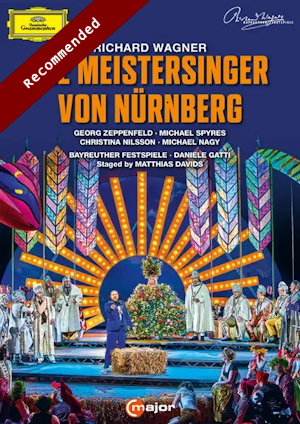
Richard Wagner (1813-1883)
Die Meistersinger von Nürnberg (1868)
Hans Sachs – Georg Zeppenfeld (bass-baritone)
Walther von Stolzing – Michael Spyres (tenor)
Eva – Christina Nilsson (soprano)
Beckmesser – Michael Nagy (baritone)
Pogner – Jongmin Park (bass)
David – Matthias Stier (tenor)
Magdalene – Christa Mayer (mezzo-soprano)
Fritz Kothner – Jordan Shanahan (baritone)
Nightwatchman – Tobias Kehrer (bass)
Chor & Orchestrer der Bayreuther Festpiele / Daniele Gatti, Matthias Davids (stage direction)
rec. live, 2025, Bayreuth Festival Theatre, Bayreuth, Germany
Reviewed in DTS 5.1
Deutsche Grammophon/C Major 773808 [2 DVDs: 280]
Ultra-traditionalists will not much like Matthias Davids’s production of Die Meistersinger, but everybody else will find a lot to enjoy. In truth, his take on Wagner’s most human work never asks you to swallow all that much. The aesthetic is highly stylised and often pretty garish – the sets reminded me heavily of the sort of approach you would expect Laurent Pelly to take. Yet if you can forgive this, then they are often very beautiful. Act 1 looks, for example, as though it is all going to play out on an abstract infinite staircase, but the set promptly swings open to reveal an interior halfway between a theatre and a church. That is exactly the sort of place you would expect the Song School to happen. The buildings in the street scene in Act 2 are fairly abstract, with vegetation that resembles neon Christmas trees, all of which peels away for the riot scene. However, the eye gets used to it very quickly, and Davids uses the frame to tell the story really very directly. There is no high concept and, if you are comparing it to other Bayreuth stagings, it is far closer to Wolfgang Wagner’s playful-traditional 1999 staging than his daughter Katharina’s headache-inducing 2008 one.
Most importantly, Davids recognises that this is a comedy and – shock horror! – several moments in the staging made me laugh out loud. The background slapstick in the second half of Act 2 is so precisely observed that it will raise many a chuckle, and the riot is brilliantly choreographed. That is, however, also the moment most patchy musically. It is difficult to hold together in any normal theatre, but in Bayreuth’s tricky acoustic it is almost impossible to coordinate.
The festival meadow is a hoot, full of neon costumes, silly dancing and a giant inflatable cow that Beckmesser unplugs at the end in a fit of pique. Earlier, the scene in Sachs’s shop is very nicely observed. The staging of the Act 3 prelude is very sensitive, giving us a window into his past as we see a picture of his wife and (presumably deceased) son.
Davids directs his actors most successfully. They clearly buy into what he is trying to do because the cast act as well as they sing – and musically everything is good. At the staging’s core is Georg Zeppenfeld’s warm, humane Sachs. Zeppenfeld has a stunner of a bass voice, and he has been a mainstay at Bayreuth for about a decade now. Here, his Sachs is really tremendous, far better than when he recorded it at Salzburg for Thielemann. There is depth, richness and power throughout the whole span of the voice, and bags of stamina: he hardly sounds fatigued even during the final scene. Alongside the power, however, there is warmth and humanity in his monologues, and his scene with Eva in Act 3 is full of bittersweet beauty. Christina Nilsson’s Eva is a delight: bright, clean and lyrical, marvellously cresting the wave of the ensemble scenes.
Michael Spyres has come out of nowhere to be, perhaps, the finest Wagner tenor we have today, and his Walther passes every test with flying colours. There is youthful impetuosity in Act 1 alongside petulance in Act 2, and he sings each iteration of the Prize Song with ringing, lyrical beauty. Matthias Stier’s David is youthful, vigorous and fun, though he seems rather young for Christa Mayer’s matronly, if rich-voiced, Magdalene. Among the Masters, Michael Nagy is one of the finest Beckmessers you will see. He sings the whole part with lyrical beauty and a smooth line that comes close to bel canto. He also never hams his part, and his scenes with Sachs are beautifully observed. Jongmin Park is a tremendous, booming-voiced Pogner who commands every scene in which he sings.
The other Masters are all nicely characterised and, as you would expect at this address, the chorus are a knockout. This is the Wagner opera least flattered by the Bayreuth acoustic, but the orchestra play angelically and the 5.1 surround sound that I listened to brings out the theatre blend very well. Daniele Gatti has total command of the score. His reading is not that different to his 2013 Salzburg production, but it feels more commanding and less chamber-like in this theatre, and that is no bad thing.
So three cheers for this Meistersinger, a production beautiful to look at, marvellously sung and, for all its foibles, a genuinely engaging attempt to bring Wagner’s comedic masterpiece to life. Take a chance on it: you just might laugh!
Simon Thompson
Buying this recording via the link below generates revenue for MWI, which helps the site remain free

Other cast and production staff
Kunz Vogelgesang – Martin Koch (tenor)
Konrad Nachtigall – Werner Van Mechelen (baritone)
Balthasar Zorn – Daniel Jenz (tenor)
Ulrich Eisslinger – Matthew Newlin (tenor)
Augustin Moser – Gideon Poppe (tenor)
Hermann Ortel – Alexander Grassauer (bass-bar)
Hans Schwarz – Tijl Faveyts (bass)
Hans Foltz – Patrick Zielke (bass-bar)
Andrew D. Edwards, set design
Susanne Hubrich, costume designer
Fabrice Kebour, lighting design
Video details
Picture format: NTSC/16:9; Sound format: PCM Stereo/DTS 5.1
Region code: 0
Sung in German; Subtitles: German, English, Korean, Japanese