
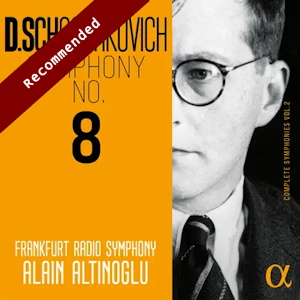
Dmitri Shostakovich (1906-1975)
Symphony No 8 in C minor, Op 65 (1943)
Frankfurt Radio Symphony / Alain Altinoglu
rec. 2025, Groβer Saal, der Alten Oper, Frankfurt
Alpha 1287 [64]
Just recently, I reviewed the first volume in Alain Altinoglu’s planned cycle of the Shostakovich symphonies. I was seriously impressed by the playing and the interpretation and also by the quality of the recorded sound. So, I’m delighted that I’ve received Vol. 2 which is devoted to one of the composer’s most eloquent achievements, the wartime Eighth symphony.
After, in effect, chronicling the terrible siege and eventual deliverance of the city of Leningrad in his Seventh symphony (1941), Shostakovich responded to the horrors of war and the ordeal of the people of the Soviet Union at the hands of Nazi Germany in an even deeper fashion in his Eighth symphony. Nikita Sorokine remarks in the notes accompanying this disc that the Eighth “is in many respects a harrowing meditation on what humanity has become after the Seventh”. I think there’s a lot in that. The composer had allowed himself what I might term the luxury of a big, positive conclusion to the Seventh: Leningrad delivered. The Eighth, however, is a much bleaker affair and it ends on a note of subdued ambiguity. It reminds us that whist the tide of war might have turned by the time of composition, the struggle was far from over.
Like the Fifth symphony, the Eighth opens with an arresting call to attention by the strings, though I think the effect is more anguished in the later symphony. In this performance, the lower strings of the Frankfurt RSO dig deep; they really compel the listener’s attention. The passage for strings that follows is played in an appropriately glacial fashion and already one has the impression that Altinoglu and his orchestra are acutely aware how to put across this music; the playing is chilly and sorrowful. As this very substantial movement unfolded I became more and more aware of the grip and focus of Altinoglu’s conducting. When the Allegro non troppo section begins (5:42) the pace increases slightly but even so the music is given the necessary breadth and space. The tension never lets up, even though much of the music is subdued and introspective; one really appreciates the excellent dynamic range not just of the playing but also of the recorded sound. From about 12:22 the tone becomes more strident as the build-up to the main climax begins; in fact, the music is almost unbearably dissonant at times. Once again, Altinoglu judges the way the music should ‘go’ in an ideal way. When the climax arrives (17:14-18:06), it is immense and forbidding. Immediately afterwards, we hear an extended cor anglais threnody. How bleak and sorrowful this sounds; the Frankfurt player delivers this desolate passage most eloquently. I don’t think Altinoglu and his players put a foot wrong during the course of this extended movement; the performance is superb.
There follows a short Allegretto. The tone is set immediately; the music is made to sound tart and taut, just as it should be. Throughout the movement there’s terrific bite and precision in the playing with the woodwind section well to the fore. In the middle of the movement, piccolo and contrabassoon join in a macabre dance; the way Shostakovich uses these two extremes of pitch in the woodwind section during this episode is most imaginative – and grotesque.
The remaining three movements are played without a break. First comes an Allegro non troppo movement, much of which is founded on a relentless ostinato played by the strings. The ostinato is punctuated by a series of fierce downward figures played by violins and high woodwind (in the reprise, a xylophone is added, to telling effect). Michael Steinberg has rightly described this music as sounding like “a savage, relentless machine”. Even more memorable is what he says of the downward figures I’ve just mentioned, which he likens to a scream: “I think every time of the cellars of the Gestapo and the GPU”. Mid-movement (from 3:25), Shostakovich inserts a passage which, were this a Scherzo, we might describe as the Trio. This is dominated by a swaggering solo trumpet part which is played with terrific incisiveness in this performance,. The return of the ostinato music, played with great precision and spikiness, impels the movement forward to its moment of catharsis; a piledriver of a climax to which the recording does full justice. This terrifying climax marks the start of the Largo.
The Largo takes the form of a passacaglia during which the basic theme is subject to a series of variations, but there’s much, much more to the music than that technical description implies. This movement shows us Shostakovich at his bleakest and most introspective. Nikita Sorokine aptly likens the movement to “a landscape after a battle”. This movement demands – and here receives – total concentration from conductor and players. There’s a glacial hush throughout as the music moves slowly and inexorably on its way. Midway through (at 5:55), there’s a remarkable, eerie passage played by the flutes, who use flutter-tonguing throughout the episode; I don’t think I’ve ever heard this done better. Subsequently, ghostly, sinuous clarinets catch the ear, though not in an obtrusive fashion. Throughout the course of this movement the control displayed by all members of the orchestra is absolutely exemplary.
Eventually, the clarinets lead the music from a cold, remote minor key to the more relaxed domain of the major and the concluding movement (Allegretto). The solo bassoon, gruffly accompanied by his section colleagues, half suggests a lighter mood but, to be honest, this is deceptive. The finale is typical of the composer in its ambiguity. The bassoon section leads the way and there are further, excellent contributions by other elements of the woodwind choir in the first three minutes or so. Over time, Shostakovich increases the tension; Altinoglu faithfully reflects that, his conducting acutely responsive to the composer’s intentions. There’s one final, grinding climax (8:20): I don’t know which is the more impressive; the way in which the climax is delivered or the tension-building way in which Altinoglu approaches the climax. After the climax, the bass clarinet (later joined by the solo violin) almost suggests playfulness but I rather think that Shostakovich’s deliberate use of that deep-throated instrument indicates that this apparent playfulness is not all that it seems. The very end of the symphony (from 12:34) is a masterstroke; hushed strings and flute ensure that the work ends in great ambiguity; the Frankfurt players deliver these closing pages marvellously.
Shostakovich’s Eighth symphony is one of his most profound utterances. Here, it receives a performance which confirms the work’s stature. The playing of the Frankfurt RSO is superb from start to finish. The orchestra is capable of delivering the mighty climaxes with all the necessary power but they’re just as impressive – arguably, more impressive – in the way they play the many episodes which call for great subtlety and refinement. Alain Altinoglu guides them through this emotionally and technically challenging score with consummate assurance. He really has this score at his fingertips and, as a Shostakovich interpreter, he confirms the very favourable impression that I got from the previous volume in the series. I’ve heard several very distinguished recordings of this symphony over the years and this probing, deeply felt interpretation is as fine as any I’ve encountered. It’s an outstanding rendition of this challenging masterpiece.
The previous volume in this series was superbly engineered and this recording is just as good. Philipp Knop and his team of engineers have produced sound which has great presence and impact. Best of all, the recording has a marvellous dynamic range; it comfortably conveys the mighty climaxes and is just as thrilling in the way that the frequent episodes of hushed music are faithfully reproduced.
In terms of both the performance and engineering this is an outstanding release. Just as importantly, it confirms the promise of Volume One. I think I can now say with some confidence that this is going to be a very considerable Shostakovich cycle. I await the next instalment with keen anticipation.
John Quinn
Buying this recording via the link below generates revenue for MWI, which helps the site remain free













