
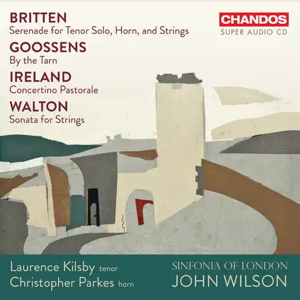
Music for Strings
John Ireland (1879-1962)
Concertino pastorale (1939)
Benjamin Britten (1913-1976)
Serenade for Tenor Solo, Horn and Strings
Eugene Goossens (1893-1962)
By the Tarn Op.15 in G Minor (from Two Sketches for String Quartet, arranged for the composer for string orchestra)
Sir William Walton (1902-1983)
String Quartet in A Minor (1945-1947, transcr. composer and Sir Malcolm Arnold)
Laurence Kilsby (tenor), Christopher Parkes (French horn), Sinfonia of London / John Wilson
rec. 2025, Church of St Augustine, Kilburn, London, UK
Chandos CHSA5392 SACD [74]
The jury may still be out on just how successful some of the now many CDs produced by the John Wilson and the Sinfonia of London are. His Daphnis and Chloe, for example, admired by many, was for me the result of too much tinkering and experimentation in trying to improve the original. It was a lockdown project which might better have been left uncompleted, with a low-key opening which was hardly recognisable. There have been other partial failures, too, but just as no-one would question the brilliance of this combination in the series of four musicals they have been producing, another great success has been in this series of English music from Chandos, of which this CD is the third. It seems to be, not unnaturally, music in which the orchestra and conductor appear to be thoroughly at home, just as much as they are in Chandos’ recent My Fair Lady.
Gerald Finzi wrote an Eclogue and the Ireland Concertino pastorale is very similar in its distinctive English string sound. It shares a world with Vaughan Williams’ Thomas Tallis and Elgar’s Introduction and Allegro and Serenade. There is a point right at the end where the rich string sound dips and then surges back again, before fading out elegiacally.
The shorter Threnody is a slow lento, whose heartfelt melody is the sort of thing that the Sinfonia of London and John Wilson can eat for breakfast. They have shown this right from their award-winning recording of Korngold’s Symphony onwards: the ability to keep a tight ensemble while alternatively sighing and surging. Again, the pianissimo from three minutes in, leading to a final surge of the melody is quite exquisite and beautifully judged and held. This is a new piece to me and I was entranced. The same orchestra and conductor have done a whole John Ireland CD and this leaves me wanting more. Likewise, the stabbing pizzicato of the violins in the final Toccata, an allegro that is marked not too fast. Wilson and the orchestra certainly deliver at what feels just the right speed to me with busy bustling strings and a distinctive ending.
I cannot pretend to be much of a fan of Benjamin Britten, save for a few individual pieces like the Four Sea Interludes, which I love, along with Peter Grimes with its folksong influenced score. Also, like many, I was introduced to A Young Person’s Guide to the Orchestra at an early age and came to adore it. Unfortunately, like far too many of us, I was a child of the 60-70s where music lessons consisted merely of being forced to sing. In our case it was Benjamin Britten’s Friday Afternoon Songs, and the wound and memory have gone deep.
I therefore approach anything by Britten fairly nervously, especially with the unpromising sounding combination of a tenor and horn. Happily, I was pleasantly surprised by the music, the orchestra, the horn playing and especially the tenor, Laurence Kilsby, who has exactly the right voice to sing English music – a proper tenor, thankfully not inclined to bleating. I suspect that if I heard these with other English tenors, I might have a different response. The pieces are short and often poignant, something the horn helps to evoke, and the strings are the perfect accompaniment. The balance between songs, singer and accompaniment are perfectly in balance, and once again John Wilson and his orchestra show just what fine players of English music, they can be. The crucial song for me is Blake’s ‘Oh rose, thou art sick.’ When it is sung separately, out of context, I have just wanted it to be over. Here, it’s unbearably sad mood simply fits in with everything else. The Dirge that follows is undercut by a sinister string rhythm, which builds into a march. How easily both these pieces could become a wail, and how ably Lawrence Kilsby avoids it. The march becomes more and more frenzied and bombastic, all participants adding to that build-up. The text was written anonymously in the fourteenth century.
The fast Hymn to the words of Ben Johnson is perhaps hurried but nicely paced and marked presto leggiero. The right leisurely speed is maintained in a tight duet for tenor and rollicking French horn. John Keats’ sonnet gives the horn player a break and Laurence Kilsby is able to show more of his quality in a plangent reading of the piece, backed at first by beautifully hushed strings, which grow eventually into a frenzy. The original hush of this adagio returns in one of the most beautiful moments of this performance. Maybe the final treat is the famous off-stage and occasionally off-key horn, with more marvellous playing from Christopher Parkes, which seems to fit this beautiful but uneasy cycle very well indeed. This is a fine performance from all concerned, but especially Laurence Kilsby.
Before the second main course of Walton’s Sonata for String Orchestra, (1971) we are treated to the beautifully evocative By the Tarn Opus 15, no 1 (1919) by Eugene Goossens. To say that this piece doesn’t outstay its welcome is rather an understatement. The piece comes from his Two Sketches for a String Quartet (1916). It is marked andante tranquillo, which it certainly is, but it is typical of these forces that they turn what might in other hands have sounded a slight piece into something beautifully and carefully evocative.
Walton’s Sinfonia for Orchestra come from transcriptions by the composer and Sir Malcolm Arnold of Walton’s own string quartet in A minor, (1945-7) Like much of this CD, it is new to me. The agitated rhythms of the strings in the opening movement, an allegro con moto have a Romantic idea or two lurking behind them but conceal it teasingly for as long as possible. Instead, a nervous agitation is beautifully sustained, occasionally breaking out in short solos. The second movement is a busy and bustling presto which again you couldn’t mistake for any other composer. It’s music that seem to be enjoying itself, and the orchestra with it.
The longest movement is piu mosso, ma tranquillo and the prevailing feeling is sadness. This is perhaps the movement that evokes the mood of something composed in the last days and aftermath of the war. The tranquillity that is marked is clearly sustained, but held with such melancholy, almost an unbearable sadness. A late second subject begins quietly with the violins, but builds, almost screeching, before final growls from the basses and a general settling like sleep. Back to the familiar Walton of the film music for the final movement, an animated allegro molto. That unease and edginess is back, now and then interrupted again by short and sweeping wafts of something more Romantic.
It’s nice to report that orchestra and conductor are as reliable and tight as ever, but it’s the tenor Laurence Kilsby in the Benjamin Britten who steals the laurels.
Stephen John Wray Gladwin
Buying this recording via the link below generates revenue for MWI, which helps the site remain free













