
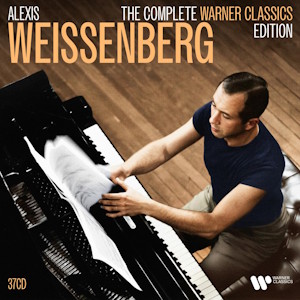
Alexis Weissenberg (piano)
The Complete Warner Classics Edition
rec. 1964-1983
Warner Classics 2685429126 [37 CDs]
Whatever you may think of Alexis Weissenberg and the 37 CDs that constitute his EMI legacy, he’s not a pianist easy to ignore. Whether pro or contra – it’s quite difficult to situate yourself in the middle so singular were his qualities – there’s no doubt that this edition has been very well compiled. What follows is a brief overview.
There are two recordings of the Goldberg Variations, first from 1967 and the remake in 1981. The first version blows fast and slow and is full of an exceptional digital clarity that often sounds superficially showy. The tone hardens too often, and the playing can be bludgeoning and bluntly phrased. Where was the tenderness? The gap between the Quodlibet and the Aria da capo is endless and the aria itself seems endless – it lasts 5:34. The remake sees some welcome rethinks regarding the Aria and its da capo (both mercifully shorter), his attention to articulation in the second variation is now crisper than in 1967 and he takes variation 13 more swiftly too but, alas, the Black Pearl goes the other way, stretching to not far short of ten wretched minutes. He doesn’t take the repeat in variation 29, otherwise he takes them all. Neither recording is especially sympathetic.
The Partitas are rather machine-tooled and once again teem with formidable clarity somewhat at the expense of expressive simplicity. Weissenberg prefers a wintry hauteur, a flinty, hard-edged, breathless sense of the music. Where his Bach comes most alive is in hyphenations where he is more voluble and volatile. Though this can come across as aggression, there’s something individualistic and very un-Myra Hess like about Jesu, Joy of Man’s Desiring. Some of the other hyphenations – by Busoni and Liszt – are impressive but I find his Bach-Busoni Chaconne to be unduly mechanistic and metrical.
CD 6 is devoted to three Beethoven sonatas. The Moonlight is powerfully emotive and convincing though not all will be converted to his brand of tonal gauntness in its finale. The Pathétique is effective and whilst the Appassionata is not especially tonally gratifying it is digitally commanding. His Beethoven Concerto cycle with von Karajan occupies the next three discs. Critical judgement on this set ranges from negative to revisionist-positive and all points in between. I didn’t find it as awful as some critics, though I did find phrasal hesitancy from the pianist at points in the C minor, along with an associated lack of buoyancy in the finale. Then in the G major there’s an aesthetic disparity between Karajan’s long legato lines in the slow movement – not grim enough – and the pianist’s responses. Having just listened to Eugen Jochum and Edwin Fischer in this work, I know what I’m missing. Otherwise, the Emperor reprises these aesthetic differences but to a less pronounced degree.
Weissenberg recorded Brahms’ D minor concerto twice, firstly with Giulini and the LSO in 1972, where the conductor adopts a rather magisterial approach, and again a decade later in Philadelphia with Muti. Muti may not indulge Giulini’s inflections, especially in the opening movement, but he proves a more direct and linear accompanist. After these discs you’ll have to turn up the volume for Weissenberg’s collaboration with Anne-Sophie Mutter in the three Brahms Sonatas and the Franck (CDs 12 and 13) as both performers are recessed in the balance. At nineteen she was already a seasoned player but little of her playing ‘sticks’ for me and her vibrato usage is too often cloying. Ignore the track list typo as they obviously don’t take 14 minutes over the Adagio in No.3. Still, Weissenberg plays Franck’s Prélude, fugue et variation very well as he does in a joyful Le Carnaval des animaux where his fellow pianist is Aldo Ciccolini.
He plays Chopin’s Nocturnes in an order of his devising, but they are mannered, unpredictable and tonally unattractive and I found elements of both Sonatas exhausting to sit through. He recorded quite a lot of Chopin but doesn’t seem artistically suited to the repertoire; his bludgeoning spirit too often leaves the music wilting, as the Waltzes disc illustrates only too graphically. It’s only when he is accompanied by Stanislaw Skrowaczewski and the Société des Concerts du Conservatoire that he sounds more assured and less stylistically wayward.
I hadn’t heard his Haydn Sonata album before and so it came as a pleasant surprise. The wry directness of the music encourages a comparably restrained response. In more popular repertoire, he can still prove a resilient and combative exponent. His Liszt Sonata, recorded in 1967 in Paris, is a case in point, full of intensity and introspection but devoid of mannerism. His role as song accompanist is often forgotten. He joins Hermann Prey for a Liszt song album – a rather gloomy selection, gloomily sung. Weissenberg proves excellent though. CD 23 couples two Mozart Concertos – No.9 with Mozart’s cadenzas, and No.21 with cadenzas by Weissenberg. I’m not much taken by the latter but the collaboration with the Vienna Symphony and Giulini works quite well.
There are occasional eccentricities of accenting in his Pictures at an Exhibition and his penchant for long pauses is evident here too, as the music stops between Baba Yaga and the Great Gate of Kiev for what seems an eternity. In the latter he introduces some Horowitzisms which are attractive. The coupling of Ravel’s Le Tombeau de Couperin is rather unconvincing, not least its Fugue. There’s a sumptuous Rachmaninov’s Second Concerto with the Berlin Philharmonic and von Karajan. The orchestra delivers a glorious performance and the soloist is on energised form except for a ridiculously protracted slow movement where everything, orchestra and piano, come to a full stop for over 14 minutes. The Franck Symphonic Variations is thankfully better and offers less latitude for indulgence. Rachmaninov’s Third Concerto is with the Orchestre National de France and Leonard Bernstein and receives another excellent performance. At first I thought the orchestral balance was unduly recessed but that’s not in fact the case.
Weissenberg the sensitive accompanist can be heard once more with Nicolai Gedda in seventeen Rachmaninov songs. It’s probably his most successful collaboration of the kind in this set. In CD 28 he plays Ravel and Prokofiev (No.3) with Seiji Ozawa and the Orchestre de Paris – both unimpeachably first-class, though I wish he were more generous in the central movement of the Ravel – and with the Berlin Philharmonic and Ozawa turns in a respectable Rhapsody in Blue (with clarinettist Karl Leister doing his best to blend-blur his line) and Variations on “I Got Rhythm”.
His Schumann occupies five discs. Carnaval is volatile, virtuosic but also relaxes and the Second Sonata generates kinetic tensile drive – taut and incisive. The Fantasie is less successful overall and Kinderszenen is ponderous in places whilst the Symphonic Studies are strongly personalised – some are formidably compelling, others listless. Perhaps because they offer less manoeuvre for this kind of personalisation, the Album for the Young is excellent and charming too – not a word that often comes to the critical pen when discussing the pianist. Davidsbündlertänze reflects his strengths and limitations too but in general his Schumann is much more convincing than his Chopin.
In 1979 he recorded an album of Richard Strauss songs with Montserrat Caballé adding Turina’s Canto a Sevilla and Montsalvatge’s Cinco Canciones Negras a month of two later. Again, he is a more than competent accompanist in these two discs, even if I still prefer the Gedda collaboration. His recording of the Tchaikovsky Concerto in Berlin with von Karajan does very little for me. It’s a misfire. The Three Movements from Petrushka finds Weissenberg on more solid ground – solo, bracing repertoire and a fine traversal. Finally, there are two LP albums of ‘Le Bis d’Alexis Weissenberg’ conjoined on one CD. These potpourris revisit elements of his discography – Chopin, Debussy – and mine the core repertory (there’s a truly feeble Brahms Intermezzo in A major) but also investigate novelties, with exciting results, such as his erstwhile teacher, Pancho Vladigerov’s Improvisation, Op.36/4 and de Séverac’s Valse romantique.
The box comes with a slim but well-written booklet note and a work list of the pieces in the set with CD number cross references. Eight of the 37 discs have been newly remastered by Art & Son. Certainly, love him or loathe him – or both – I can’t imagine this box being done better.
Jonathan Woolf
Buying this recording via the link below generates revenue for MWI, which helps the site remain free

Contents
CD 1 BACH Goldberg Variations (1967)
CD 2 BACH Goldberg Variations (1981)
CD 3 BACH Keyboard Partitas Nos. 1-5
CD 4 BACH Chromatic Fantasia and Fugue · Keyboard Partita No. 6 · Overture in the French Style · 4 Duetti, BWV 802-804 · Italian Concerto
CD 5 BACH “Jesus bleibet meine Freude”, Great transcriptions for piano
CD 6 BEETHOVEN Piano Sonatas Nos. 14 “Moonlight”, 8 “Pathétique” & 23 “Appassionata”
CD 7 BEETHOVEN Piano Concertos Nos. 1 & 2 (Berlin Philharmonic Orchestra/Herbert von Karajan)
CD 8 BEETHOVEN Piano Concertos Nos. 3 & 4 (Berlin Philharmonic Orchestra/Herbert von Karajan)
CD 9 BEETHOVEN Piano Concerto No. 5 “Emperor” (Berlin Philharmonic Orchestra/Herbert von Karajan) · Rondo “Rage over a lost penny” · Bagatelle “Für Elise” · Rondo Op. 51 No. 1 · 32 Variations on an Original Theme
CD 10 BRAHMS Piano Concerto No. 1 (LSO/Carlo Maria Giulini)
CD 11 BRAHMS Piano Concerto No. 1 (Philadelphia Orchestra/Riccardo Muti)
CD 12 BRAHMS Violin Sonatas Nos. 1-3 (Anne-Sophie Mutter)
CD 13 FRANCK Violin Sonata (Anne-Sophie Mutter) · Prélude, fugue et variation | SAINT-SAËNS Le Carnaval des animaux (Aldo Ciccolini · Michel Debost · Georges Prêtre)
CD 14 CHOPIN 12 Nocturnes
CD 15 CHOPIN 9 Nocturnes · 3 Mazurkas
CD 16 CHOPIN Piano Sonata Nos. 2 & 3
CD 17 CHOPIN 14 Waltzes
CD 18 CHOPIN Piano Concertos Nos. 1 & 2 (Société des Concerts du Conservatoire /Stanislaw Skrowaczewski)
CD 19 CHOPIN Fantasy on Polish Airs · Andante spianato et Grande polonaise brillante · Variations on Mozart’s “Là ci darem la mano” · Polonaise-fantaisie · Krakowiak (Société des Concerts du Conservatoire/Stanislaw Skrowaczewski)
CD 20 HAYDN Piano Sonatas Hob. XVI:52, 20 & 37
CD 21 LISZT Piano Sonata in B minor · 3 Sonetti di Petrarca
CD 22 LISZT Lieder for baritone · 3 Sonetti di Petrarca (Hermann Prey)
CD 23 MOZART Piano Concerto Nos. 9 “Jeunehomme” & 21 (Vienna Symphony/Carlo Maria Giulini)
CD 24 MUSSORGSKY Pictures at an Exhibition | RAVEL Le Tombeau de Couperin
CD 25 RACHMANINOV Piano Concerto No. 2 | FRANCK Symphonic Variations (Berlin Philharmonic Orchestra/Herbert von Karajan)
CD 26 RACHMANINOV Piano Concerto No. 3 (Orchestre National de France/Leonard Bernstein)
CD 27 RACHMANINOV Songs (Nicolai Gedda)
CD 28 RAVEL Piano Concerto in G | PROKOFIEV Piano Concerto No. 3 (Orchestre de Paris/Seiji Ozawa)| GERSHWIN Rhapsody in Blue · Variations on “I Got Rhythm” (Berlin Philharmonic Orchestra/Seiji Ozawa)
CD 29 SCHUMANN Carnaval · Piano Sonata No. 2
CD 30 SCHUMANN Fantasie in C major, Op. 17 · Kinderszenen
CD 31 SCHUMANN Études symphoniques · Abegg Variations · Arabeske
CD 32 SCHUMANN Album für die Jugend
CD 33 SCHUMANN Davidsbündlertänze · Humoreske · Vogel als Prophet · Träumerei
CD 34 R. STRAUSS Lieder (Montserrat Caballé)
CD 35 TCHAIKOVSKY Piano Concerto No. 1 (Berlin Philharmonic Orchestra/Herbert von Karajan) | STRAVINSKY Three Movements from Petrushka | RAVEL Valses nobles et sentimentales
CD 36 TURINA Canto a Sevilla | MONTSALVATGE Cinco Canciones Negras (Montserrat Caballé)
CD 37 Les Bis d’Alexis Weissenberg













