
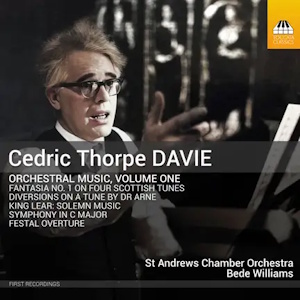
Cedric Thorpe Davie (1913-1983)
Festal Overture (1950)
Symphony in C major (1945)
Diversions on a Tune by Dr Arne (1953-54)
Solemn Music from the music to Shakespeare’s King Lear, for strings (1950)
Fantasia No.1 on Four Scottish Tunes (1937)
St Andrews Chamber Orchestra/Bede Williams
rec. 2-4 March 2026, McPherson Recital Room, Laidlaw Music Centre, University of St Andrews, Scotland
Toccata Classics TOCC0593 [63]
It was years ago, whilst watching the credits of the 1956 black-comedy film The Green Man, that I first came across the name of the composer of its score, Cedric Thorpe Davie. Now here is a disc that presents first commercial recordings of three of his major works, ones that derive from a period when he enjoyed a highly visible presence on the British musical scene, namely 1946-54. There is also the Solemn Music and a youthful, vivacious Fantasia from 1937 to close the disc and also making their first appearances on disc.
The Festal Overture was commissioned by conductor Walter Susskind to open concerts by the newly-named Scottish National Orchestra in 1950. It’s a buoyant, confident 12-minute work flecked with his native Scottish figures and possesses enough reflective material to balance the stirring bombast.
It prefaces the 18-minute, three-movement Symphony in C major which was awarded second prize in the Daily Express Symphony Competition of 1945 – those were the days – and first performed the following year by the LPO under Constant Lambert, winning further performances, one of which was with the Hallé and Barbirolli. The winner of the competition was Bernard Stevens with his ‘Symphony of Liberation’, which was recorded a long time ago by Edward Downes. The conciseness of the symphony allows for a tight organisational structure and impactful incidents, right from the opening timpani rolls and brooding dark trombones before opening out with Sibelian-derived ostinati. Both Thorpe Davie and Stevens share this trait to a degree, and to contemporary ears it sounds as if they were channelling both Sibelius and another devotee of the organic symphonic statement, Edmund Rubbra. Rubbra was only twelve years Thorpe Davie’s senior but already had four symphonies to his name. Other elements of the symphony point to the influence of Walton, certainly in the central movement, a terse but undulating Adagio. The jaunty finale manages to say all it needs to in six minutes and it’s here that potential models, or coincidental models, collide in both Walton and Sibelius. If I stress other composers, it’s only to try to situate Thorpe Davie’s milieu, not to label him derivative.
The Diversions on a Tune by Dr Arne was a commission from the National Youth Orchestra of Great Britain and first performed by them and Sir Adrian Boult at the BBC Proms. Conjecturally it’s a piece influenced by Britten’s The Young Person’s Guide to the Orchestra. The theme is followed by nine variations and Thorpe Davie has no need of a concluding fugue. His willingness, however, to turn the screw is evident from the first variation which comes as a shock after the gracious refinement of the Theme. Immediately we are plunged into a gritty, grim repudiation. Thereafter the music oscillates fruitfully, from pastoral and antiphonal drollery via a beautiful, if threnodic Adagio – so beautiful that 1:24 seems insufficient to contain its richness – and on to further variety. There’s Iberian influence in variation 5, music of sultry and terpsichorean vitality (Rubbra had done the same in the finale of his pre-war Second Violin Sonata). After this madcap travelogue, there’s an aggressive March variation and another slow variation featuring solo oboe. Then Scottish drollery infuses the penultimate variation, a movement that should put a smile on your face, so piquant is it, and the finale’s March rhythms, with trombone and percussion to the fore – not timidly, either – foreshadow something of what Malcolm Arnold would soon do in his Scottish Dances of 1957. Arthur Bliss’ Meditations on a theme of John Blow appeared the year after Thorpe Davie’s work but is a rather different affair and more serious, though still based on a theme and variations form.
Solemn Music from the music to Shakespeare’s King Lear, for strings, dates to 1950 and is very brief but possesses a moving austerity of expression. The final work in this disc is the Fantasia No.1 on Four Scottish Tunes of 1937, thirteen minutes of opulence and rhapsodic amplitude. Though it’s clearly the work of a younger man it possesses an uncomplicated, sonorous and uplifting generosity and brings the disc to a genuinely rousing end.
Though his film scores are still remembered, his orchestral works are, as the Blurb for this disc notes, as good as forgotten. I hope this release, noted as the first volume, will act as a herald for reclamation for his music and admiration for it, and for him.
The booklet notes offer a great deal of important information about him biographically and about the works performed. I also commend Toccata for putting links on its website to two BBC broadcasts of Thorpe Davie talking in 1976 and 1978, and very entertainingly and wittily. They were a must for me, and I think they will enhance your enjoyment of this disc. The music in these talks is clearly non-commercial and of historic significance.
The St Andrews Chamber Orchestra is a talented group though the strings are rather underpowered and occasionally a bit glassy, and the recording perspective in the university’s Recital Room remains a bit flat. Whilst it would have been valuable for the national orchestra to have presented these works, I imagine that cost considerations made that impossible. No one, though, with an interest in Thorpe Davie will want to pass up the opportunity to listen to these vivid scores which have been presented with vitality and sympathy by Bede Williams and his orchestra.
Jonathan Woolf
Buying this recording via the link below generates revenue for MWI, which helps the site remain free













