
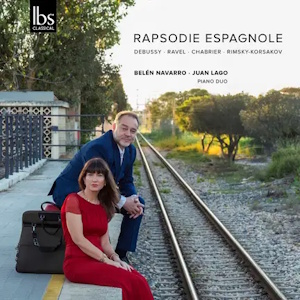
Rapsodie espagnole
Claude Debussy (1862-1918)
Ibéria (1905-8)
Emmanuel Chabrier (1841-1884)
España (1883)
Maurice Ravel (1875-1937)
Rapsodie espagnole (1907-1908)
Nicolai Rimsky-Korsakov (1844-1908)
Capriccio espagnol (1887)
Belén Navarro and Juan Lago (piano four hands)
rec. August 2022, Auditorio Manuel de Falla, Granada, Spain
IBS122025 [56]
The Spanish piano duo Belén Navarro and Juan Lago begin their recital with Debussy’s Ibéria, the central three-movement part of his Images for orchestra. Obvious as it may sound, the orchestral textures are such a major factor in one’s enjoyment that the keyboard cannot help being a disadvantage. Par les rues et par les chemins, the first movement of Ibéria, is the most successful in this performance. I could have done with more languor in parts of Les parfums de la nuit – more emphasis on Debussy’s marking of rêveur.
The artists’ keyboard touch is short on subtlety. I do not like an airy-fairy, hazily impressionistic approach to Debussy’s slower music, but neither do I care for this rather matter-of-fact interpretation. Also needed is more contrast between sections – for instance, the end of the central movement into the “Marche lointaine” which opens Le matin d’un jour de fête. This music is continuous, but the distant march (pianissimo) should immediately create a totally different world. Ms Navarro and Mr Lago allow this to pass almost unnoticed. A sense of abandoned revelry, of joie de vivre, is a little underplayed in this third movement, though they do work up a head of steam in the final pages.
In Chabrier’s España, I wish for more colour and flair. It is often rather pedestrian. Many passages with repeated notes are not easy on a keyboard, and that is pretty much how they sound here. The theme for trombones, marked forte, should be more assertive.
Ravel’s Rapsodie espagnole cries out for much more atmosphere at the beginning. In spite of the limitations of the piano, it is surely possible to create more magic here. The concluding Feria, truly festive, is the most successful performance on the disc.
I do not want to overstate my case but, as Rimsky-Korsakov and Ravel are among the most celebrated of orchestrators, each will particularly suffer in keyboard arrangements. The performance of the Capriccio espagnol is generally good, if not exceptional, so anyone requiring this rarely recorded version will not hesitate.
The booklet, in Spanish and English, tells us that Ravel’s and Rimsky-Korsakov’s pieces were arranged by the composers, Debussy’s by Caplet and Chabrier’s probably by Messager, though Chabrier himself did arrange a keyboard version. Elsewhere, the booklet notes are equally informative. The recorded piano tone is less than ideal, but this may prove as minimal a disadvantage for other listeners as it does for me.
Philip Borg-Wheeler
Buying this recording via the link below generates revenue for MWI, which helps the site remain free













