
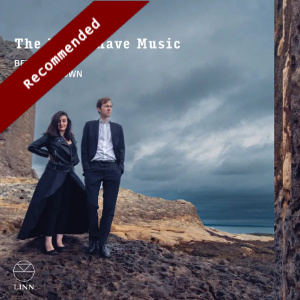
The Deeps Have Music
Beth Taylor (mezzo-soprano)
Hamish Brown (piano)
rec. 2025, University of St Andrews, UK
Original texts and English translations included
Reviewed as a download
Linn CKD794 [80]
Beth Taylor is a young Scottish mezzo-soprano whose career is developing fast. I was lucky enough to see her perform in an intimate setting in France at the end of the Covid period, and immediately realised that she was a remarkable singer and artist, whose career was bound to blossom. Recently she has contributed to recordings of, for example, Purcell, Handel, Mozart and Mahler, with some of the most prestigious conductors and performers, but this collection of songs, accompanied by Hamish Brown, is her first solo recital.
The songs here, grouped around the theme of the sea, were all first published between 1899 and 1924, with the exception of the three Schubert Lieder. Half of them are well-known, and it will be a real pleasure for the average listener to discover the rest.
What struck me immediately on hearing this recording was the pure vocal quality on display. There is a remarkable richness in the lower and middle registers, and a purity on the high notes. The timbre is velvety, the vibrato fast and perfect (except when it is reined in for effect), and the dynamic range impressive. Above all, there is never any hint of strain or wobble, or poor intonation, or any loss in evenness; just an impression of total security.
The sea, with its changing moods and multiple emotional connotations, is of course a theme which enables this voice to show all its facets, and Taylor uses all her potential with considerable sensitivity and artistry. The Harty songs which bookend the selection are performed very expressively by both singer and pianist; there is lightness, but also searing grief and drama in Sea Wrack, which Taylor concludes with a beautifully held note.
Hedwige Chrétien’s Petits Poèmes du Bord de l’Eau are charming miniatures, demanding a light touch, which have, as far as I know, been recorded only once before, in 2023. I certainly prefer Taylor’s opulent but graceful timbre to Cyril Dubois’ rather flimsy tenor. She not only catches the lightness, even mischievousness, of these pieces, but also sings in extremely well-pronounced French.
I was also very glad to discover Ethel Smyth’s interesting mini cycle Three Moods of the Sea, which requires a more reflective, intense approach. Here again, Taylor shows the whole of her dynamic range, from dramatic declamation to exquisite piano passages. These songs have attracted some much-deserved attention recently, having been recorded at least five times in the last fifteen years. My sampling of those other recordings confirms my opinion that Taylor’s rendering is second to none. Hamish Brown, the pianist, also gives the accompaniment the requisite energy, without excessive gestures.
Cameron Biles-Liddell wrote his two-song group The Breakers specifically for Beth Taylor. The first, dramatic, song certainly makes good use of her tremendous low register. In the second, the pianist produces some very nice colours, and Taylor some very delicate singing, but I admit to being less convinced, personally, by the poem and its setting.
To turn to the more well-known songs: Alma Mahler-Werfel’s Lobgesangand the three Schubert Lieder illustrate Taylor’s ability to sing German as authentically as French. She brings the richness of her timbre, and the solid core of her voice to bear on this reflective song very effectively.
She sings Schubert’s Meeres Stille with a gravitas which produces a striking contrast with Chrétien’s mélodies that preceded, draining the vibrato out of the voice very expressively at the appropriate moments; her performance certainly measures up to renderings by illustrious predecessors such as Christa Ludwig. In Gruppe aus dem Tartarus the colour is quite different, perfectly conveying the despair of the damned souls. Lied eines Schiffers an die Dioskuren brings us back to a more serene relationship between man and the ocean, with both singer and pianist creating a feeling of serenity.
Elgar’s Sea Pictures are the best-known collection on this disc, and listeners will probably know one or other of the previous recordings, usually accompanied, of course, by a full post-romantic orchestra, reviewed here by Ralph Moore. But if, like me, you have Janet Baker’s superlative version sounding in your ears, you need not fear: Taylor does not suffer in the least by comparison. The initial phrase of Sea Slumber Song is truly beautiful, with its descent to a G to which she lends all her contralto richness. She shows the range of her expressive possibilities in the various songs, be it the feeling of absolute solidity in Sabbath Morning at Sea, the rhythmic suppleness in Where Corals Lie, or the vigorous attack in The Swimmer. The booklet states that Hamish Brown is here playing his own adaptation of Elgar’s piano version; the differences are not enormous, but certainly contribute extra details from the orchestral score, adding lyricism or drama as the case may be.
Listeners looking for excellent singing and piano playing in the service of sensitive interpretation need look no further than this album. Beth Taylor’s voice never loses expressiveness, even when singing quietly, and she has the ability to make long, held notes really ‘live’. Whether it is to hear some well-known songs given fresh life, or to discover some interesting, less-known works, lovers of the song repertory would do well to acquire this album.
David James
Buying this recording via the link below generates revenue for MWI, which helps the site remain free
Contents
Traditional, arr. Hamilton Harty (1879–1941)
1. My Lagan Love 4:43
Hedwige Chrétien (1859–1944)
Petits Poèmes du Bord de l’Eau
2. La Rivière 1:16
3. La Barque 1:40
4. Les Saules 1:24
5. La Lune 0:30
6. LʼOndine 0:56
7. LʼHiver 2:01
Franz Schubert (1797–1828)
8. Meeres Stille, D. 215a/216 1:59
9. Gruppe aus dem Tartarus, D. 583 3:22
10. Lied eines Schiffers an die Dioskuren, D. 360 2:55
Cameron Biles-Liddell (b. 1997)
The Breakers
11. The Storm 5:05
12. Twilight 8:20
Alma Mahler-Werfel (1879–1964)
13. Lobgesang (No. 4 of Five Songs) 4:16
Ethel Smyth (1858–1944)
Three Moods of the Sea
14. Requies 3:15
15. Before the Squall 5:17
16. After Sunset 3:38
Edward Elgar (1857–1934)
Sea Pictures, Op. 37
17. Sea Slumber Song 5:31
18. In Haven 1:54
19. Sabbath Morning at Sea 6:17
20. Where Corals Lie 4:05
21. The Swimmer 6:48
Hamilton Harty
22. Sea Wrack 5:04













