
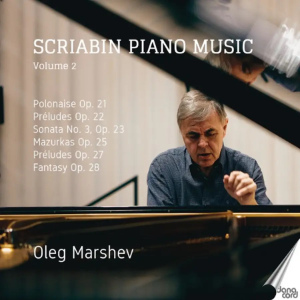
Aleksander Nikolayevich Scriabin (1872-1915)
Piano Music Volume 2
Polonaise in B Flat Minor (1897)
4 Preludes Opus 22 (1897)
Piano Sonata No 3 in F Sharp Minor Opus 23 (1897-98)
9 Mazurkas Opus 25 (1898-89)
2 Preludes Opus 27 (1900-1901)
Fantasy in F sharp minor (Opus 28) (1900)
Oleg Marshev (piano)
rec. 2026, Cultural Institute, Milan
Danacord DACOCD1020 [74]
Having recently reviewed and thoroughly enjoyed what the Armenian pianist Hayk Melikian called ‘a multi-coloured Scriabin spectrum’ in his CD ‘Bright Lights, Dark Flames’, now barely a month later I come to the turn of the acclaimed Russian pianist Oleg Marshev trying his hands at several pieces in Volume Two of his series of early Scriabin, which will certainly now be on my shopping list. His performance of Prokofiev’s First Sonata was reviewed as ‘one of the most authoritative and impassioned performances on disc so far.’ He trained at the Gnessin State Musical College and with Mikhail Voskrensky at the Moscow Conservatoire, and has won awards in several international piano competitions.
The recital begins with the Opus 21 Polonaise in B flat minor, a fairly substantial work which alternates between gloom and brightness. As in a lot of Scriabin’s piano music, many moments in it sound like Chopin – or at least the next step after him. Oleg Marshev captures these mood swings as gently as he does powerfully, with the stateliness of the polonaise managed very well.
By contrast, the Opus 22 preludes (2-5) are short and lyrical, but equally gentle in mood, and here Marshev’s touch is at its most delicate. They comprise of two andantes. with no. 3 having a slightly quicker allegretto. No. 5 is an andantino.
These are followed by the substantial piano sonata No. 3 in F sharp minor, Opus 23, which lasts just over nineteen minutes. The opening movement is marked drammatico, but the second subject, where Marshev’s gentle touch is again shown to advantage, is far more lyrical, until the final, powerful restatement of the opening theme. The third movement andante is a more substantial and played with quiet expansion, the bass undertow echoing subtly underneath, gradually building a wonderful effect whereby Marshev reduces the treble to perfectly balance the bass. For me, it is one of the highlights of the F sharp minor sonata. The final presto con fuoco gathers fire gradually, spitting here and there with occasional echoes of Rachmaninov-like sonorities. This central section eases into a more lyrical ending, while still keeping the fires burning, allowing a new theme to burst through gloriously and all too briefly. It is a fine, thoughtful performance.
The nine mazurkas of Opus 25 take up nearly half of this disc, and apart from the statelier lento of No. 3, and to a lesser extent that of No. 7, they tend towards the lively and bouncy. A typical example is the second of these in C major, a simple, playful allegretto which certainly doesn’t outstay its welcome. The E minor lento which follows is a more solemn affair, whose sadness is evoked with quiet, understated playing from Marshev. No. 4, marked vivo is a suitably lively piece in e major, bright and breezy, and clearly needing a dance floor. No. 5, in C sharp minor, is marked agitato, and is another piece that evokes sadness. I’m not sure whether the glissandos are marked, but they don’t always feel necessary. Halfway through, the agitato dies down, as if it has run out of energy, but is regaining just enough at the end to play itself out with reasserted power.
No. 6 begins as a gentle allegretto in F sharp major, a series of ripples building like the beginnings of a stream and gathering force before a final full restatement of its power in a fine crescendo from Oleg Marshev. It’s minor twin, No. 7, is in F sharp minor, marked moderato, and again echoes Rachmaninov. However, in the middle, it gathers force into something less sad and more life-affirming, but still with much of the agitation of Mazurka No 5. No 8, in B major, is another of those playful allegrettos, like the C major earlier, but deep down something darker is sounding a warning note, which insists on making its statement before we return to playtime. The ninth mazurka is genuinely sad, a mesto full of melancholy in E flat minor. Marshev shows a real affinity for these sad moments, as he does for the changes of dynamic between moods for this group of mazurkas.
This mood holds for the first of the two Opus 27 preludes, the G minor, which is marked patetico, full of driving angst and those Rachmaninov-like sonorities. Only a minute long, No. 2 in E-flat Major is an andante which seems to be barely over before it has begun.
Which leaves us with the Fantasy in F sharp minor Opus 28. The mood is again melancholy, but at times much more driven. Once again, Marshev proves himself expert at managing shifting dynamics. At nine minutes, there is ample opportunity for such shifts. Halfway through, there is another of those moments where a completely new theme burst through with intense passion, a real sit-up-and -take-notice moment and another highlight of this recital for me. The brief hushed piano that follows is beautifully conveyed, and in the final two minutes of the Fantasia, and of this recital, Marshev leaves us both impassioned and enervated.
Stephen John Wray Gladwin
Buying this recording via the link below generates revenue for MWI, which helps the site remain free













