
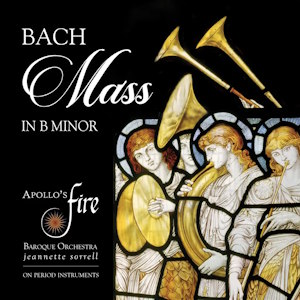
Johann Sebatian Bach (1685-1750)
Mass in B minor BWV 232
Rebecca Myers (soprano), Aryssa Leigh Burrs (mezzo-soprano), Jacob Perry (tenor), (contralto), Paul Max Tipton (bass-baritone), Edward Vogel (baritone)
Apollo’s Singers
Apollo’s Fire/Jeanette Sorrell
rec. 2025, Trinity Cathedral, Cleveland, USA
Latin text and English translation
Avie AV2850 [2 CDs: 102]
When it comes to recordings of Bach’s B minor Mass – his most Catholic, despite his being a devout Lutheran – my tastes betray me as an unreformed and unrepentant traditionalist, in that my favourites are headed by Marriner (despite the presence of a tenor who does not please me), Karajan, Münchinger and Richter, all of which date back to the 60s and 70s. Those are uniformly grand, comparatively large-scale renditions; nonetheless, I am by no means averse to a leaner, more modern interpretation with reduced forces on period instruments, reflecting the changes of taste resulting from the “historically informed” movement – and this issue from the ever-productive and enterprising Avie label caught my eye. I first sampled the sound snippets before opting to review it, deciding that it was an interesting option.
I quote the summary description on the Presto website as entirely apt: “The recording employs what Jeannette Sorrell considers to be the ideal forces for the work, utilising twenty-four instrumentalists and twenty-two choristers, including the five soloists. Sorrell said she has always wanted to do a B Minor Mass that evokes the emotional intimacy of Bach’s own performances.”
The first noticeable feature of this new recording is its comparative briskness; the traditional performances above take around two hours, whereas this is just over one hour and forty minutes, without sounding rushed, just propulsive. Secondly, the choir’s delivery of runs is interesting: elision and legato are often eschewed in favour breaking up the notes into distinctly articulated phrases. Thirdly, and obviously, the smaller forces create a more intimate and immediate mood, as per the conductor’s intention above. The singing per se is very tuneful and sweet-toned and the balance between the four vocal categories is good. The soloists are similarly pleasing, even if I am not always happy about the two women singers’ habit of swelling a note “straight” then introducing vibrato towards the end of longer phrases, as that can sound a little mannered – but better that than being vibrato-free. At no point am I left feeling that this is under-powered and the strength of the contrabass line underpinning the melodic lines anchors the performance firmly.
The Gloria has plenty of bounce and spring and the trumpets are especially bright and engaging; the melismata are elegantly despatched without any hint of breathiness or aspiration. The soloists are not operatic “star singers” of the kind who grace the vintage recordings but they are musical and tuneful, secure of intonation and without distracting mannerisms apart from that mentioned above; mezzo Aryssa Leigh Burrs and violinist Alan Choo make an attractive partnership in “Laudamus te” and the easy, natural tenor of Jacob Perry is far preferable to Robert Tear in his duetting with soprano Rebecca Myers, accompanied by the brace of delicate traverso flutes in “Domine Deus”. I feared that I would find the choir under-staffed but was pleasantly surprised to find that was not the case and there is a real drive and energy about the chorus “Cum sancto spiritu” concluding the Gloria. They are very busy in the Credo and despatch its complex counterpoint and fugue with élan. I suppose I do miss the richer, darker tones of the famous mezzos such as Janet Baker, Christa Ludwig and Yvonne Minton – what a trio – who have sung “Qui sedes” but alto – is she really? – Emily Marvosh is competent. The same goes for Paul Max Tipton, who is no Sam Ramey or Karl Ridderbusch, but we are hardly comparing like with like there and his singing per se is similarly agreeable, especially as he is supported by some sonorous, agile corno di caccia (natural, valveless hunting horn) playing from Todd Williams.
The prevailing sunniness of this work is aptly punctuated by the melancholy “Et incarnatus est”, its falling violin figures and choral lament of “Crucifixus” injected with deep emotion, then the release of “Et resurrexit” is joyful with again some agile passage work from the small choir and brilliant brass, and the “Ed expecto resurrectionem” is sung with great verve. I think my favourite number in the piece is the lilting “Et in Spiritum sanctum”, here sung with natural, unforced tone by the aptly named, light baritone Edward Vogel, accompanied by some melodiously grainy oboes. The remainder of the Mass exhibits all the virtues already adumbrated and further commentary on my part would be superfluous.
If the ethos of this venture appeals, you will be wholly content with its execution here.
Ralph Moore
Buying this recording via the link below generates revenue for MWI, which helps the site remain free













