
Vicente Álamo (b. 1980)
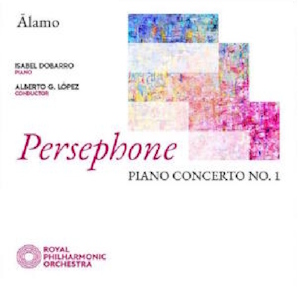
Piano Concerto No. 1 Persephone
Isabel Dobarro (piano)
Royal Philharmonic Orchestra/Alberto G. Lopez
rec. 2026, Abbey Road Studios, London
Private release [38]
This is a large-scale concerto of great emotional depth and personal passion written at a dark time for the composer. The music seems to reflect his emergence from a period which we all, at some time, can experience, and how it grew into the positive experience into a fully-fledged piano concerto. But first, let us consider Persephone.
She is the Greek goddess of the dead, but also of growth and the burgeoning of spring. Her husband was Hades who abducted her as she walked through a verdant field. She spends the winter underground but re-emerges in the spring and summer. Unsurprisingly, she has been associated with the afterlife. In other words, from near tragedy and pain there emerge optimism and prosperity. This, then, is the background to Álamo’s concerto.
The first movement begins with a beguiling piano cadenza which bursts into power before the orchestra take over with its dreamy hallow of sound which folds itself around the long lyrical lines of the piano writing. The strings wash over the solo line and the tempo is largely slow. The movement is entitled ‘Descensus’ which, of course means descent – that is, Persephone descends to the underworld.
Movement 2 is almost fourteen minutes and might appear a little too long for its material; it is also mostly slow being, I think, the emotional heart of the work. Its subtitle is ‘Inter-modus’ which I suppose in this context means ‘between ways’. The piano plays a constant string of broken arpeggios sometimes culminating in a passage which searches upwards towards the light but also offering a sense of profound loneliness, whilst often the orchestra offers hints of joyous or even ecstatic support and at other times helps the soloist to dig deep into a more personal darkness.
This is not a concerto in the tradition of the nineteenth and early twentieth centuries, where there is a conflict or struggle between soloist and orchestra; in the third movement, we have the piano in just less than the four minutes that this movement takes simply interweaving between the orchestra’s rich harmonies provided mainly by the strings. The subtitle, ‘Ad Astra, Interludio’, literally means ‘to the stars’, but if we were to add ‘Per aspera ad astra’ the meaning becomes more like ‘through hardships to the stars’ which may well be more relevant to a fuller understanding of this concerto.
Movement 4, with its silvery harmonies and rising harp arpeggios, clearly moves towards a sense of re-emergence. Its subtitle is ‘Reditus’, which I think can be thought of as ‘journeying home’. It takes over five minutes before the piano makes an entry, and it is surrounded by a big, grand, lyrical melody which seems to be never-ending in its generosity. Once it climaxes and fades it seems that Persephone, in the shape of the piano alone, has a final gentle gesture to end this extraordinary work.
As to the performance, I gather that Isabel Dobarro and the conductor had many rehearsal and discussion sessions together over a period of several weeks, and there can be no doubt that they clearly work as a team, grasping the composer’s needs. Indeed, any composer would be enormously grateful for their diligence and obvious love and understanding of the work. Dobarro plays with virtuosic intensity and the RPO are quite obviously enjoying the experience.
To summarise, this ambitious concerto is well worth exploring and one hopes that more performances will result.
Gary Higginson
Availability
This recording would appear to be only available for streaming on the major platforms.













