Joseph Haydn (1732-1809)
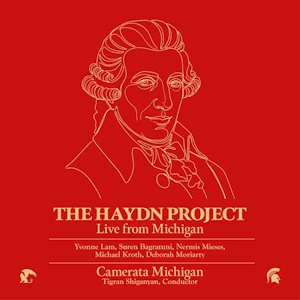
The Haydn Project – Live from Michigan
Sinfonia Concertante for violin, cello, oboe and bassoon in B flat Major, Hob. I:105
Piano Concerto in D Major, Hob. XVIII:11
Violin Concerto in G Major, Hob. VIIa:4
Cello Concerto in D Major, Hob. VIIb:2
Yvonne Lam (violin), Suren Bagratuni (cello), Deborah Moriarty (piano)
Nermis Mieses (oboe), Michael Kroth (bassoon)
Camerata Michigan/Tigran Shiganyan
rec. live, 6 October 2025, Fairchild Theater, Michigan State University, USA
Reviewed as lossless download
Blue Griffin BGR737 [89]
This recording comes from a 2025 concert at Michigan State University, part of the annual Cello Plus festival, which is mostly chamber music, but expanded here to accommodate these orchestral works. The “Haydn Project” as it has been labelled was made possible by a generous sponsorship, and I suspect that largesse extends to this release which, in its physical form, spreads rather thinly across two CDs.
Camerata Michigan is a chamber orchestra comprising students of the Michigan State University College of Music, and the five soloists are members of the college’s staff. Therefore the orchestral players are talented amateurs (I’m assuming they aren’t paid and playing in the orchestra is part of their course), and while the soloists and conductor do have solo careers, their main focus is presumably the classroom.
So how do I approach reviewing this release? Do I treat it as the commercial recording that it is, or rather, a memento of a concert that would have been enjoyed by all present? If the former, then it is in competition with the many, many recordings of these works with the best orchestras and soloists.
If the latter, then the target audience for the recording is going to be friends and family, most of whom won’t be reading this review anyway, and will buy (or not buy) it regardless of what I say.
There isn’t a right answer to this quandary, and I run the risk of sounding either brutal or patronising, neither of which is intended. So let me make a general statement about the performances to begin with, and then I will pick out some of the things that I liked, and didn’t. The general statement is that all four works are given decent performances – all the right notes in all the right places – but characterisation and colour is sacrificed in the name of accuracy. Unless you have no recordings of these works, the performances here are not going to be among your best.
The Sinfonia Concertante begins and ends well. There is freshness in the opening measures, and excellent interweaving of the four soloists throughout. The Andante is, however, taken too slowly, to the point it becomes an Adagio. Even though I felt the performance was quite good, it fades into blandness in comparison with Arcangelo and soloists directed by Jonathan Cohen (Hyperion), which is dazzling in its precision, pacing and colouring.
The Piano Concerto in D is the most recorded of Haydn’s keyboard concertos by some margin, with Presto listing over one hundred, among them some of the greats such as Michelangeli, Hamelin and Argerich. The Vivace opening movement can’t be described as vivacious in any way, Allegro non troppo seems more the approach. This time the slow movement works much better, with some delicate playing from soloist and orchestra. My comparison is Jean-Efflam Bavouzet and the Manchester Camerata (Chandos), so much better in the Vivace and also wonderfully cheeky in the Rondo.
The Violin Concerto is the least recorded of the four works – though Presto still lists over fifty – and probably fares best of the four. Yvonne Lam’s tone is not the most silky I’ve heard – that was especially evident in the Sinfonia Concertante – but it never becomes wiry or harsh. The orchestra’s playing again lacked the real fizz of a top quality orchestra, but that’s hardly surprising. I did have the sense that the soloist was having to rein herself in to avoid running ahead of the accompaniment at times. The recording of the concerto in my collection was by Amandine Beyer and Gli Incogniti (Harmonia Mundi), a very much HIP version, and hence not a great comparison. Therefore, I streamed a more mainstream one – Augustin Hadelich with the Cologne Chamber Orchestra (Naxos) – for comparison. The difference in quality was nowhere near as substantial as in the other three pieces, but I suspect that is, in part, because it is the least inspired work.
I approached the Cello Concerto, one of my favourite pieces of music, with something approaching reluctance. The opening Allegro moderato is the shortest in my collection (13:32), but the orchestral introduction is quite slow. There is a gradual acceleration, but the overall effect is rather leaden, and there are moments throughout the first movement where the orchestra does not shine, shall we say. I found the Adagio lacking a degree of poetry and in the Rondo, there is a remorselessness which was unattractive. I have no way of knowing whether the works are presented here in the order they were performed at the concert, but it did cross my mind that the players in the orchestras may have been starting to tire if this was indeed the final piece on the program. I have numerous versions of the D Major, including those by Daniel Müller-Schott (Orfeo) and Jean-Guihen Queyras (Harmonia Mundi); needless to say, the comparisons weren’t flattering.
The booklet notes are rather unbalanced: two pages covering the music, six on the performers. The sound quality is a little congested in places, and the piano is too prominent in the mix compared to the orchestra in the concerto. There is applause after each work.
If you have some connection to the music school at MSU, then this will be a good way of honouring that, but if you were at the concert, I don’t think the recording will quite stir the emotions as the live performance undoubtedly would have. If, however, you are looking at this in an objective way as a possible addition to your Haydn collection, I can’t really recommend it. It’s not as though there is anything drastically wrong, just that so many others are so much more polished, colourful and dazzling.
David Barker
Buying this recording via the link below generates revenue for MWI, which helps the site remain free