
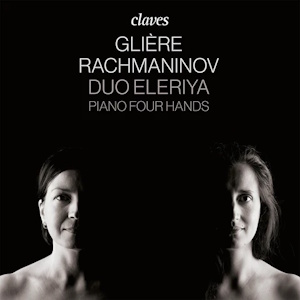
Reinhold Moritzevich Glière (1874-1956)
12 Morceaux Op 48
Sergei Vasilyevich Rachmaninoff (1873-1943)
6 Pieces Op11
Duo Eleriya Piano Four Hands
Elena Soussi (piano primo)
Valeriya Berestneva (piano secondo)
rec 2025 Théâtre Durance, Scène nationale, Les Lauzières, Château–Arnoux-Saint-Auban, France.
Claves L3369 [45]
The Russian composer Reinhold Glière’s 12 pieces for two pianos are a simple delight. I have come across his symphonies before, especially in the recordings conducted by Sir Edward Downes with the BBC Philharmonic, but his piano music is completely new to me. Indeed, this is the world premiere recording of these twelve pieces; why, I wonder, have they been so neglected? It takes a mere twenty minutes to play them; they are paired on this beautiful CD from Claves, (although we are still somewhat short-changed with only 45 minutes’ runtime) with the much better known 6 pieces op 11 for two pianos by Rachmaninov. One of the advantages of this is that it is very easy to play and thoroughly enjoy the programme over and over again without it outstaying its welcome. These two very different cycles make for a fascinating contrast: Glière, who composed and survived throughout both the Tsarist and Stalinist regimes without seemingly troubling either of them, and Rachmaninov, forced into exile in the United States of America.
Glière died in 1956, so this is the seventieth anniversary of the composer’s death, hence the opportunity for this CD. These pieces were written when he was 34, at the time of his full maturity and contain a variety of dances, lyrical passages and folk-inspired melodies. The balance between the two pianos is flexible enough to allow for different shifts and emphasis between the players and themes, and subtle interplay between textures and colours.
I love the way that the Prelude is played with such heartfelt sadness and belief; it reminds me of some of Greig’s lyric pieces: two minutes of exquisite torment or love and what a lovely start. The waltz is short and bright, the two pianists interplaying beautifully like dance partners. By contrast, the Esquisse is a light and bubbly confection, full of runs and fun and a very firm solo chord. You would think with the fourth morceaux, the plainte, that you were hearing Rachmaninov – a simple tune, but one with a sadness hidden behind every note, something the Duo Eleriya manage beautifully until it falls away. The short étude feels like a simple exercise you would use for practice for two pianos and is given a suitably bright and unified account. It, too, ends with a firm bang. The chanson bergère is also short and one of the great joys of this reassembled set is just how much Glière can express in such a short morceau.
The seventh of the pieces, arabesque, is the shortest of the twelve pieces, deliciously minor and almost like Satie. The more substantial En rêve is less dreamlike than you might imagine, somewhat fugue-like, where perhaps the second piano would work better if played at a quieter pace, more like an echo. It is however, played with a subtle delicacy. The mazurka sounds familiar enough for me to wonder if I have heard it – or something like it – before. As a mazurka, it possesses a gentle power of the sort you wouldn’t necessarily expect. It’s one of the longer pieces with a repeat and doesn’t outstay its welcome. Whereas En rêve has fugal elements (fughetta), morceaux no 10 is a proper fugue, clearly influenced by Bach, and like so many of these pieces, a tiny delight. By far the most rambunctious of the pieces is the scherzo of no 11, its bobbing notes in counterpoint to a melody which could come straight from Debussy’s Children’s Corner. No 12 brings a final touch of the east in the delicate orientale, where the upper chords move nicely over the top of a passacaglia like bass. All the moods of these twelve pieces are captured beautifully and hopefully will encourage other pianists to play the whole set or even programme them as a short filler.
Into the darker and more pensive world of Rachmaninov now, and his six pieces, op 11, written when he was just 21 and establishing those aspects of his output which would later make him so famous: the lyricism, the richness of his harmonies and the overall depth of his pianism. The barcarolle has that lovely sense of a gondola bobbing on the water, and again the two pianists convey the ripple and its undertow beautifully. In the latter stages, the ripples grow as a swell develops with some deep and resonant minor chords taking us back down to a fading ripple on the once gentler waters. The seemingly lightly dancing scherzo, is interrupted by warning chords, settling down into playful runs like a scurrying mouse. This Tom and Jerry effect is beautifully conveyed, until the strong chorded cat takes over the music altogether. The mouse has one final word, and a final truce seems to have been made. What a perfect, playful scherzo – quite beautifully played, and one of the highlights of the set; also a useful reminder that a scherzo is supposed to be a joke. The thème russe is a rather sombre piece which sounds to me as if it takes place in the quiet of the night. The effect of the interplay between the pianists is like that of church bells, but these are interrupted by runs which become briefly frantic until the bells restate themselves, before dying away leaving the original plaintive melody. The bells reappear in one final imperial reminder of their status.
No 4 is a waltz which could conceivably come from one of Shostakovich’s ballet suites. In a seesaw of exchange, the two pianists step between deep minor sonorities and echoes, before the higher register explodes again in a thoroughly delightful reengaging with the original waltz tune. I am reminded mostly of a roundabout, but if the roundabout ended as suddenly, there would be casualties. Elena Soussi and Tatyana Berestneva play the slightly thoughtful, slightly doleful Romance with as much care and unity as they do everything else. We are left with the sixth and most familiar piece of these six, Slava, or glory. For a piece with such a confident theme, it takes a good amount of time to get to the bell-like climax (Rachmaninov put bells in everything), but once we are there, there is no doubt that triumph and celebration is what this is all about. In another of the duo’s finest moments, the whole thing is built up beautifully, before being sustained with great power and finesse.
Spending forty-five minutes in the company of this duo is an absolute delight, but the first airing of these delightful twelve morceaux by Glière is the real winner here.
Stephen John Wray Gladwin
Availability: ClavesContents
Reinhold Glière
12 Morceaux
Prelude
Valse
Esquisse
Plainte
Étude
Chanson Bergere
Arabesque
En Reve
Mazurka
Fughetta
Scherzo
Orientale
Sergei Rachmaninov
6 Pieces opus 11
Barcarolle
Scherzo
Theme Russe
Waltz
Romance
Slava (Glory)













