
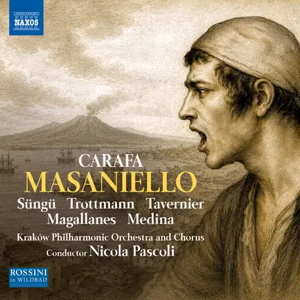
Michele Carafa (1787-1872)
Masaniello (1827)
Masaniello – Mert Süngü (tenor)
Léona – Catherine Trottmann (soprano)
Ruffino – NathanaëlTavernier (bass)
Le Conte Torellas/ Calatravio – Luis Magallanes (tenor)
Matteo –Juan José Medina (tenor)
Kraków Philharmonic Chorus and Orchestra / Nicola Pascoli
rec. live, 19 & 26 July 2024, Trinkhalle, Bad Wildbad, Germany
French Libretto is available for downloading online
Naxos 8.660614-15 [2 CDs: 119]
This is the world premiere recording of Carafa’s Masaniello, written for the Opéra-Comique’s Christmas season in 1827. Carafa was a colleague and close friend of Rossini from his days in Naples, where he did his musical studies. Despite posterity keeping most of Carafa’s compositions well within Rossini’s shadow, Rossini thought enough of Carafa’s musical skills to ask him to help out by providing music for one aria in the first version of Mosé in Egitto (1818). Carafa took on the challenge of conquering Paris at roughly the same period that Rossini did. Masaniello was one of his most successful works composed for Paris. It was an enormous hit in 1827 and only gradually began to disappear behind the shadow cast by Daniel Auber’s La muete di portici (1828), which is based on the same historical event and happens to have the same character name for its leading role (a situation which causes some confusion between the two works). It should be noted that the stories and characters of both operas are completely different from one another. Interestingly, because of the political nature of the plot for both operas, the French censors were as much preoccupied with Carafa’s opera, as they were a year later with Auber’s.
The first thing one notices on hearing Carafa’s music is how engagingly tuneful it all is. His invention is recognizably Rossinian in manner but his own style adds a little twist. The melodies trip and bounce along in a rather lively manner, not unlike any other music intended for the Opéra-Comique in that era. For today’s listener it is almost like one might experience in a Gilbert and Sullivan operetta. In a direct comparison with the more famed music of Daniel Auber’s La muete di portici, theItalian Carafa’s musical achievement wins in terms of the composer’s captivating melodic gift. Where Carafa fails his audience is in providing music of sufficient dramatic weight to support the seriousness of the events of the libretto. Auber’s opera develops a defined musical stature as it goes along whereas Carafa resolutely resists any weighty approach to the music until the very last number in the Fourth Act. With Mount Vesuvius erupting and the main character simultaneously being assassinated by the populace, he could hardly avoid having to abandon the consistently bel-canto bounce of the rest of this score. This leaves one with the impression that the score is relatively incongruous on the whole. I don’t wish to make too much of this, but if Carafa’s score lacks dramatic impact, it still provides a major compensation in the beautiful, melodic structure it possesses. This new recording derives from a series of concert performances from the Rossini Festival in Bad Wilbad where they performed all of the music, but eliminated the spoken dialogue between each number.
The singing on these recordings is rarely on an accomplished level, but the young singers used are all more than capable, and they and do a fine job of rescuing the score from the total oblivion in which it has resided since the last known revival of the opera in 1882.
Mert Süngü’s Masaniello is a flawed but interesting performance. His tone can be bright and open but there is a slight unevenness at the core of his timbre, which gives the character an extra hint of instability that is not inappropriate for the fiery tempered fisherman. Catherine Trottmann is an alluring Léona. Her refulgent tone and authentic French style make the lovely Second Act Romance a real highlight of this set. Carafa doesn’t make any huge demands on her In terms of flexibility, but what there is she manages very well. NathanaëlTavernier as Ruffino really impresses with his huge, well-managed bass. His contribution is the most notable achievement among the entire cast. Luis Magallanes brings a bright, heady-sounding tenor to the double roles in which he is cast (Le Conte Torellas/Calatravio). Magallanes’ abilities are well captured by the engineers and I look forward to hearing more from both him and Tavernier in future.
Nicola Pascoli conducts this opera with a good instinct for presenting the lively rhythms and orchestral colours. Both the orchestra and chorus are very engaged although they each could stand the addition of a few extra members to get the music across. The strings in particular sound to me as if they are working with a reduced number of players. The engineers have done a good job of capturing these live performances within a relatively natural sounding acoustic. Where the orchestra is concerned the sound is pleasingly like being in an auditorium and it is only in a couple of fully concerted passages where the recording starts to sound a bit congested. The chorus is a bit distanced and one has the impression that a few more bodies would give their music greater impact. Notwithstanding, I would rather the chorus be too distanced, rather than having them too close in the sound field. The principal singers are all very forwardly placed so their singing has plenty of presence. Naxos provides the usual well-tracked description of the plot rather than the complete libretto, which can be accessed online.
Despite Carafa’s music lacking sufficient dramatic weight this is a most enjoyable discovery. As long as one doesn’t mind immersing oneself in music of lightness, brio and charm, with a limited engagement of one’s deeper emotions. The overall level of performance, while slightly flawed, gives the listener enough of an impression of Carafa’s skills to hopefully encourage more of his works back into the light of day again.
Mike Parr
Other cast
Théresia – Camilla Carol Farias (mezzo)
Le Gouverneur / Giacomo – Francesco Bossi (baritone)
Pedro / Charlatan – Massimo Frigato (tenor)
Buying this recording via the link below generates revenue for MWI, which helps the site remain free













