
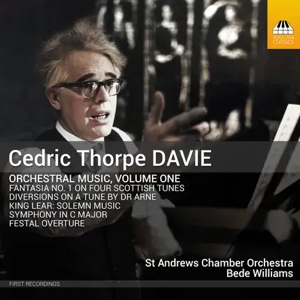
Cedric Thorpe Davie (1913-1983)
Festal Overture (1950)
Symphony in C major (1946)
Diversions on a Theme by Dr Arne (1953/1954)
Solemn Music from King Lear (1950)
Fantasia No.1 on Four Scottish Tunes (1937)
St Andrews Chamber Orchestra / Bede Williams
rec. 2026, McPherson Recital Room, Laidlow Music Centre, University of St Andrews, UK
Toccata Classics TOCC0593 [63]
Before I received this disc, I had but a very limited knowledge of Cedric Thorpe Davie’s music: two short works – an anthem for chorus and organ of 1937 and the Coronation March Royal Mile of 1952 – and the somewhat more substantial Christmas Sequence Rejoice and be merry for treble voices, strings and piano of 1956. (The latter appeared in a recital of Christmas carols mostly by Flemish composers, sung by Flemish school choirs; it was released on a label that must now be impossible to track down.) The present disc is most welcome, and I suppose many will give it a warm welcome too. This first volume in Toccata’s series of Davie’s orchestral music offers a fair survey of his output, works that span some twenty years of his composing life.
The selection opens in a rumbustious, appropriately festive manner. Walter Susskind commissioned the Festal Overture for the inaugural concert of the newly renamed Scottish National Orchestra. The music has all the impetus, swagger and energy befitting the occasion. It may sound somewhat Waltonian at times, none the worse for that, but with a clear Scottish accent. This brilliantly scored overture demonstrates, if proof was needed, Davie’s feel for telling orchestration.
Composed at the very end of the war, Davie’s Symphony in C major is a considerably more serious affair. This compact work is a formidable example of concentrated symphonic writing packed with invention. Davie submitted it to the Daily Express Symphony Competition in 1945. It was awarded second prize; the winner was Bernard Stevens’s Symphony of Liberation.
The symphony is laid out in the fairly traditional three-movement pattern. The Allegro moderato movement begins with an arresting gesture: a three-note motif functioning as a unifying element throughout the movement, be it in it original form or in variations. This lends remarkable coherence to the whole. The Adagio movement is appropriately expressive without ever falling into banality or sentimentality. The Allegro non troppo lastmovement resumes the impetus by way of pithy melodic cells and “subtle Scottish inflections”, as Bede Williams has it in the remarkably detailed notes about the music.
One may wonder why this symphony is not heard more often, let alone recorded. It suffers the same fate as many works of the early 1950s, when the prevailing trend took the musical world in a quite different direction. Now, however, the time is ripe for a serious and honest reassessment of all these composers and their all too easily overlooked output. (Think of Richard Arnell, Stanley Bate and many others often snubbed as the Cheltenham symphonists.) I think that this powerful piece definitely deserves to be appreciated for all it is worth.
Diversions on a Tune by Dr Arne show another side of Davie’s hugely varied music-making. The National Youth Orchestra of Great Britain commissioned the work and first performed it at the BBC Proms under the direction of Sir Adrian Boult. The piece is roughly comparable to Britten’s The Young Person’s Guide to the Orchestra of 1945, composed for a British educational documentary. It is a theme and variations on a theme from Thomas Arne’s opera Thomas and Sally from 1760, stated right away in a pure Neo-classical manner. The music moves from one variation to the other with ease and sometimes with a good deal of gentle musical humour; consider the fifth variation Comodo with its Iberian accents – Dr Arne travels to Spain?. That allows for an agreeably varied (pun unintended) composition which culminates in a fugal momentum to bring the Diversions to their triumphant close. This delightful work was well received and appreciated at the time of its early performances, but did not manage to resist the musical fashion of its time.
The Solemn Music is an arrangement for strings of some incidental music that Davie composed for the 1950 production of King Lear directed by Sir John Gielgud and Anthony Quayle. The music was then scored for solo violin and divisi violas and cellos, suggesting a viol consort. It must have sounded quite well in its original layout. The arrangement for strings made at the same time works remarkably well too. It is a very fine example of Davie’s ability to express much within a short span of time.
The last work here is also the oldest. The Fantasia No.1 on Four Scottish Tuneswas “most probably composed at the instigation of Ian Whyte who conducted the first performance”. Ian Whyte (1901-1960) was a pupil of Ralph Vaughan Williams, as was Davie. He had a fairly large output including an opera, two symphonies and much more that is still to be reassessed. The Fantasia is based on the hymn tune Martyrs that has the lion’s share and acts as a linking thread till the very when it is forcefully restated in an assertive final gesture. Contrasting with Martyrs are On Ettrick’s Banks introducing “a gently pastoral strain” and My Love’s in Germany. The final section, Miss Mary Grant’s Reel, imbues the music with a strong Scottish flavour before the crowning restatement of Martyrs.
Fantasia No.1 is a lovely piece, a fitting conclusion to this release. By the way, there exists a Fantasia No.2 on Four Scottish Tunescomposed in 1964, which one hopes to find in Volume 2 of Toccata’s series.
All in all, this is a fine release with excellent performances in very good recording and with in-depth notes that are a definite asset. (I have quoted from them, with thanks.) I for one cannot wait to hear Volume 2. Davie’s music is well worth more than the occasional hearing.
Hubert Culot
Buying this recording via the link below generates revenue for MWI, which helps the site remain free













