
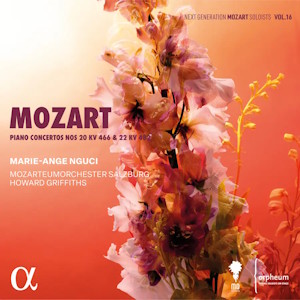
Wolfgang Amadeus Mozart (1756-1791)
Piano Concerto No. 20 KV466
Piano Concerto No. 22 KV482
Marie-Ange Nguci (piano)
Mozarteumorchester Salzburg/Howard Griffiths
rec. 2023, Angela Fersti Saal, Orchesterhaus Salzburg
Next Generation Mozart Soloists Volume 16
Alpha Classics 1245 [65]
As my colleague Ralph Moore recently confirmed, this sixteen-volume series of Next Generation Mozart Soloists from Alpha Classics has been getting solidly positive reviews here on Music Web International. With what I believe to be the final instalment, the producers of the series have decided to end on a high, following on from Ralph’s high praise for the previous instalment, especially Piano Concerto no 27. So, to finish, we have the remaining two piano concertos from the fiercely talented 29-year-old Albanian pianist Marie-Ange Nguci. Aged thirteen, she entered the Paris Conservatory where she studied with Prof. Nicholas Angelich. Having studied orchestra conducting at Vienna’s Universität für Musik und darstellende Kunst, aged eighteen she was admitted to the City University of New York for a PhD-DMA degree in Music. She also holds an MBA degree in Cultural Management. Still so young, she has already toured extensively and collaborated with a whole mass of conductors and soloists. Following her acclaimed debut came Festival de la Roque d’Anthéron, she has also been pursuing her conducting career.
In the Concerto No 22, it’s the orchestra which I notice first: the sound is tight and full, the very best of period instrument approaches in the allegro; there is no need for vibrato when the pace is this tight and punchy. The pianist has a light and springy touch, which at first hearing also seems full of joy. Woodwinds stay in the background, complementing without pushing, but the orchestra make their mark at the second tutti. There is a lovely balance between orchestra and soloist, and a shimmer to her tone – there is a danthron definite sense that this is how I want Mozart to be played. In the section before the final tutti and the cadenza, Nguci shows herself capable of great force in the lower register. The short, but delightful Hummel cadenza is delivered with equal delicacy and fluidity on the one hand, switching to that same forcefulness, before displaying dazzling runs to play out the movement.
Even before you hear the andante second movement, you know that Nguci will probably play it with that same loving lightness of touch that she showed in the opening movement. Once again, the flutes and clarinets in particular provide the perfect accompaniment, and there is a real sense growing of orchestra and soloist belonging to each other. It feels as if they have played this together many times. There are beautiful flickering runs between flute and bassoon, before the second part of the movement, where both the orchestral playing and the pianism are more ornamented and extensive. The bassoon grandfathers grumpily in the background, as the movement falls out beautifully.
Some people might have grown tired of Nguci’s universal lightness of touch by now, but I’m not one of them. In this movement’s allegro, it’s the Mozarteumorchester Salzburg who again provide the punch, ably pushed on their way by Howard Griffiths, leaving Nguci to her delightful springing and dancing, accompanied by excellent woodwind flourishes. After the repeat, the flourishes and ornamentation return, but the same gossamer delicacy is evident. A beautiful woodwind passage, straight out of Mozart’s wonderful tune playbook, is reminiscent of the reconciliation scene from the end of The Marriage of Figaro, and the interplay between orchestra and pianist is quite delicious. Finally, the springing ornamentation, the backing of winds and finally the whole orchestra come together in joyful union to finish this truly memorable account of one of Mozart’s most popular concertos, and the staggered conclusion is one of the many delights of this performance.
The orchestra and Howard Griffiths give the opening of the D minor concerto one of the finest openings I have heard: a real growling base, followed by the solid punch of the main theme. Once again, Nguci slides in as if she were born to it, becoming part of the ensemble and adding her own undercurrent to complement it. Her chords are strong when they need to be, and wisp-delicate when they do not, and the woodwind, especially the bassoon and flute, again bring a wonderful counterpoint to her playing and the almost hidden sense of fun behind the minor angst. The orchestra’s repeat of the original growling opening is even lighter this time, giving real punch to the following section. I believe one of the signs of a good Mozart performance is when both orchestra and soloist bring something just slightly different to the table in the repeat. Here there is a shift in dynamics from both, leading into the famous Beethoven cadenza. I love her grumbling lower chords at the beginning, giving way at times to a delicacy which has surely become one of the watchwords of these performances. Her runs and shifts are beautifully judged, as are the power chords right at the end.
The famous romance has the same delicate approach for much of the time, but clearly it’s even more appropriate here, where in the opening section in particular, Howard Griffiths backs her with the same understated playing. Again, for such well known music, something a little different is needed, with the upward runs maybe providing the more appropriate darker edge to this minor concerto. Just before the final repeat begins, Nguci slows up the piece beautifully, showing that her judgement is as ever impeccable.
The piano leads the orchestra into the final rondo, and the orchestra’s excellent strings are buzzing and powerful. Nguci’s springy playfulness comes to the fore again in preparation for one of Mozart’s most playful endings. Indeed, she pretty much saves the best until last, ably backed by the fizzing playing of the Mozarteumorchester Salzburg. Hummel’s short cadenza leaps and bounces, teasing us into the ending. Then, in peep the woodwinds and those driving strings, while Nguci’s piano re-states that growling undercurrent that swims the piece towards the close.
There are, of course, shelf-loads of other interpretations from many years back. I have always had a soft spot for many of the concertos with Ashkenazy and the Philharmonia, but especially the D minor, and Murray Pereiha and the English Chamber Orchestra gives a sensitive account of no 22, as he does the remainder of the cycle. If given a choice between discarding these two, and replacing them with this edition, I would need to give it deep consideration and you can’t say fairer than that.
In conclusion, I have to be totally positive, as I find that these delightful interpretations of well-worn repertoire are not just well above the average, but also provide a sense of joy and fun which is the mark of Nguci’s style.
Stephen John Wray Gladwin
Buying this recording via the link below generates revenue for MWI, which helps the site remain free













