
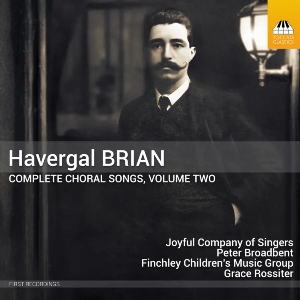
Havergal Brian (1876-1972)
Complete Choral Songs Volume 2
rec. 2021/22, St. Jude on the Hill, London, UK
Full texts in English only
Toccata Classics TOCC0680 [67]
This is the companion to Volume 1 which Toccata Classics released in the middle of 2025 (review). Both volumes were recorded at the same sessions, so my comments on the quality of recording, sensitive performances and good documentation apply equally. All thirty two tracks are marked as first recordings; the Joyful Company of Singers perform twenty five and Finchley Children’s Music Group the remaining seven. The notes identify A Child’s Prayer as a SATB setting but John Pickard’s exemplary essay confirms what the listener’s ear suggests: this is a two-part setting for children’s choir. Indeed, the bulk of this programme are settings for upper voices. Stars of the Summer Night are a setting for 8-part choir, and another eight are for the standard 4-part SATB.
Returning to this repertoire a year or so later, I find my reaction to the actual performances almost identical. The Joyful Company of Singers are clearly a skilled group. The amount of far-from-easy (or familiar!) repertoire they sing here is very demanding, so it is great credit that the performances are as competent as they are. Yet I cannot say I find their actual sound especially attractive. The notes are all there and the intonation is steady but tonally there are a couple of voices – especially in the soprano line – that sound intrusive rather than blended. Given the preponderance of upper-voice songs on this volume, this is more noticeable. This is not a major issue but it does detract slightly from the sheer aural pleasure. The singing of the Finchley Children’s Music Group continues to impress. It strikes me that they have exactly the right kind of tonal blend and youthful brio.
In many ways, any review of this disc is fairly superfluous. Admirers of the composer or those who bought Volume 1 will be collecting this disc regardless of reviews. Conversely, this is a niche area, an unlikely gateway for those coming to the music of Havergal Brian for the first time. In the notes to volume 1, John Pickard suggested that there were at least eighty such works; that suggests that volume 3 must be in the offing to complete the survey. Three of the current collections date from relatively early in Brian’s career, 1905-1910, and the rest from 1914-1924.
The notes suggest that the five latest works have compositional links to the mighty Gothic Symphony. They show a similar use of canonic writing and imitative polyphony. Pickard suggests that those are eithera kind of compositional ‘studies’ for the larger work or simply a recreational break from the epic score. Because of this association and the fact they are SATB settings, I found them to be particularly interesting.
Pickard characterises Introit as “rather stiff” but he notes a kind of cross-centuries similarity to Palestrina – I have to say I enjoyed it, exercise or not. Vital Spark of Heavenly Flame,another canon from 1924 is for four-part upper voices. This is the kind of somewhat tortuous winding harmony that I suspect some listeners do not respond to in Brian’s work: it could sound rather effortful and lacking fluency. Toccata interestingly juxtapose this with the simplest of songs, the two-part A Child’s Prayer which could not be more different. It has a naive charm but there can be little doubt that Brian wrote this and several other settings on this disc as potential money-makers rather than out of any great artistic imperative. This applies to all of the eight settings for children’s voices and a significant number of the upper voice settings too. Let me repeat the observation from my earlier review:
“Brian’s composing career was in no small part shaped by the fact that he had to work and earn a wage. Not for him the comparative luxury of private wealth and income that benefitted contemporaries such as Bax, Delius or Vaughan Williams. As such it can be understood that possibly the writing of accessible part songs for the use by amateur choirs might well provide an income stream. Unlike composers such as John Foulds, Brian never embraced the earning opportunities of the burgeoning light music field – although when you hear some of these settings as well as his earlier orchestral suites you realise he did have the compositional capacity to write in a ‘popular’ style should he have so wished.”
More interesting are the less ‘commercial’ settings such as The Phantom Wooer. It is interesting to compare the “chromaticism runs amok” of this work with, say, Hubert Parry’s contemporaneous masterly Songs of Farewell. The latter represent the summation of an important establishment composer rooted in the previous century; the former is a self-taught maverick seeking his own voice. Perhaps, now that this survey is some sixty songs along its course, it is possible to form a more considered opinion as to Brian’s voice (pun intended) as a choral composer.
I find it telling that all of these works date from the phase of his compositional life when he needed to see a financial return from his musical labours. The result is a group of songs that either are consciously simple or else veer towards the demandingly complex. Brian is not the first significant composer who wrote ungrateful vocal parts. Yet in the more complex songs I wonder whether he interest lies more with the musical/technical aspect of the writing – the counterpoint and harmony, for example – than crafting the flow of the vocal lines. Clearly, through the wide and careful choices of authors and texts, Brian did care deeply about the words he was setting but I am not convinced he was a natural song writer.
Collectors committed to the composer or to this series will make their minds up to purchase or not. This is going to be a niche release – albeit a valuable one – of a niche composer. As before, the production team of engineer/editor Adaq Khan and producer Michael Ponder have done an excellent job of ensuring consistency of sound production across the different session dates and locations. Toccata’s documentation is as informative and illuminating as ever. Perhaps my enthusiasm for Brian’s choral songs is beginning to wane just slightly.
Nick Barnard
Contents
Daybreak1 (SATB 1910)Tell me, thou soul of her I love1 (SATB 1906)
Stars of the Summer Night1 (SSAATTBB 1905)
Rondel: in a fairy Boat1 (SSAA 1906)
Introit1 (SATB 1924)
Vital Spark of Heavenly flame1 (SSAA 1924)
A Child’s Prayer3 (SA 1914)
If I had but two little wings3 (SA 1914)
Little White Lily3 (SA 1914)
Tell me, where is fancy bred1 (SSAA c.1919)
It was a lover and his lass1,2 (SSAA 1919)
Fairies’ Song1 (SSAA 1908)
Absence1 (SSAA 1919)
Pack, Clouds, Away1,2 (SSA 1919)
Pastoral: The Shepherd1 (SSAA 1914)
Infant Joy1 (SSAA 1914)
The Lamb1,2 (SSA 1914)
Laughing Song1,2 (SSA 1914)
The Fairy Palace1,2 (SSA 1915)
Spring, the sweet spring1,2 (SA 1919)
The Lost Doll3 (Unison 1914)
The Dream1,2 (SSA 1914)
The Echoing Green1,2 (SSA 1914)
The Moon3 (SA 1914)
The River3 (SA 1914)
The Mountain and the Squirrel3 (Unison 1914)
What does little birdie say?3 (Unison 1914)
Shall I then be spared?1 (SATB 1924)
O Happiness, celestial fair1 (SATB 1924)
Sweet Solitude1 (SATB 1924)
The Phantom Wooer1 (SATB 1918)
He was a rat1 (SATB 1914)
1 Joyful Company of Singers / Peter Broadbent
2 Gavin Roberts (piano)
3 John Evans (piano), Finchley Children’s Music Group, Grace Rossiter
Buying this recording via the link below generates revenue for MWI, which helps the site remain free













