
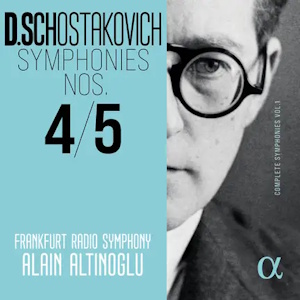
Dmitri Shostakovich (1906-1975)
Symphony No 4 in C minor, Op 43 (1936)
Symphony No 5 in D minor, Op 47 (1937)
Frankfurt Radio Symphony / Alain Altinoglu
rec. 2024, Groβer Saal, der Alten Oper, Frankfurt (No 4); Sendesaal des Hessischen Rundfunks, Frankfurt (No 5)
Alpha 1173 [2CDs: 110]
A little belatedly, I’ve just caught up with this set which is, I understand, the first instalment in a projected cycle of the Shostakovich symphonies from the French conductor, Alain Altinoglu and the Frankfurt Radio Symphony Orchestra. To the best of my recollection, I’ve not encountered much of Altinoglu’s work in the past. However, in 2024 I was very impressed by a very fine recording that he and the FRSO made of Florent Schmitt’s La Tragédie de Salomé (review). I think that recording was been made just after he became the Chief Conductor of the FRSO, an appointment which began in the 2021/22 season and which I believe has now been extended to the 2027/28 season. The excellence of the Schmitt recording made me keen to hear the partnership in Shostakovich.
It was shrewd planning to begin the cycle with a pairing of the Fourth and Fifth symphonies. The Fourth, caught up in the Lady Macbeth of Mtsensk furore, was withdrawn from the firing line by its composer; the scheduled premiere was postponed and the work was not performed until the end of 1961 though, significantly, the symphony retained its opus number, meaning that Shostakovich stood by it. The Fifth, ‘A Soviet artist’s response to just criticism’, was much more conservative in tone and rehabilitated the composer in official eyes.
It’s pointless to speculate as to the direction in which Shostakovich’s music might have moved had the Fourth symphony been premiered and published on schedule. It’s a radical work but also, I believe, a great one. For my money, it represents a considerable advance on the Second and Third symphonies. Everything about the Fourth symphony is on a huge scale; its three movements play for some 65 minutes and the outer movements are hugely ambitious in scope and duration. Furthermore, it requires a vast orchestra and the music makes tremendous demands on all sections of the orchestra and on the conductor who leads the performance. I found this present performance highly impressive in terms of both the playing and the interpretation. Altinoglu grabbed my attention at once; the opening pages of the symphony’s first movement are incisive and purposeful. It soon became apparent that the conductor has a firm grip on the music and that the FRSO is in trenchant form. The performance is enhanced because the engineers have provided first class sound: the recording has great clarity and a wide dynamic range. The first huge, dissonant climax (7:16) is brazen in its power, but immediately afterwards the quiet bassoon threnody, with the barest of accompaniment, is just as compelling. The movement is split into two tracks; the second track (Presto) begins after 15:40. In that Presto, the Frankfurt strings have to play at a blistering pace but their articulation never falters. At 4:33 comes a series of dissonant brass chords with percussion decoration, each one is louder than the previous one. Altinoglu brings this off expertly as he does the varied reprise of the movement’s opening for which those chords have paved the way. The profoundly uneasy conclusion to the first movement is very well done.
The second movement (Moderato con moto) features piquant, precise playing. The movement as a whole is a success, not least in the way conductor and orchestra deliver the shadowy conclusion (from 8:13). The vast third movement is also divided into two tracks, the first of which contains the imposing Largo. This section begins slowly and ominously – the first bassoon does very well. The music is essentially a slow, spectral march during which Altinoglu gradually increases the tension. He handles the transition to the second, much longer part of the movement very convincingly. This second section begins Allegro non troppo. The performance is fast-paced and fierce but Altinoglu is careful not to overlook the ‘non troppo’ qualification. A lot of attention is claimed first by a brisk, witty solo bassoon (from 6:54) and, subsequently by a much more assertive solo trombonist; these two excellent players vie for centre stage in an extended episode which shows Shostakovich’s sardonic humour. However, at 14:11 relentless timpani begin to pound and an immense and extended climax ensues (to 16:40). This is quite unlike anything in the composer’s symphonic output to date. Altinoglu and his orchestra, aided by superb engineering, really deliver the goods in this passage; despite the tumult there’s still great clarity. This ominous climax is followed immediately by the equally ominous and very extended hushed coda. Here, conductor and orchestra display great concentration and control. It’s a very unsettling end to a disturbing symphony.
On the surface at least, the Fifth symphony is more traditional and more Russian, factors which no doubt explain why it is so popular while the enigmatic and troubled Fourth takes some getting to know. Once again, Altinoglu grabs the listener’s attention at once; his strings really dig into the opening phrases. In the opening paragraphs, the Frankfurt string choir plays with eloquence. It seems to me that Altinoglu paces the music idiomatically, communicating it well. He builds the movement gradually to its main climax and when it arrives (10:52) the climax is potent. Thereafter, as the movement nears its end, the gentle flute and horn duet comes as balm. There’s good weight in the sound made by the cellos and basses as they begin the Allegretto. The playing in this movement has all the brio and panache that the music needs if it is to make its effect.
The start of the Largo is grave and serious; the string sound is full-bodied. I admired the intensity that Altinoglu and his orchestra bring to the music but the intensity feels natural; this is not a heart-on-sleeve performance. As a result, the climaxes seem arrived at in a very logical way. In saying all this, though, I mustn’t give the impression that this is a cold, detached performance; such is not the case. I think I’d describe the performance overall as one of sober eloquence. Altinoglu works up to the main climax (from 8:31) in a very convincing fashion and makes it into a powerful utterance. In the finale Shostakovich gave the Party what the apparatchiks wanted. Initially, Altinoglu delivers a fast and extrovert performance – it’s almost headstrong. At 3:36 Shostakovich applies the brakes and produces a much more reflective episode, led off by a ripe horn solo; for my money, this is the most convincing part of the movement. This section (to 7:33) is very well done. Then Shostakovich builds to a rather obvious, full-blown ending; Altinoglu and the FRSO pay the composer the compliment of producing a very fine account of the closing pages, making the music sonorous and powerful.
This is a very good performance of the Fifth, though I feel that the Fourth is even more impressive. Alain Altinoglu has the measure of that challenging score and communicates it very effectively. That’s also true of the Fifth symphony. The playing of the Frankfurt Radio Symphony is outstanding in both works.
Both performances are conveyed in first-class sound. Two different venues and engineering teams were involved. I had the impression that there was a little more space around the sound of the orchestra in the Fifth symphony but both works have been recorded with clarity, excellent definition and presence.
If this standard of playing and interpretation is maintained throughout the rest of this projected cycle it will be very interesting to follow. The release of the second instalment – the mighty Eighth – is imminent, I believe. I await that with considerable interest.
John Quinn
Buying this recording via the link below generates revenue for MWI, which helps the site remain free













