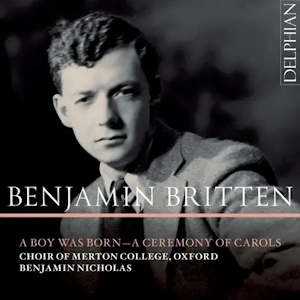
Benjamin Britten (1913-1976)
A Ceremony of Carols, Op 28 (1942/43)
A Hymn to the Virgin (1930)
A Shepherd’s Carol (1944)
A boy was born, Op 3 (1933)
Prelude & Fugue on a Theme of Victoria (1946)
Festival Te Deum, Op 32 (1944)
The Girl Choristers of Merton College, Oxford
The Choir of Merton College, Oxford / Benjamin Nicholas
Cecily Beer (harp); François Cloete (organ)
rec. 2025 & 2026, Chapel of Merton College, Oxford
Texts included
Delphian DCD34370 [77]
To mark the fiftieth anniversary of the death of Benjamin Britten, Benjamin Nicholas and Delphian have had the happy idea of putting together a programme largely, but not wholly, centred around the composer’s Christmas music for a cappella choir.
A Ceremony of Carols is very often performed and recorded by choirs of boy trebles. Indeed, it was through singing the work as a schoolboy that I first came to know it. Only later did I discover not only that it is just as effective when sung by adult sopranos and altos but that Britten conceived the work for such voices; it was an adult choir which first performed it. On this disc we hear it sung by the sopranos and altos of the Choir of Merton College. The Procession (‘Hodie Christs natus est’) is marvellously presented here. I imagine that the sopranos began to sing at the west end of the College Chapel, where the organ is situated. Paul Baxter’s recording catches their distant voices to perfection and then we hear them very naturally getting closer as they process into the chapel itself. ‘Wolcum Yole’ has a fine spring to its step; in contrast, I love the steady, mysterious tread of ‘There is no rose’. During this performance of A Ceremony of Carols no fewer than six members of the choir sing solos; all do extremely well. Arguably, it’s invidious to single out a particular singer but I feel I must do so in the case of the alto, Divine Simbanegavi. She sings ‘That yonge child’ with lovely tone and with a degree of expressivity that’s quite exceptional, yet she never overdoes things at all. ‘As dew in Aprille’ is fresh and joyful, just as it should be. I like very much the drive and bite in the singing of ‘This little babe’; the three vocal parts are all clearly differentiated. The performance of ‘In freezing winter night’ benefits from a very well controlled build-up of tension. There’s all the discipline and unanimity of attack that you could wish for in ‘Deo gracias’ and then the Recession is a mirror image of the opening Procession in that the departing singers are once again exceptionally well recorded as this very fine account of A Ceremony of Carols gradually fades into the distance.
So far, I’ve focused on the singing in discussing A Ceremony of Carols but it would be quite wrong to overlook the contribution of harpist Cecily Beer. I hadn’t been aware until I read Lucy Walker’s excellent notes that while Britten was living in the USA – in other words, before the composition of A Ceremony of Carols – he was asked by the principal harpist of the Philadelphia Orchestra to write a concerto for her. Nothing came of this, but Britten got as far as purchasing a harp manual in order to investigate and understand the instrument in more depth. Small wonder, then, that the harp part in A Ceremony of Carols sounds so idiomatic. Cecily Beer plays quite marvellously and nowhere more so than in the Interlude. Here, her playing is really poised and atmospheric; I love the way that she imparts so much resonance to the lower strings, something which Paul Baxter captures to perfection in his recording.
A boy was born is not quite the earliest piece on the programme but it’s the most substantial. It was composed during Britten’s final year at the Royal College of Music; it’s an astonishing achievement for a young composer. There are six variations after the opening ‘A boy was born’. Each one of them reveals not only a discerning approach to the selection of texts – a characteristic that Britten never lost – but also a highly imaginative response to the chosen texts. Not content with SATB textures of significant complexity, in three of the variations Britten also incorporated a separate choir of trebles; here, that role is undertaken by the Girl Choristers of Merton College, who are excellent. It’s amazing how much musical content Britten gets out of his theme which is “just” a four-note phrase. The first variation, ‘Lullay, Jesu’ is a haunting piece which has complex choral textures; Nicholas and his singers clarify these textures very skilfully. In the next movement, ‘Herod’, it’s unsurprising that the music is much harsher in tone; the singing has firm discipline hereabouts. Welcome contrast is provided by the gentle ‘Jesu, as Thou art our Saviour’. This is a wonderful choral contemplation; in this sensitive performance the lovely soprano solo lines stand out to just the right degree. In the setting for upper voices of ‘In the bleak midwinter’, the music is fragile and wintry. The way Britten weaves into the textures the haunting ‘Corpus Christi Carol’ – here beautifully sung by the Girl Choristers – is ingenious. The last movement, ‘Finale: Noël!’ is the longest and shows Britten delighting in pulling all the stops out. The choral textures are more complex than at any other point in the work and the music teems with incident and invention. The Merton College choir revel in the challenges. This is a super performance of A boy was born.
The programme is completed with a selection of shorter works. Though not all are specifically Christmas-related I don’t think that matters at all. Britten wrote A Hymn to the Virgin during his last few months as a schoolboy. Precocious, or what? It may not be typical of his mature output, except that it is definitely typical in terms of his skill in writing for voices and in respect of his sensitivity to words. The setting of the macaronic text is tender and extremely beautiful; it’s music that appeals very directly to the listener. Nicholas and his choir treat us to a gently radiant performance. Lucy Walker reminds us that after Britten returned home from the USA in 1942 his relationship with W H Auden cooled significantly. However, in 1944 Auden sent him a long poem entitled A Christmas Oratorio. Britten took two passages from the poem and set them as separate works, one of which is A Shepherd’s Carol. I have to say that I don’t find the solo interjections all that appealing – though they’re well sung here – but the refrain-like choral passages are lovely.
The Prelude & Fugue on a Theme of Victoria is something of a rarity in Britten’s catalogue of works: a piece for solo organ. It may be almost unique in his output but he was evidently comfortable writing in this genre. The piece was written for St Matthew’s, Northampton, so I presume it was a commission by that great patron of the arts, Rev. Walter Hussey. The short Prelude is grand, though not overbearing in any way. The Fugue is somewhat austere but skilfully composed. François Cloete plays the piece very well and it sounds impressive on the Merton organ. The organ is also involved in the Festival Te Deum, which closes the programme. Britten composed this for St Mark’s Church in Swindon in 1944. It’s a piece that shows Britten at his most accessible, though it is not without its challenges for the performers. Benjamin Nicholas takes the opening spaciously but once Britten ups the tempo the music is fast and sounds full of joy. The soprano solo at ‘O Lord save thy people’ is very well sung by Harriet Twigger-Ross and the hushed ending of the piece comes off really well.
This is a splendid disc and a very fine anniversary tribute to Britten. The standard of performance is consistent with what we’ve come to expect from Benjamin Nicholas and the Choir of Merton College; in other words, the singing is of the highest quality. The adroitly chosen programme presents many challenges but this gifted and well-trained choir surmount them with seeming ease. ,
Producer/engineer Paul Baxter must be very familiar by now with Merton College Chapel as a recording venue. That experience shows here in a recording of excellent fidelity. As usual, Delphian’s documentation is first class.
Collectors who favour CDs rather than downloads should be aware that the CD version is a limited edition of 500 copies; so, don’t delay. Whatever, your preferred method of listening, you should lose no time in acquiring this excellent album.
John Quinn
Buying this recording via the link below generates revenue for MWI, which helps the site remain free