
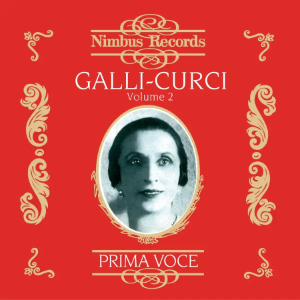
Amelita Galli-Curci (soprano)
Volume 2
rec. 1917-1930
Nimbus Records NI7852 [75]
I have already very favourably reviewed volume 1 of arias and songs recorded by Amelita Galli-Curci; this second volume completes the Nimbus Prima Voce survey of her legacy. She did not, by all accounts, have the largest of voices – unfavourable comparisons with Rosa Ponselle were made by London critics – but her coloratura abilities, purity of timbre and evenness of production were clearly astounding and these further recording show them off to her advantage. As with the first volume, she is several times here partnered by singers of equally high calibre; the two ensembles from Lucia di Lammermoor and Rigoletto rival those made by Caruso and co., while in the excerpts from La traviata her voice combines especially felicitously with that of that elegant prince of tenors, Tito Schipa. She is also accompanied in three numbers by expert flautist Clement Barone.
Chief among her gifts were a perfect trill, a lapidary precision in runs, superhuman breath control – especially for so small a woman – and extraordinary soft, high notes – all which she amply demonstrates throughout, right from the opening Bell Song. Regarding the last, however, as her career progressed and in the later recordings here, a hint of flatness creeps in, perhaps indicating the onset of the thyroid problem which eventually necessitated surgery for a goitre and her subsequent vocal decline. Nonetheless, to my ears, while I concede issues of intonation and the power of high notes post-1924, otherwise virtually everything approaches vocal perfection. She must have been a stunning Lucia on stage, even if her interpretative skills were not her strongest suit.
Delicacy and pathos are found in abundance in her portrayals of Gilda and Violetta, too, the latter enhanced by Schipa’s contribution to the duets. Her venture into singing Leonora’s arias Il trovatore betrays a certain lack of the gutsiness vocal depiction of that feisty heroine surely demands; low notes are a bit sketchy and she emerges as a little “tweety”. Here, the unflattering comparisons with such as Ponselle are surely justified. She is heard at her best rather in arias such as the “Song of India” from Rimsky Korsakov’s Sadko – one of her most famous and best-selling recordings, sung in a French translation and made when she was at her peak in 1922 – even if it doesn’t actually contain much in the way of vocal pyrotechnics.
Admirers of this artist who already possess the first volume will not need much urging to complete their collection by acquiring the second one.
Ralph Moore
Buying this recording via the link below generates revenue for MWI, which helps the site remain free
Contents
Delibes: Lakmé: Où va la jeune Hindoue? (Bell Song) (Recorded 1917)
Donizetti: Lucia di Lammermoor: Il dolce suono…Spargi d’amaro pianto (Recorded 1922)
with Clement Barone (flute)
Verdi: Rigoletto: Caro nome (Recorded 1917)
David: La perle du Bresil: Charmant oiseaux (Recorded 1917)
Bizet: Les pêcheurs de perles: Comme autrefois (Recorded 1921)
Proch: Air and Variations in B-Flat Major (Recorded 1917)
with Clement Barone (flute)
Verdi: Il Trovatore
Come d’aurato sogno…Tacea la notte placida (Recorded 1923)
Timor di me?…D’amor sull’ ali rosee (Recorded 1924)
Rimsky Korsakov: Le Coq d’Or: Hymn to the Sun
Rimsky Korsakov: Sadko: Song of India
Thomas, Ambroise: Hamlet: Mad Scene (Recorded 1925)
Donizetti: Lucia di Lammermoor: Chi mi frena? (Recorded 1927)
with Beniamino Gigli, Louise Homer, Ezio Pinza, Giuseppe De Luca, Angelo Bada
Metropolitan Opera/Giulio Setti
Verdi: Rigoletto: Bella figlia dell’ amore (Recorded 1927)
with Beniamino Gigli, Louise Homer, Giuseppe De Luca
Metropolitan Opera/Giulio Setti
Verdi: La Traviata
with Tito Schipa
Un dì felice (Recorded 1928)
Parigi o cara (Recorded 1928)
Gounod: Philémon et Baucis: O, riante nature (Recorded 1930)
with Clement Barone (flute)













