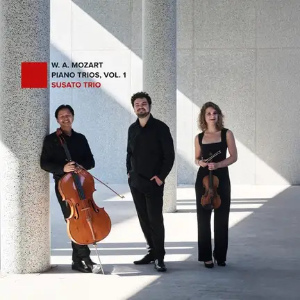
Wolfgang Amadeus Mozart (1756-1791)
Piano Trio No. 2 in G Major K. 496 (1786)
Divertimento (Piano Trio No. 1) in B Flat Major, K. 254 (1776)
Piano Trio No. 5 in C Major, K. 548 (1788)
Susato Trio
rec. 2026, Predikherenkerk, Mechelen, Belgium
Reviewed as lossless download
Evil Penguin Classic EPRC0087 [67]
Mozart’s six piano trios tend to fly under the radar, swamped by the extraordinary quality of some of the symphonies, concertos and operas. They have a not inconsiderable number of recordings – it is Mozart after all – but few people would list any of the six in their Top 10 favourite works of his. Nevertheless, there is plenty of good music to be found – again, it is Mozart after all – not surprising when one considers that the five proper trios (I’ll explain that in the next paragraph) were written in the last five years of his life, therefore sharing writing desk time with Figaro, Don Giovanni, Così, Magic Flute, the clarinet concerto and the last four symphonies.
Let me explain the “five proper”. The manuscript of what is usually described as Trio 1 actually bears the title Divertimento à 3. It is really an accompanied keyboard sonata, with the cello doubling the violin. At this point, Haydn’s piano trios were not much more sophisticated, so Mozart was essentially following the leader in the genre at that time. It is a sunny work, unsurprisingly dominated by the piano. I did feel that the opening Allegro assai should have been more lively, at times seeming more like an Allegretto, but the Adagio is quite beautifully paced. It’s not explained why this is not placed first on the recording, when a chronological ordering would have shown the development in both composer and genre.
Ten years on, Trio 2 is a substantial advance in compositional style, with a work that distributes the melody line more evenly, though it does open with seventeen bars of the piano solo. It is apparent immediately that this is music from Mozart’s prime, elegant, flowing and meltingly beautiful. Trio 5, from two years later, has real emotional depth, in its dark and moody opening movement and wistful Andante cantabile.
My reference for the Mozart trios is the Florestan Trio, and their second volume exactly matches the content of this first volume of the Susato’s. The Susato Trio comes out pretty level with the Florestans on Trio 1 and certainly does a better job with the Adagio where the Florestans employ a tempo that doesn’t seem remotely like Adagio. The situation is reversed in the opening movement where, as noted above, the Susato Trio are not lively enough. In Trios 2 and 5, the Susato Trio is very good, only just shaded by the Florestan Trio overall. Tempos are remarkably similar between the two recordings. It is difficult to explain how the Florestan Trio is better; it is a matter of degrees, a little more subtlety, delicacy and character here and there. That said, the Susato Trio does win out in places, notably the final movement variations of Trio 2, where they are outstanding.
The Susato Trio is a Belgium-based group only formed in 2022. I have been impressed by their ensemble playing, and in general by their sound, though very occasionally, and always at high volumes, the violin timbre did become a little harsh and nasally. The sound quality is very good, while the booklet notes do their job adequately, but are rather put in the shade by those supplied with the Florestan recordings: the latter has twice as much on just the C major trio as the Susato booklet takes for all three works. This is totally off the track, but I would love to know the reason for the label’s name.
These are very fine performances which would grace any collection; it’s just that the Florestan Trio are better, though not nearly as much as I’d expected they would be. I look forward to the second volume by the Susato Trio.
David Barker
Buying this recording via the link below generates revenue for MWI, which helps the site remain free