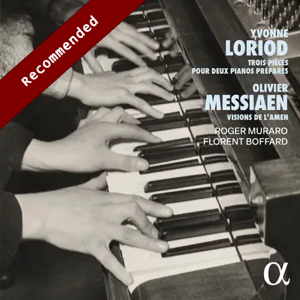
Yvonne Loriod (1924–2010)
Trois pièces pour deux pianos préparés (1951)
Olivier Messiaen (1908–1992)
Visions de l’Amen for two pianos (1943)
Roger Muraro, Florent Boffard (pianos)
rec. 2025, Conservatoire National Supérieur de Musique et de Danse de Paris, Paris, France
Reviewed as a download
Alpha Classics 1273 [72]
This is one of those releases whose importance lies not only in what it contains but in the perspective from which it asks us to listen. Yvonne Loriod is still most often remembered as Olivier Messiaen’s pianist, pupil, muse and, later, wife, yet the recovery of her own manuscripts has begun to complicate that familiar picture. Around a dozen works survive from 1943 to 1951. They were rarely performed and never published during her lifetime. The Trois pièces pour deux pianos préparés, heard here in their world-premiere recording, therefore amount to more than an archival curiosity: they restore Loriod to the history she helped to make.
Loriod entered Messiaen’s harmony class at the Paris Conservatoire in 1941, aged seventeen. Her phenomenal technique soon encouraged him to write with a freedom and difficulty proportionate to her abilities, beginning with Visions de l’Amen in 1943 and Vingt Regards sur l’Enfant-Jésus the following year. Loriod, however, was also absorbing the experimental climate of post-war Paris. John Cage’s 1949 visit, during which he presented his prepared-piano works, offered her a new means of extending the instrument’s colour. In Trois pièces pour deux pianos préparés she distributes roughly ten families of timbre across the two instruments, turning the keyboards into a highly differentiated percussion orchestra rather than a succession of exotic effects.
The compact Gamelhang immediately shows how structural Loriod’s ear for colour could be. Metallic resonance, dry attacks and unprepared piano tones are treated as contrasting materials rather than decoration. The preparation of the two instruments is the result of unusually detailed archival reconstruction: Loriod preserved not only the scores but ten boxes of materials associated with the preparations, and Muraro and Boffard selected more than one hundred unique sonorities for this recording. Their authority here is therefore documentary as well as pianistic. The result is a sound-world in which timbre itself carries the argument.
La Murmurée is the most poetic of the three pieces. Loriod’s own note describes lovers enclosed in a private forest of imagined birds: blackbirds, a nightingale and a proliferation of smaller species pass through the texture before the movement dissolves into a dream. The avian subject inevitably recalls Messiaen, but the chronology complicates any one-way account of influence. Loriod’s bird writing predates his major concertante bird works of the 1950s and invites us to hear their exchange as more reciprocal than the familiar composer-and-interpreter narrative suggests. Her use of prepared sonorities also gives the birds a curious distance from naturalistic imitation: they are heard as memory, fantasy and colour.
La Martelée is more confrontational. Loriod assigns distinct characters to the two pianos, one described as feminine and the other masculine, and builds the piece around resistance, hammering and eventual ‘fondution’, her invented word for a rhythmic melting-together. Some of the gendered imagery belongs unmistakably to its period, but the musical conception remains audacious. Dry wood, bells, buzzing metal, glissandi and unprepared notes are organised into a drama of opposition in which tenderness and violence coexist to the end. Taken together, the Trois pièces reveal a composer with a strong sense of theatrical form and an unusually fertile imagination for instrumental colour.
Pairing Loriod’s triptych with Visions de l’Amen is the decisive curatorial idea of the disc. Messiaen divided the two-piano texture according to complementary roles: to Loriod he entrusted rhythmic difficulty, chord clusters, speed, charm and timbre, while reserving for his own part the principal melody, thematic material, emotion and power. Heard after Loriod’s prepared-piano pieces, that division no longer sounds like the simple story of a composer exploiting the gifts of a virtuoso performer. It sounds instead like a creative exchange between musicians whose interests in rhythm, resonance and colour were already deeply entangled.
Muraro and Boffard bring unusual authority to that exchange. Both were pupils of Loriod, and both have spent their careers in close contact with twentieth century repertoire. In Visions de l’Amen they make the contrast between weight and velocity central to the argument. The opening Amen de la Création establishes the work’s monumental scale, while the following Amen des étoiles, de la planète à l’anneau turns rhythmic propulsion into something almost physical. Later movements move between anguish, desire, birdsong, judgement and fulfilment without losing the sense that the seven Amens form one immense arc.
The final Amen de la Consommation is especially convincing. Messiaen’s accumulating sonorities can become merely massive if their internal hierarchy disappears; here the climactic writing retains direction. Chordal weight and resonance build over a long span, but the texture never collapses into an undifferentiated blaze. The recording also preserves a notably wide dynamic range, which matters in music whose spiritual rhetoric depends upon the distance between near-silence and overwhelming affirmation.
There can be no direct comparison for Loriod’s Trois pièces, since this is their first recording. Visions de l’Amen, by contrast, has a substantial discography. Messiaen and Loriod’s own 1949 recording (review)) remains an indispensable historical document, while Steven Osborne and Martin Roscoe’s modern account (Hyperion CDA67366) provides a useful reference point for the work’s formidable demands. Muraro and Boffard need not displace either to justify this release. Its distinction lies in the coupling itself: heard beside Loriod’s recovered music, Messiaen’s 1943 masterpiece acquires a different historical perspective. The pianist for whom so much of his later piano writing was conceived emerges here as a composer whose own music is far too distinctive to remain a biographical footnote.
This is therefore both a premiere and a reassessment. Loriod emerges not simply as the extraordinary interpreter who made Messiaen’s most demanding ideas possible, but as an experimental composer with her own language of timbre, rhythm and poetic imagery. Alpha Classics has built a programme in which rediscovery genuinely alters context. After the Trois pièces, Visions de l’Amen sounds less like the product of a solitary imagination and more like part of a creative dialogue whose second voice is finally becoming audible.
Cristina Alejandra Estrella
Buying this recording via the link below generates revenue for MWI, which helps the site remain free