
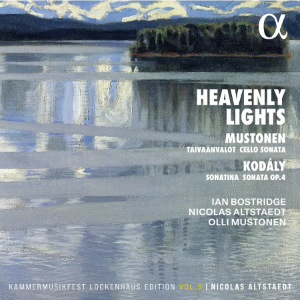
Heavenly Lights
Olli Mustonen (b. 1967)
Taivaanvalot (Heavenly Lights) (2016)
Cello Sonata (2006)
Zoltán Kodály (1882-1967)
Sonatina (1920-1922)
Sonata for Cello and Piano (1909-1910)
Ian Bostridge (tenor)
Nicolas Altstaedt (cello)
Olli Mustonen (piano)
rec. 2023/25, Pfarrkirche, Lockenhaus, Austria
Alpha Classics 1292 [68]
One may not see Olli Mustonen and Zoltán Kodály as natural bedfellows, but they suit each other admirably on this disc. They both embraced the folk traditions of their countries. Kodály’s cello works presented here have received numerous recordings and are in the standard repertoire. Mustonen, on the other hand, has established himself more as a pianist than as a composer.
Based on the evidence here, Mustonen is as skilled a composer as pianist. He became a composition student of Einojuhani Rautavaara when he was eight years old, and was composing music since then. In recent years, he has also gained international recognition as a composer. The Finnish epic Kalevala played a major role in Rautavaara’s music, as it did in Sibelius’s. The most ambitious work on this disc, Taivaanvalot (Heavenly Lights), uses texts from that epic poem in Keith Bosley’s English translation. Mustonen labels the work as a Symphony for Tenor, Cello, and Piano. Indeed, he later orchestrated the piece; that version has been recorded (review).
Like Sibelius’s early Kullervo, Taivaanvalot is more of a dramatic symphonic poem with voice than a true symphony in the traditional sense. The work depicts the actions of Kalevala characters, sage Väinämöinen and blacksmith Ilmarinen, and the spells of Louhi, the hag of the north. Louhi transforms herself into a hawk and turns the world into darkness, without moon or sun. After the blacksmith forges a collar and imprisons the hag, she changes from a hawk to a dove and frees the sun and the moon. Väinämöinen composes a Finnish hymn to celebrate the outcome. This hymn, which concludes the tale, is sung in Finnish, whereas the rest of the piece is in English. I was reminded of Kullervo, especially the hymn, not only because of the Finnish language.
Mustonen’s style shows Rautavaara’s influence on his harmony. The work is generally tonal, but modernistic, often giving the impression of ambiguity. Yet there is no questioning the individuality of Taivaanvalot. Mustonen premiered the work with tenor Ian Bostridge, cellist Steven Isserlis, and himself. It suits Bostridge’s tenor well, reminding me of some of his Britten repertoire. Taivaanvalot’s power and dramaheld my interest throughout its nearly half-hour. Altstaedt and Mustonen excel in the instrumental parts, with substantial passages to themselves.
The piece can be divided into sections, corresponding to the action of the poem, but is on a single track here. (The recording of the orchestral version noted above helpfully has four separate tracks.) At times I felt that Bostridge’s voice was buried in the texture of the cello and piano. This is noticeable in the quieter passages where he sings in a low register. At others, when he is singing forcefully, he can sound a bit hectoring. Generally speaking, his soft singing in the higher register is exquisite. The printed text in the booklet enhances one’s appreciation of the piece. Those final bars sung in Finnish are very sensitively done, the highlight for me. Overall, this is an excellent, authoritative performance.
Mustonen’s other composition on this disc is his attractive Cello Sonata, recorded at least once before (review). It is in four movements, beginning with a slow Misterioso where low chords on the piano accompany the cello part and make bell sounds. Antti Häyrynen in the informative booklet note likens this to “distant echoes of orthodox chanting and bell ringing”. The second movement also begins slowly and enigmatically before the music really takes off after the first minute. It becomes slow and mysterious again, and concludes pensively with the cello’s soft pizzicatos underpinned by the piano.
The third movement, marked Precipitato, truly lives up to this name in its one-and-a half minutes. Virtuoso and exciting, the cello has loud chords and slaps, with a fast and furious piano part. It is too short and just stops before the Con visione finale commences with an entrancing theme. The music becomes quite Romantic and builds in intensity. The movement becomes very animated with all going at once, until it ends abruptly on a short chord. I have not heard the account by Isserlis and Mustonen on BIS, but I doubt it is better than what Altstaedt and Mustonen have provided here.
Kodály’s cello works receive equally fine performances. While not as famous, perhaps, as his Solo Cello Sonata or his Sonata for Violin and Cello, the Sonata for Cello and Piano is a major work. Originally in three movements, it premiered that way. The composer then dropped the first movement, having decided it did not belong with the others. The influence of Hungarian folk music is palpable, especially in the Allegro con spirito second movement. The first movement is a fantasia with much variety, including passionate outbursts. It is followed by a virtual folk dance. Kodály may have intended the Sonatina as a replacement for the sonata’s original first movement. According to Häyrynen, the composer likely kept it as a separate work because his style had changed too much in the intervening years. It is often placed before the sonata, as it is here. One may think of it as belonging to the earlier piece. The Sonatina has folk elements, but there also is the influence of Debussy’s 1915 Cello Sonata.
Of the numerous recordings of the Cello Sonata and Sonatina, one of my favourites has been the accounts by cellist Sung-Won Yang with pianist Ick-Choo Moon on EMI. Altstaedt and Mustonen’s could not be more different. Yang and Moon play the pieces straightforwardly, and allow the music to express itself naturally without interpretative license. Their performance is warm and generous, with sound to match. We are in another world with Altstaedt and Mustonen. They find all kinds of colours in the music, lacking in the earlier one’s plainspokenness. Altstaedt’s tone is gorgeous one moment and purposely ugly the next. Mustonen’s touch is more pellucid than Moon’s, and can be downright percussive when the music demands it. They also deploy rubato and a greater dynamic range. I would not want to be without either of these, though I must say Altstaedt and Mustonen are quite convincing as they shed new light on these works.
This disc, as a whole, has given me much pleasure with its unique programme and terrific performances, and the recorded sound is fully state-of-the-art. I will surely return to it when I want something off the beaten path (Mustonen) or a fresh take on more familiar music (Kodály}.
Leslie Wright
Buying this recording via the link below generates revenue for MWI, which helps the site remain free













