
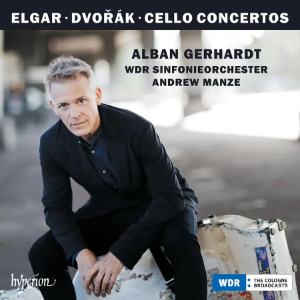
Sir Edward Elgar (1957-1934)
Cello Concerto in E minor, Op. 85 (1919)
Antonin Dvořák (1841-1904)
Cello Concerto in B minor, Op. 104 (1895)
Alban Gerhardt (cello)
WDR Sinfonieorchester/Andrew Manze
rec. 2025, Philharmonie, Cologne, Germany
Hyperion CDA68486 [62]
This disc couples together the two cello concertos that will be, for many people, their favourites. To add to this, collectors will probably have their own preferred recorded performances, and we know that these are frequently the ones from which we first got to know the works. Then a third circumstance is that for each of these particular concertos there is one performance that has achieved almost iconic status. These are, of course, Jacqueline du Pré and Barbirolli in the Elgar, and Rostropovich, with Karajan, in the Dvořák. Both these works have been extensively recorded, though, and the catalogue is full to the brim with marvellous performances, leading me, as so often, to wonder by what right we pretend to pass judgement on these great artists. Aside from such things as fidelity to the score and technical prowess, on which any reasonably informed person can justifiably comment, it comes down to how we, as listeners, hope and wish to hear the work in question, a simple matter of taste and personal opinion.
When one tries to encapsulate Elgar’s Cello Concerto in a few phrases we often find ourselves falling back on words like ‘autumnal’, ‘nostalgic’, and maybe even ‘yearning’. When the theme of the slow movement returns shortly before the end of the work it is difficult to hear this without evoking the word ‘regret’; curiously, though, the word ‘melancholy’ does not seem quite right. Jerrold Northrop Moore, in his magisterial biography of the composer (OUP, 1984), in telling us what was in the composer’s mind as the idea of the work began to form, adds a few words of his own. The first movement theme that Elgar had sketched earlier ‘he now resolved to make the basis of a concerto – but such a concerto of isolation, loneliness, farewell even, as had never yet been written.’ Hearing for the first time this performance by the magnificent Alban Gerhardt led me to think that he had made a deliberate decision to see the work in terms other than those described above. The grinding opening chords are superb, but the following melody, with its long/short/long/short rhythm, seems rapid, even rather business-like in delivery. The repetitive rhythm makes it difficult to inject meaning into this tune, though a minimum of freedom of pulse and phrasing would go some way to achieving this. The second subject, at the same tempo, almost dances here. Needless to say Gerhardt is technically brilliant in the second movement, though when we come to the brief moment where Elgar marks ‘nobilmente’ in the score, and where almost all cellist pull back the pulse (track 2, 01:32), Gerhardt barely marks the moment. The third movement is played at a flowing tempo, and with vibrato well under control and the soloist’s ravishing singing tone we are convinced. One notes a little more fantasy and freedom in the finale, and the glorious passage that precedes the return of the slow movement theme is beautifully done. That reprise is given with dignity and purity rather than overt emotion. Then there is the rush to the finish, like a book slammed shut. Elgar seems to be saying ‘There, I’m done with it!’ If so, Gerhardt fulfils the composer’s wishes perfectly.
The booklet carries a fine note and listening guide by Francis Pott, but I chose to listen to the disc before doing any reading. This meant that I heard both concertos before finding the short statement from the soloist in which he explains that, like so many of us, he grew up with du Pré and Rostropovich in these two concertos. He writes, however, that he found himself ‘questioning certain interpretative choices from early on.’ He decided to return to the scores themselves, arguing that obeying scrupulously what appears there produces a more satisfactory result than following ‘later traditions’. His choices of ‘tempi and proportions … feel not only closer to the composer’s intentions, but also more alive.’ Had I read this first I would have been better prepared, for the Elgar especially.
Alban Gerhardt’s view of Dvořák ’s glorious concerto diverges less from the more established ‘later tradition’ than does his Elgar. The works, of course, are very different one from the other. Dvořák, unlike Elgar, decided to open his concerto with a lengthy orchestral introduction, and Andrew Manze shapes this to perfection. Significantly, he only marginally eases the tempo for the principal horn’s second subject solo, remembering that the composer’s indication is only ‘un poco sostenuto’. The composer also deprives his soloist from participating in the final bars of the finale – is there a more satisfying close to any concerto? – and Manze is very fine there too. The West German Radio Symphony Orchestra plays well throughout both works, with, crucially in the Dvořák, much splendid wind playing. We do not have, on the other hand, the gorgeous string sound of the Berlin Philharmonic, though many will think this a plus point. Manze accompanies his soloist with great finesse in both works, worth commenting on given that the interpretations are frequently less than orthodox.
In spite of what Gerhardt tells us in the booklet the principal tempo of the first movement in this performance is well below the composer’s marking of 116 crotchet beats to the minute; it is closer to 104, in fact, and all the better for it, in my view. The movement brings few real surprises, but at those points where we are accustomed to being treated to a little hesitation here, and a gentle push there, Gerhardt tends to avoid it. You can rely on him, on the other hand, to follow the composer’s indications when Dvořák marks ‘animato’ in the score. He is in full technical command, of course, but nobody in my experience has ever rivalled Rostropovich in the quasi glissando in octaves (track 5, 10:37). The lead-in to this passage is ferocious, and the music that immediately follows it, which seems to cry out for a broadening of tempo, here seems urgent and impatient. I would have liked more of a pause between the first two movements, though the second is nicely done, a high spot being the wonderfully brassy horns in the quiet passage accompanied by just the orchestral cellos and basses (track 6, 5:27). The finale follows with no break to speak of, which works well. I have never heard the opening passage of this movement played with quite such heavy emphasis, and as the movement progresses I found myself once again wishing that these performers would leave us a little more breathing space. The lovely cantabile melody at 5:46 (track 7) is beautifully done, but this quickly becomes forced and urgent again, and when a little later the same melody is taken up by the solo violin one cannot, in all conscience, agree that this is a satisfying way to interpret the composer’s marking of ‘tranquillo e molto espressivo’. In the long introspective passage that precedes the close – the prime example of Dvořák’s heartbreakingly endearing habit of being unwilling to bid farewell to his themes – many listeners will, I think, wish for more time and more warmth.
For a reading of Dvořák’s Cello Concerto that avoids self-indulgence and mawkishness whilst retaining the work’s essential qualities of tunefulness, intimacy, nostalgia and tenderness, readers might try to locate a recording by Gerhardt himself, from 2001, with the BBC Philharmonic and Neeme Järvi, released as a BBC Music Magazine cover disc. Rostropovich is unrivalled, and his DG version with Karajan is essential, though a 1952 performance with Václav Talich (Pristine) is fabulous, if less glamorous. Of many other admirable versions I know well I will cite just one, by Janos Starker and Antal Dorati with the London Symphony Orchestra on Mercury. For the Elgar, I am indeed one of those listeners who finds the famous du Pré/Barbirolli performance a little too much, and have always preferred André Navarra, also with Barbirolli, recorded way back in 1957 on Pye, now Warner. Navarra conveys more than does Gerhardt of what I feel is the essence of the work, truly ‘nobilmente’ yet never indulgent. I like to imagine that Elgar himself would have appreciated it.
William Hedley
Buying this recording via the link below generates revenue for MWI, which helps the site remain free













